Showing posts with label Psychological. Show all posts

Monday, May 18, 2026

Lord of the Flies (1954) v Lord of the Flies (1963) v Alkitrang Dugo (Clotted Blood, 1975) v Lord of the Flies (1990) v Lord of the Flies (Netflix, 2026)

Pig hunt

(Warning: plot and surprise twists in book and TV series discussed in explicit detail)

I remember reading William Golding's 1954 debut novel as a teen and having nightmares about running through the jungle with other boys in pursuit, waving sticks sharpened at both ends-- did not help the development of my socialization skills, lemme tell you. 

The book comes off as a fable, the characters barely sketched-in symbols, the theme clear enough and neat enough for literature majors to milk for their theses: humans have this ingrown tendency to violence, and we flirt with or ignore it at our peril. Really that simple, the novel's chief virtue and key weakness, and folks who seek to adapt it flirt with this fact or ignore it at their peril. 

Monday, August 07, 2023

Bug (William Friedkin, 2006)


The Itchy and Scratchy Show


Bug is a small, relatively unheralded release costing four million dollars-- gargantuan by Philippine standards (most medium-sized productions run about half a million or so), but practically peanuts by Hollywood's, where 'small' films run from twenty to forty million. It's also the single best thing William Friedkin's ever done.

Friday, February 03, 2023

Elephant (Gus Van Sant, 2003)

In the room

I can only guess Van Sant's thinking when he did Elephant: that there were all these docudramas and documentaries and news specials and articles trying to pin down the motives of the shooters, and the film is a response saying "there's no way to truly know." 

Thursday, June 09, 2022

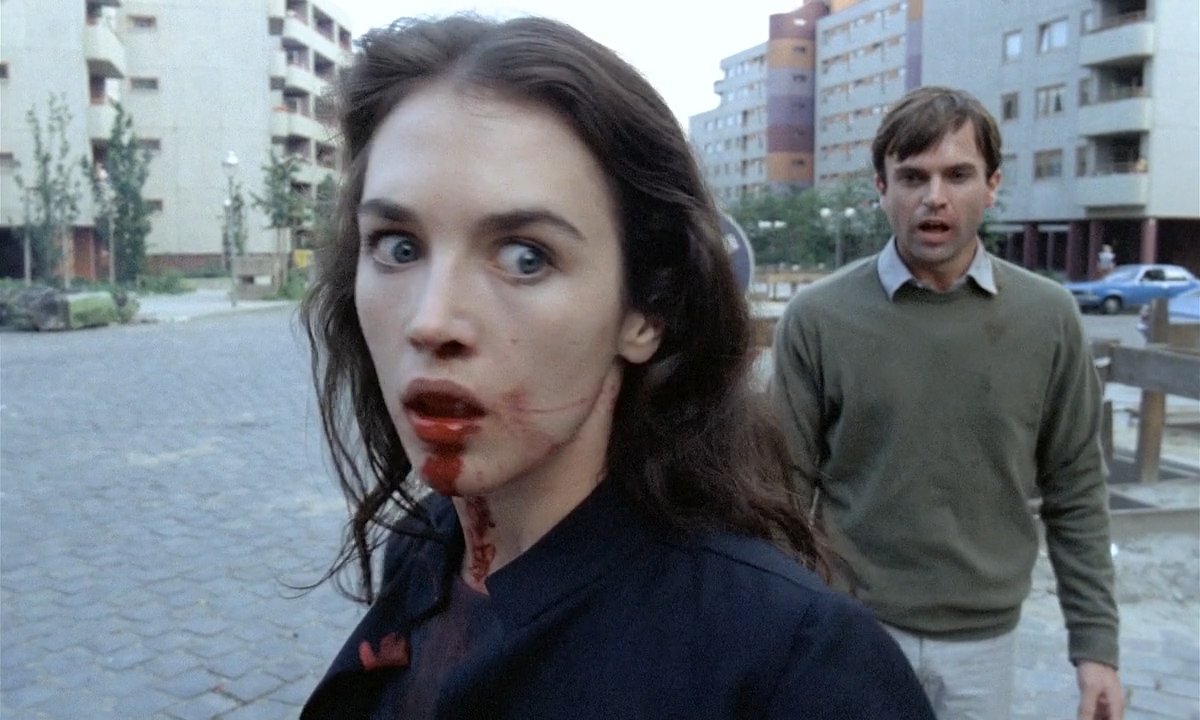
Possession (Andrzej Zulawski, 1981)


The dispossessed

(Warning: plot and narrative twists discussed in explicit detail)

Watching Andrez Zulawski's Possession (1981) again I was struck not so much by the violence and bodily fluids being flung about as I was by the feelings being wielded like so much casual cutlery. When it comes to extreme horror the film has been sadly left behind by more recent arthouse efforts such as Lars Von Trier's Antichrist or (for sheer masochistic suffering) Pascal Laugier's Martyrs-- 'sadly' not because this film should stay top of the heap but because the genre has chosen to go in this rather fruitless direction, to the point of numbness.

Thursday, March 17, 2022

The Batman (Matt Reeves, 2022)

Batman returns

Dear diary

6:10 PM

Fear is a tool. When light hits the screen it's not just the movie's start, it's a warning. Only who's being warned-- the bad guys on the big screen or us sitting here? Maybe you, reading this? Confused now. 

Sat down to watch Matt Reeves' The Batman. A hundred and seventy-six minutes to go.

Need I remind you? NARRATIVE AND PLOT TWISTS TO BE DISCUSSED IN EXPLICIT DETAIL.

Moving on. 

Friday, December 10, 2021

The Power of the Dog (Jane Campion, 2021)


Power of the perverse

(Warning: some hints and suggestive talk about the film's narrative twists)

Jane Campion's latest-- her first feature in eleven years-- is hailed as one of her finest yet; high praise considering, for the director of Sweetie, The Piano, Bright Star, Top of the Lake among others. 

Friday, December 04, 2020

Midnight in a Perfect World (Dodo Dayao, 2020)

History made at night

I thought Violator-- Dodo Dayao's debut feature-- to be one of the most intriguing of recent horrors; think Kurosawa Kiyoshi doing a punk remake of Rio Bravo, with Hawks' sticks of dynamite swapped out for the apocalypse. Midnight in a Perfect World sees Dayao stepping up his game, this time proposing a semi-utopian society afflicted with both drug use and police fascism. 

Thursday, September 24, 2020

I'm Thinking of Ending Things (Charlie Kaufman, 2020)


I'm thinking of rending things

Charlie Kaufman's latest, a reasonably close adaptation of Iain Reid's novel, may provoke the desire to tear the Netflix-platformed film--or anything handy within reach for that matter--to little bits. It's that polarizing, I think.

Thursday, August 09, 2018

You Were Never Really Here (Lynne Ramsay)

You will never really cohere

Lynne Ramsay's films as narrative features are to put it mildly problematic: they rarely unfold in the approved straightforward manner; are elliptical to the point of obscure; are dark violent disturbing.

And yet and yet and yet

Monday, August 15, 2016

Super (James Gunn, 2010)


Duper

James Gunn is better known for mixing quirky humor with standard-issue superhero shenanigans in Guardians of the Galaxy (2014). The movie (which for the record I liked) was actually watered-down Gunn for the PG crowd, a fairly risky move (A gun-toting raccoon? A walking tree with only one line?) that paid off handsomely to the tune of $770 million worldwide.

Super made four years earlier hews closer to authentic adult-dosage Gunn. Frank Darbo (Rainn Wilson) is a short-order cook and longtime loser who has experienced only two perfect moments in his life so far: his marriage to former junkie Sarah (Liv Tyler) and his helping a police officer catch a purse thief--both moments immortalized in colored-pencil drawings that he tapes to a wall. Sarah soon leaves him for Jacques (Kevin Bacon), a local strip club owner and mid-level dealer who lures her away with offers to renew and maintain her habit.

Frank is knocked into a downward spiral, weeping over his fry grill and making pathetic attempts to win Sarah back (for which efforts he's thoroughly beaten). Gunn documents Frank's descent in unflinching detail, including the pained reactions of people forced to deal with him (they keep him at arm's length, as if failure was contagious); when Frank hits rock bottom his roof and walls split open, his bedsheets twist round his arms holding them down tight, his skull is sliced open by tentacles wielding boxcutter blades and the Finger of God comes down from on high...

It's John Ford's The Searchers by way of Martin Scorsese's Taxi Driver with a dash of Monty Python. What makes Gunn's version work is that Wilson is no John Wayne or Robert De Niro--he has neither Wayne's reassuring stoicism (Frank weeps, given sufficient provocation) nor De Niro's psychopath charm (women tend to look past him) but instead has a lumpenprole quality that makes one want to leap up in recognition: "One of us! One of us!" We imagine being in his shoes (they're practically our size) so when Frank is beaten or humiliated yet again--and Gunn doesn't stint on the beatings and humiliation--we identify with his pain in a way we don't with De Niro or Wayne.

Frank is compelled to pull on a cowl and swing a pipe wrench, though the forces driving him seem religious. That admittedly requires a leap of faith--can't think of two cultures (comicbook collecting and churchgoing) less likely to intermingle, though 1) there have been attempts to adapt The Bible into comics (Robert Crumb's Book of Genesis being one of the best) and 2) the loneliness of geeks does in some ways resemble the loneliness of religious extremists (was about to say there aren't any evangelical superhero TV shows till I remembered Preacher) and 3) Frank's visions seem less like spiritual revelations and more like desperate attempts to take images from TV (including the cheesy parody The Holy Avenger) and real life and stitch them together in a dream sequence that would make sense of his life.

Libby (Ellen Page) on the other hand is both a more convincing construct and obvious male fantasy--how many attractive female comic book geeks with overactive sex drives can there be out there anyway? Yet Libby talks acts thinks in a more familiar manner than Frank (despite being smoking hot): realizing who she's talking to she presents him with a proposition ("Batman had Robin; the original Human Torch had Toro") complete with name ("Boltie"), costume (yellow and green with cute short skirt), an awkwardly executed series of tumbles and rolls ("See what I'm getting at?" "No."). Going on her first adventure she's bored out of her mind ("You just sit here and wait for crime to happen?"); confronted with her first fight she goes berserk, smashing a car into the adversary's legs and jumping out half-naked (she was in the middle of changing) to spew obscene homophobic taunts.

The violence does more than release Libby's aggression; she offers sex to Frank, who promptly turns her down ("I'm married!"). Frank and Libby are a study in contrasts: where Frank is a romantic puritan who represses himself to the point that wearing a costume is the only way to vent his anger, Libby is an amoral free-floating hedonist seeking to direct her hostility--a direction only Frank has been able to provide. Libby plays Robin to Frank's Batman,* though Libby would've jumped Batman deep in their Batcave some time ago.

*(Not just any Robin and Batman but Frank Miller's Dynamic Duo ("Does this mean I'm not fired anymore?"), an indication of Miller's for better or worse lasting influence on the genre)

It's an interesting dynamic; Frank has been building up pressure all this time (like a swollen boil), some of that pressure relieved by becoming The Crimson Bolt (impressive name, till you realize a bolt is an inert hunk of metal used to hold objects together or keep people out--to maintain the status quo if you like). Frank's example unleashes the id in Libby who acts in turn as Frank's id--"What if we did this? What if we did that?" she keeps asking. To the problem of Frank's marriage she suggests wearing costumes during sex. "The Crimson Bolt's not married to Sarah--Frank is," she offers helpfully.

For the movie's look Gunn has hit on a non-style suggesting both cinema-verite and the kind of do-it-yourself videos amateurs post on YouTube all the time (if this were made some years later Gunn could've done exactly that). The look pays off with onscreen violence far more disturbing than anything found in Matthew Vaughn's Kick-Ass, released earlier the same year--where the violence in Vaughn's movie is extravagant even grotesque, the violence in Gunn's could be happening right now, down the street from where you're sitting, to people you might know. Gunn's has often been compared to Vaughn's which I don't buy for a minute: Vaughn doesn't touch costumed sex, doesn't cast unglamorous everyday faces (Wilson recalls a younger Garrison Keillor), doesn't skirt as daringly the borderline between comedy and horror.

Critics complain of the wildly varied tone; I'd say the film only really fails towards the end (skip the rest of the paragraph if you haven't seen the movie!) with the suggestion that some good came out of Frank's misadventures--the music is suddenly dreamier, the camerawork settles into a contemplative gaze, the film overall feels disappointingly gauzy, softheaded. Sarah's rescue demands the same sardonic treatment as the rest of the pic, only it turns out she's a true innocent, and the dullest character onscreen (Scorsese in Taxi Driver is at least able to suggest the last-minute rescue was an ironic coda). Instead of a much-needed slam against vigilantism (much needed today, particularly in our country) we have wishy-washy foot-shuffling, the "if you're willing to pay the price you can do whatever you want" kind of Faustian mantra Pixar and Disney like to push on defenseless children. Love the movie, but that ending is a disappointingly feeble squib.

First published in Businessworld 8.5.16


Sunday, April 25, 2010

Shutter Island (Martin Scorsese, 2010)


Island of Lost Souls


It's become a bit of a fashion to bash Martin Scorsese, and that's understandable--in his films of the '70s (Mean Streets (1973), Taxi Driver (1976) he was an exciting independent filmmaker who hurled his personal obsessions on the big screen; a breathtaking experience and, many of us thought, an essential one. The achievement wasn't so much the violence, which can be bloody, or the immediacy of style, which can be a head-rush thrill, but the self-confessional quality of his cinema, the sense that he's flashing us images of his soul. If we at all respond (and there are those that don't--that are in fact repelled by Scorsese's candor), his achievement becomes all the more extraordinary.

How do you top work like that? Scorsese tried; in Raging Bull (1980) he attempted to dissect the psychology of a violence-obsessed brute accursed with a thirst for redemption (come to think of it, Scorsese might have been prophesying the rise of Mel Gibson). In The King of Comedy (1982) he documented the queasy relationship between a battle-fatigued celebrity and his psychopath fan (think of it as Taxi Driver meets Network). In The Last Temptation of Christ (1989)--easily my favorite of his '80s work--he brought immediacy and angst to the ossified story of Jesus Christ (possibly the film's most iconic image for me was Judas half-dragging Jesus past a broken brick wall--Christ, on the mean streets of Jerusalem). This decade was a searching, a restlessness, a reaching out to various genres, time periods, subject matter; often the attempt and approach, the process by which he tried to explore chosen material, was at least as interesting as the end result.

In the '90s there was still some stretching (The Age of Innocence (1993) was an adaptation of Edith Wharton; Kundun (1997) his adaptation of the Dalai Lama's autobiography), but in key films you saw a concerted effort to pull back, to consolidate over familiar ground. Goodfellas (1990) returned to the genre he is best known for, the Mafia film--it became his most acclaimed picture since Raging Bull. Casino, made some five years later, is to my mind the more interesting work, taking actors from the previous production (Joe Pesci, Robert de Niro) and a similar milieu (the Mafia, this time operating in Vegas) and pitching it at the level and magnitude of opera.

This past decade is possibly his most problematic--he has become Martin Scorsese, America's most respected commercial filmmaker and a cinematic institution; he is able to raise a budget and set of expectations few other filmmaker can handle. Some say he can't--that he's fallen from grace, sold out, whored himself to Hollywood for thirty pieces of silver (or the modern Babylon's equivalent, in thousands of dollars). There's something to that argument--his budgets have become larger, he has come to tackle more conventional material, and the results are more decidedly mixed.

I think it's the mixed results that should clue us in to what he's doing--or at least trying to do. Gangs of New York is the Hollywood historical epic brought to seething life in the sets of Cinecitta; more than the plot (a simplistic one of a boy avenging his father), what possibly interested Scorsese was animating Herbert Asbury's nonfiction history, and juxtaposing the struggle of tiny human figures against the background of a city rising, as it were, from primordial mud (you saw that mud in most scenes, plus the wood four-by-fours sprouting like the citizens' mute aspirations out of the sodden earth). The Aviator (2004) was Scorsese's take on the Hollywood biopic; Hughes' life here not only paralleled the lives of contemporary power figures (a post-election George W. Bush, for one) but climaxed with an introverted life-death struggle: Hughes shutting himself in a room, to deal with his inner demons. The Departed (2006) is perhaps Scorsese's most conventional work--ironically it won him the long-coveted Academy Award for best director--but Scorsese manages to recast Andrew Lau and Alan Mak's thriller as an evolutionary struggle between two rival tribes (their tribal leaders, past breeding age, are identified as the source of both authority and corruption), the final shot revealing who is in the best position to eventually inherit the earth.

Scorsese's latest, Shutter Island (2010), an adaptation of Dennis Lahane's novel and, presumably, his take on the Hollywood psychological thriller, is both his least conventional and for many most problematic. The plot is ridiculous, the acting and atmosphere, overwrought. Easy enough to say this is deliberate, that Scorsese intentionally brought the film's emotional tone up to fever pitch, the better to say what he's trying to say--but what is he trying to say? It's difficult to pin down the theme of a Scorsese film; when he's at his best it's well nigh impossible. The best you can say--as with Goodfellas or Mean Streets or a Gangs of New York--is that he's aiming for an immersive experience, that he wants to fill you with the sights and sounds and emotions of a specific cultural milieu. 

This film alludes to Dachau, to abuses at mental institutions, to the Cold War and mind control experiments; the film also pays homage to, among others, Sam Fuller's Shock Corridor and Val Lewton's haunting mood pieces (I think it a disservice to call them 'horror films'). Critics complain that he's tossing out red herrings, he's referring to other films like a film geek (funny, Quentin Tarantino refers to other films in his latest movie, and not as many people pay mind). Perhaps they've lost patience with Scorsese; perhaps they feel that what he's doing has become tiresome, stale. I understand the sentiment.

Is the reasoning “at least he's directing” so disingenuous? I see him as taking one Hollywood genre after another, and undermining them by tossing out the plot, leaving in the conventions (at least most of them), and telling the story (and we know how little regard he gives story) his way--through the rush of imagery and music, like Michael Powell on amphetamines (and perhaps a few hallucinogens). Perhaps, and this I think is the most serious charge, he has moved away from the sources in his life that made his work such a charged experience--that feeling of stepping into a confessional to listen in every time we step into a movie theater with his name on the marquee. Possibly the well has run dry, and he's had to move on, taking up mainstream Hollywood as the source (monetary, anyway) of his inspiration. Perhaps all he has left is his ability, his skill at telling stories visually--is that such a little thing?

Of his later films, or at least of his visual style when doing the later features (I'm not even going to comment on his documentaries, which I think are tremendous, and a whole other ball of wax) the key film, I think, isn't any particular feature but an omnibus, the 1989 New York Stories, for which he directed the segment “Life Lessons,” an adaptation of Dostoevsky's The Gambler. The key moment there, the single crucial image with which Scorsese possibly identifies the most (still does, for all I know) is of Soho artist Lionel Dobie (Nick Nolte) standing before a huge canvas, poised and breathless, as if about to dive in. His love life's a wreck, his woman has nothing but contempt for him, he's under pressure to deliver for an upcoming gallery show, he possibly suspects he's lost his soul (I know Scorsese constantly worries about this, and on the evidence of his recent work most critics must be wondering as well), he possibly hopes to regain it through work, and he's about to try--swiftly and spectacularly, in a symphony of flashing brushes, smearing fingers, spattering paint. Not an easy place to be, but I think it's the place Scorsese most wants to be, even if he has nothing to say, even if he has no one to say it to.


First published in Businessworld, 4.15.10