Showing posts with label DVD. Show all posts

Thursday, May 19, 2016

Son of Saul (Laszlo Nemes)

Saul surfer

Lazlo Nemes' extraordinarily shot and executed debut feature Son of Saul (Saul fia, 2015) answers a question I (and a few other folks) have been wondering about for some time: is there a new, fresh, perhaps even galvanizing way to realize the story of the Holocaust on the big screen?

Thursday, April 28, 2016

Taxi (Jafar Panahi)


Drive

Jafar Pahani's Taxi would be remarkable just for existing--it's the third feature the filmmaker has done since the Iranian government prohibited him from directing and writing for 20 years (Aside from the ban he may or may not serve a 6-year jail sentence--the possibility hangs over his head like a constantly raised ax). 


Saturday, April 21, 2012

Tatlo, Dalawa, Isa (Lino Brocka, 1974)


Tatlo, Dalawa, Isa 

Lino Brocka's Tatlo, Dalawa, Isa (Three, Two, One, 1974) shows the filmmaker's versatility in the short form, working with various writers.

The first segment, Tony Perez's Mga Hugis ng Pag-asa (Faces of Hope) has Jay Ilagan play Noni, a drug addict struggling in a drug rehabilitation center. And while the segment is generally considered to be the weakest of the three, it does feature cinematographer Romy Vitug's fine monochromatic camerawork, and the startling image of Ilagan being shaved of all his hair (a shockingly traumatic sight when I first saw it at the tender age of nine).

Brocka is at his melodramatic best with Mario O'Hara's Hellow, Soldier. Hilda Koronel is Gina, a young slum dweller waiting for her American G.I. father to pick her up and take her to America; Anita Linda is Gina's mother Lucia, who wants her daughter to leave, yet is unable to face the loneliness of life without her. O'Hara's deceptively simple story is an evocative metaphor for any number of themes: the lurid legacy left behind by the American Occupation (Lucia was unapologetically the American's mistress, and raised the child herself); the troubling questions that arise when someone tries to do something (should Gina live with her mother or father? And what happens to Lucia?); the bitterness, the rage, the--most shameful secret of all--affection felt by Filipinos for their onetime ally and master and ostensible lover.

Brocka has his actors play their roles at a higher emotional pitch than usual, which may put some off; some, however, will believe that this is unaccountably the right way to go--how can you not be affected, with issues this personal, this deeply felt?

Orlando Nadres' Bukas, Madilim, Bukas (Tomorrow, the Darkness) is Brocka's uncharacteristically gothic short masterpiece. Brocka, who has rarely done a period film and who almost always locates his stories in the urgency of the here and now (almost always in the Manila of today), with Vitug's help creates an airless, languid realm, not so much isolated as abandoned by the outside world.

Trapped is bedridden invalid Atang (the great Mary Walter) and her spinster daughter Rosenda (the equally great Lolita Rodriguez); their relationship together is a study in miniature of a love-hate, master-servant, mother-daughter antagonism of almost unbearable intensity. Enter the ugly-handsome Miguelito (Mario O'Hara, this time as actor), Rosenda's one chance to escape her lifelong imprisonment. The result is a kind of stylized melodrama you wish Brocka could have done more often (if the results can be as wonderful as this)--Brocka's penetrating analysis of human relations, transformed by a fevered imagination and a sense of doomed poetry.

(Published here as apparently the website of CineFilipino--for which I wrote this piece--has vanished, assumed defunct)

Sunday, February 13, 2011

Three by Nora: 'Merika (Gil Portes), Condemned, Bulaklak sa City Jail (both by Mario O'Hara)

(Note: re-posted, refurbished, and re-styled for the For The Love of Film (Noir) blogathon, this year raising funds for the restoration of The Sound of Fury.)

Three faces of Nora

Gil Portes' 'Merika (1984) opens the same way any ordinary life will usually open--in the morning, in bed. But Mila (Nora Aunor) can't seem to get out of bed; she can't seem to bring herself to touch the icy floor with her feet, or brave the chill air beyond her room. She has to sit there, shivering, her comforter wrapped around her like protective coating.

Portes films the story in frozen weather and I think the decision is deliberate, brilliant even. Jersey City (where much of the picture was shot) can take on the unfriendly look of an anonymous urban population center and at no time is it more anonymous or more unfriendly than during the wintertime. There's plenty of sun but it's a weak sun, a pale sun, with rays that can barely warm the fingers, much less melt all the ice. This is a cold city, cold people, cold country--to even touch someone or glimpse his face you need to free the people from their layers of scarves, mufflers, sweaters and long sleeves before you reach human skin.


Sunday, October 31, 2010

Babies (Thomas Balmes)


Little rascals

Thomas Balmes' Babies (2010) is charming entertainment, of that there's no doubt. Four charismatic little tykes, from their birth to their first year of existence howl and crawl and pee their way through a large and often bewildering world, and you follow them with little introduction or explanation, other than titles at film's start that give us their names (Ponijao, who lives in Opuwo, Namibia; Bayar, who lives in Bayanchandmani, Mongolia; Mari, who lives in Tokyo, Japan; and Hattie, who lives in San Francisco, the United States). There's an admirable simplicity to the concept, a purity that you can't at one level help but admire: no commentary, no politics, no social observation, just babies, trying to live one day at a time.

The film begins with stark differences: Ponijao's mother rubs a red powder she ground herself on her belly, and that's pretty much all she does by way of preparation; Bayar's mother takes their child home for the first time, and she has to struggle to sling her leg across her husband's bike; Mari and Hattie, on the other hand, enjoy the last word in modern medical technology when being delivered, and you can't help but feel that if a fly dared to show its bacteria-infested face in their presence some laser defense protocol would fry it to cinders.

Each family pays a price for their choice of lifestyle (though you wonder if Bayar and Ponijao and their parents had much choice about their lifestyles). Bayar and Ponijao were born and live under the most primitive conditions (Bayar less so--you see a satellite dish standing beside Bayar's family yurt), and are entirely comfortable with sharing living space with roosters and goats and cows; Hattie and Mari do meet (and mash, and maul) the occasional cat, but brought near larger animals--a gorilla, say, or a tiger in a zoo--they scream their heads off. Possibly they're bored, or for some reason uncomfortable, but I'm guessing the presence of huge creatures you've never seen before glaring at you as if you were their next meal probably didn't help their dispositions. Likewise, you can shudder with dismay at the level of hygiene practiced--Ponijao, having no diaper, simply squirts fecal matter on her mother's knee who, just as nonchalantly, scrapes it off with a corn cob. But Ponijao also gets to sit in a river stream and dip her face in its water; she gets to kiss a dog full in the mouth, lolling tongue and all. I don't know if it's me or a bias in Balmes' choices in assembling his footage, but on the whole Ponijao seems to be enjoying the lion's share of fun and adventure. Bayar isn't close behind--he gets to step on a goat's face, and when a herd of cows approaches, has a moment of panic where he can't decide if he wants to stay atop the tub he's sitting on, climb down and crawl away, or teeter precariously in between (no that doesn't sound like fun, but it's definitely not boring).

One can imagine all the parents watching this on DVD and exclaiming "Yuck!" or "Watch out!" Part of the appeal of the film is in observing these youths learn how to handle their environments as best they can, however they can (it helps to remember that exposure to bacteria and dirt and grime are part of growing up, and that a too-sanitary environment leaves a child relatively helpless and unprepared). Again it might be me, or the filmmaker's bias, but Ponijao comes out all right--she's had a rough-and-tumble physical education, and her sense of balance (as you see towards the end) develops just fine, perhaps even sooner than the others. Bayar--don't cry for him; he's gotten a roll of toilet paper and is having a ball with it, all over the yurt's floor. I think it's telling that the film's funniest moment is at the expense of Mari--she tries to fit a pole in the hole of a toy and when this doesn't work, throws a fit worthy of James Cameron ("I want my quarter of a billion dollars and I want it NOW! NOW! NOW!"). Balmes has his biases, and while I'm sympathetic (what's wrong with scraping off crap with a corncob?), it does throw the nobility of his enterprise into questionable light.

The best one can say of the film is that it looks gorgeous: the differing tints and hues and most of all texture of baby skin--their smoothness, moistness, oiliness, the rolls of fat, the dewy fur--are vividly captured. Of the locations, the most memorable has to be Mongolia--seeing Bayar stand against that magnificent brilliant blue sky, that's a moment worth taking with you out the theater. The worst one can say of the picture is that it has a certain callowness, a playing for laughs, a safeness and benignity that frankly, undermines its verite ambitions. Why go through all this effort to film four babies from four corners of the Earth when the only message you come away with is "babies are happy, babies have fun, babies round the world are basically one?" There's nothing here that we don't already know, though there is much that is fresh to the eye and ear; the premise and execution could have been so much better, perhaps even great (include the parents' point of view, perhaps?), that you feel as frustrated as Mari, trying to jam her poor plastic pole into that poor plastic disc.

First published in Businessworld, 10.21.10

Saturday, August 21, 2010

A Prophet (Jacques Audiard, 2009)

Audiard's use of confined space in A Prophet

Little Cesar

Prison intakes can be terrifying. You see it in the prisoners' faces--if it's their first time in a penal institution they often don't know what to expect, often don't know if you mean harm or not. Standing barefoot and shivering on bathroom tiles, they are about as naked--physically and spiritually--as a human being can be, and at their most open to life lessons; positive or negative, it depends on who gets to them first (though in prisons it's really no contest).

So it is with nineteen-year-old French-Arab Malik El Djebena (Tahar Rahim), who's serving six years for assaulting a police officer--he's being strip-searched and has the caught-in-the-headlamps look of an animal whose life is about to irrevocably change. Malik falls swiftly into trouble--his shoes are stolen, and when he tries to recover them he's beaten; at the showers he's offered hashish in exchange for oral sex; when he walks into the recreation yard, he's approached by Cesar Luciani (Niels Arestrup), leader of the prison's Corsican gang--they want Malik to accept the man's sexual advances, get close, slash his throat with a razor blade hidden in the corner of the mouth.

Jacques Audiard's Un Prophete (A Prophet, 2009) is a crash course in prison life--what are the gangs, who to join, what is of value and available for buying, selling, smuggling in and out of the prison walls. Cesar finds Malik useful; despite his gang members' racism (they call him "dirty Arab"), he has Malik making coffee, running errands, doing little tasks that help Malik familiarize himself with the inner workings of the prison. Audiard and his writers (Audiard, Thomas Bidegain, Abdel Raouf Dafri, Nicolas Peufaillit) take a page from Francis Ford Coppola's The Godfather--Michael Corleone's transformation from fresh-faced college graduate to stone-cold gang lord--and transposes it here, complete with Michael's first Mafia-style murder. Malik's first is as agonizingly protracted, far less smoothly executed: as his unwitting target offers coffee, Malik realizes that he's bleeding from the blade hidden in his mouth.

The burst of energy that follows typifies much of what the film has to offer: documentarylike squalor; drawn-out tension; sudden, unglamorized violence. What breathes unruly life into the film are the bits and pieces you haven't quite seen before, not even in Coppola's epic (which in my opinion is overfamiliar, perhaps even overrated)--the hostile faces--Arab, Corsican--staring at each other from across the courtyard; the DVD players and radios delivered by cart to one's cell; the everyday delivery of fresh baguettes, as if hot bread were a right every bit as guaranteed as your weekly phone call.

If Malik is the central consciousness in the film, Malik's knotty interaction with Cesar is the film's central relationship. Certainly there's a father-son affection there, as Cesar lets his mask of brutality slip to reveal a lonely, insecure old man (mind you, this doesn't dilute Cesar's more monstrous qualities, merely makes him grotesquely fascinating). Malik seems to count on Cesar's patronage, but when Cesar at one terrifying point turns on him, pressing a spoon into his eye, the affection seems to shatter. That said, one is never surprised that Malik for all his softness grows into his criminal shoes: the boy is starved for knowledge (in school he learns reading, writing, basic Economics, Arabic; he learns--this on the fly--the problems of negotiating with people, dealing with disparate, distrustful groups), is endlessly ambitious, is watchful, constantly alert. He catches some unbelievable breaks--ever so often he manages to turn a swift ambush into a golden opportunity to network or make connections--but not once does he doubt his good fortune, or question the general velocity of his life; with the swiftness of the very young (and utterly ruthless) he makes his bloody progress up the pyramid.

Might point out the sociological movements reflected in the film: if an army is often made up of the same percentage of Caucasians and minorities, so are jails. Cesar ruled the courtyard back when Corsicans dominated the prison population; now that Middle Eastern populations have been filling the country, they have also filled the prison courtyards.

And always--always the image of Malik's uncomprehending expression during intake haunts one's view of Malik and his gradually evolving, gradually more confident face. The difference between the two faces of Malik's is like the difference between you and me, between potential and fulfillment, between wishful thinking and reality--watching the film, the difference sometimes feels huge, sometimes feels like no difference at all.

Audiard unlike Coppola doesn't have much space in which to develop his epic--his story unfolds largely in the cramp cells and narrow hallways of the French prison. His camera is largely handhold in the verite fashion, but not excessively active; it moves in for quick emphasis, then holds the image till his point is made (sometimes--as with Malik's first murder--the point takes excruciatingly longer to register). Occasionally he uses black masking, reducing Malik's field of vision to a single face, a single object; one thinks of D.W. Griffith's fluid framing, and how it can so effortlessly reflect a determined man's often narrowed focus.

Audiard's narrative line is not always clear (Malik's final series of maneuvers needs a program to keep the characters straight), and the footage of a ghost (Malik's first victim) haunting him is unintelligible (you know something's going on but you're not fully sure what). Overall, though, Audiard does a remarkable job of recording Malik's gradual corruption and rise in power--and here, again, you get this image of a sleeker, more self-contained Michael Corleone, stepping out to quietly conquer the world. An excellent film, one of the best of the year.

In French, with English subtitles. DVD features include deleted scenes, rehearsal footage, screen tests and a commentary with Director Jacques Audiard, Actor Tahar Rahim and co-Screenwriter Thomas Bidegain. 

First published in Businessworld,  8.12.10

Saturday, July 24, 2010

The White Ribbon (Michael Haneke, 2009)


Pure as the driven

Das weisse Band (The White Ribbon, 2009) is Haneke's latest, a glimpse into a past that may have given birth to the sociopathic thugs that terrorized a German family in Haneke's Funny Games (1997).

The film focuses on a town called Eichwald, dominated by three men--the doctor, the pastor, the baron--and whether or not one likes Haneke's work overall, one can admire the coolly understated way he tells their stories and the dozen or so additional tales of the town, how they connect and affect each other.

The doctor (Ranier Block) is a widower, and is having an affair with the midwife assisting him. The pastor (Burghart Klaussner) is a disciplinarian, and punishes his children for the smallest infraction. The baron (Ulrich Tukur) rules with a largely benevolent hand--he helped pay for his workers' harvest festival--but at the same time dismisses his son's nanny for no discernible reason, and has negligently allowed the flooring in his sawmill to rot (as a result, a woman has fallen through and was chewed up by the machinery below). As the film begins, the doctor is riding home on a horse; the horse suddenly stumbles, sending the doctor head over heels to the ground. Turns out someone has stretched a wire between two trees--who, and why?

All this is told by the village schoolteacher (Christian Friedel), possibly the only innocent pair of eyes in the community (his relative obliviousness is an excellent medium through which Haneke filters the town's secrets to us at deliberately timed moments, the same time he provides a kind of contrast to the overall sense of corruption). He is in love with the baron's nanny, and plans to propose marriage to her.

Call it a psychological striptease; Haneke's storytelling has never been more elliptical, or confident. The characters don't quite devolve into caricatures (they often come close--perhaps cross the line once or twice). Some of what happens is undeniably grotesque, but other moments help make the characterization more human--the pastor, for example, reacts with visible feeling to his son's gift of a caged bird (later the bird is horribly mutilated with a pair of sharp scissors); the baron tries in his own blinkered way to do right by his peasants (even if they end up falling through the flooring); you feel the doctor's pain as he struggles to sit up with a broken collarbone (despite the fact that his sins are more immediately terrible).

Haneke and his cinematographer Christian Berger reportedly studied the films of Ingmar Bergman--the default filmmaker when it comes to European guilt and angst and sexual hysteria--especially Bergman's films with Gunnar Fischer (you can see the influence of The Virgin Spring in this, with Bergman's later cinematographer Sven Nykvist channeling the style of Fischer). The bleakness, though, has an architectural flavor, a geometric precision, that's all Haneke.

For one of the film's closing images Haneke seems to have borrowed a shot from Hitchchock's Frenzy (1972) and sent his camera slowly retreating through the heart of the little village, creeping away from a door tightly shut. That's the central image--the motif, if you will--that Haneke has apparently chosen for the film. Shut doors naturally have this ineffable sense of mystery, of menace; shut doors imply secrets, and a camera retreating from a shut door implies secrets we are reluctant to reveal.

As a kind of ominous footnote, news arrives at the village: the Archduke Franz Ferdinand has just been shot. Haneke in interviews has declared that these children will grow up to be adults in the '30s and '40s, that they are basically the generation that grows up to become Nazis, that the sources of Nazism can be found in the film. I'm not sure I'm happy with that interpretation--the Second World War basically grew out of the political and economic mess caused by the First World War. Whatever caused the First World War was in all probability already far along its course by the time the events in Haneke's film have happened.

There's something old-fashioned, determinedly medieval about the film, and Haneke and Berger's gorgeous black and white cinematography emphasizes that sense of the past (at the same time evoking yet another Bergman drama, the 1957 Det sjunde inseglet (The Seventh Seal)). I would say this is more Haneke's portrait of personal, relational evil, of evil inflicted face-to-face, motivated by such recognizably human emotions as hatred and lust. The announcement of the Archduke's assassination is also an announcement of the arrival of a new kind of evil, one motivated by the principles of mass production and powered by both the electric generator and the gasoline engine. The film is a reminder--a documentary, if you like--of an evil that has lasted for millennia (and persists to this day); it is also a warning of worse to come.

First published in Businessworld, 7.8.10

Sunday, July 04, 2010

"Psycho" (Alfred Hitchcock, 1960)


Mama's boy

(Warning: story discussed in close detail)

It's been fifty years--half a century--since Alfred Hitchcock's Psycho first screened in theaters, and for the occasion there are plenty of articles written for the occasion. Jack Sullivan in the Wall Street Journal insists that Bernard Herrmann's slashing music score not only enhanced the infamous shower scene, but saved the film; J. Hoberman sketches the historical context in which the film appeared (it was released in roughly the same period as Federico Fellini's 8 1/2, Michael Powell's Peeping Tom, Michelangelo Antonioni's L'Avventura), then reprints in whole Andrew Sarris' then freshly-minted appreciation:

“Psycho should be seen at least three times by any discerning film-goer, the first time for the sheer terror of the experience...the second time for the macabre comedy inherent in the conception of the film; and the third for all the hidden meanings and symbols lurking beneath the surface...”


Sunday, March 07, 2010

Lino Brocka, Paul Morales' 'Concerto,'

Lino Brocka (in glasses) on the set of Maynila sa Mga Kuko ng Liwanag

From the San Francisco International Asian-American Film Festival (March 11-20, 2010) blog, an essay I wrote:


The festival will focus on Filipino films, with a retrospective on some of Brocka's best-known works. The festival includes some shorts and Raya Martin's Independencia.

Finally got a chance to see Paul Morales' highly praised film Concerto (2008)--about a family of Davaoenos who lived in close proximity to a Japanese military camp during the Second World War. 

I found the film unsettling at first, and not in a good way--where were the wartime atrocities, the scenes of imprisonment, pillage, and torture found in classics of the genre, in this country and in others? Thinking about it later, though, I'd realized that part of Morales' achievement was to avoid treading on what's been done before, to tell his own story (he wrote the screenplay, based on his great grandfather's book Diary of the war: World War II memoirs of Lt. Col. Anastacio Campo), on its own terms. 


Saturday, December 26, 2009

Mario O'Hara's 'Tatlong Taong Walang Diyos' (1976) and Lino Brocka's 'Bona' (1980) now on DVD!

Majayjay Church in Laguna, where key scene from Tatlong Taong Walang Diyos were shot

Not a big fan of Christmas--didn't bother putting up a tree this year and if you ever got a gift from me, it was probably a book (tough luck). 'Tis the time of year I keep my head low, keep a tighter hold on my hard-earned money than usual, keep hoping New Year arrives before I snap. And woe to whoever greets me "Merry Christmas!"--I stare till he begins to wonder if he had a hole on his forehead, and then reply "I don't really celebrate Christmas, but hope you have a happier new year than this one, at least.").

Yep, I'm just brimming with Christmas spirit, and if you ever, ever suggest that I'm too much of a Scrooge and therefore should lighten up, you can take your partridge-infested pear tree and stuff it up where Santa would be afraid to go.

All that said, there are times in this accursed season when I find myself actually thankful for something--this is one of those times. A DVD release, in effect--two of them: Mario O'Hara's Tatlong Taong Walang Diyos (Three Years Without God, 1976) and Lino Brocka's Bona (1980).

Both feature Filipina film actess Nora Aunor at her very finest; both represent the two filmmakers at their very best--represent, in my opinion, Filipino cinema at its very best.

Mind you, I haven't actually seen these DVDs: can't vouch for the video transfer quality, or the quality of the source material. I don't know if there are any extra features (probably not), or subtitles (most likely not)--but this is mainly nit-picking; the DVDs are out and I for one am grateful.

Here are articles I wrote, for Tatlong Taong Walang Diyos, and for Bona respectively. Enjoy!

Saturday, May 17, 2008

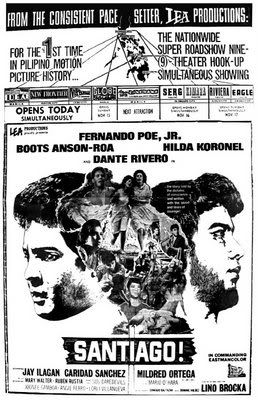
Santiago! (Lino Brocka, 1970)


It's odd thinking of Lino Brocka directing a big-budget action epic, much less directing the late action-star-turned-presidential-candidate Fernando Poe, Jr. in a World War 2 epic--but there you are; even if you watched Santiago! again and again, it still feels odd.

The film is difficult to like at first. Oh, it starts well enough, with Brocka taking a page from Jules Dassin's Du Rififi chez le hommes (Rififi, 1955): a nighttime attempt to sabotage a Japanese munitions store in the little town of Santiago, done without music or dialogue. But then comes the shock: Gonzalo (Fernando Poe, Jr.) discovers that the schoolhouse they are about to blow up is filled with women, old men, and schoolchildren (put there discourage exactly what they're trying to do); the school explodes, and Gonzalo is knocked unconscious.

Almost wished I was knocked unconscious too. At the moment of Gonzalo's realization Brocka cuts to the children, to the saboteur's panicked face, to the sparking fuse, each shot shorter and shorter in length as if to suggest the increasing sense of urgency building up inside the man. Problem is, it isn't very well edited--Brocka's films are almost never sharply edited (the one exception being in my opinion the French financed (and edited) Orapronobis (Fight For Us, 1989))--this sequence in particular is cut as if Fernando Poe's thought processes suffer from mental hiccups. Doesn't help that Brocka pours on the music, and it's a typical Lea Productions score, full of bathos and easy emotion; doesn't help either that Brocka shoots footage of the school burning in excruciatingly slow motion, as if he knew that this was a money shot, and he'd better have as much of it onscreen as he can.

Doesn't help that Gonzalo upon coming to his senses seems hysterical, or at least as hysterical as Poe is able to manage. FPJ (as Poe is affectionately called) is a gift of an action star, in that he's exactly as he seems to be: no facades, no Method acting, none of that nonsense. He's metal of the purest kind, and asking him to do something beyond the chemical properties of his particular element is like asking a fish to walk or a pig to fly; the fish just lies there, flopping, and the pig will patiently wait for you to feed him. You can ask FPJ to suggest a surprisingly large palette of emotions through his ever stolid face, but you cannot make him act them out for you, clearly and explicitly, as if in a soap opera or on a theater stage.

It does help that Brocka had for cinematographer the great Conrado Baltazar. You could tell it's Baltazar from the way he shoots domestic night scenes--he was a master at creating incandescent lighting, at making you believe a room was lit by two thirty-watt bulbs and little else. For the burning schoolhouse he manages to capture the rich orange glow, the lazy way the flames lick at the rooftop--like some fiery predator squatting atop the school, feeding on the people underneath.

The film's second half shifts the action to a small coastal town. Gonzalo has found amongst the wreckage of the schoolhouse a survivor, a seriously burnt girl (Hilda Koronel, in one of her earliest roles). Gonzalo asks a young man (Jay Ilagan) for help in carrying the girl to the young man's home; there for the next few months, Gonzalo with single-minded intensity nurses the girl back to health (shades of Douglas Sirk's Magnificent Obsession (1954)). During the few months the girl spends under Gonzalo's care she falls in love with him--which is a problem, as the young man has in turn fallen in love with her. To complicate things, the young man's older sister (Boots Anson-Roa) has also fallen for Gonzalo, even if she's already engaged to another man (Dante Rivero).

Outside of the young man's home, Gonzalo walks among the villagers like an out-of-place titan; the locals look at him with awe, and not a little jealousy. Rumors fly, of course, and quite a few malicious stories are cooked up and spread around. It's interesting watching Brocka orchestrate the dynamics of rumor-mongering, and how the community's sentiment seems to waver, then draw itself together against Gonzalo. It helps that Gonzalo's character has been backed into a role Brocka identifies with intensely, the outsider who provokes local gossip (Brocka was born an illegitimate child, and for a time lived with--and was maltreated by--his mother's relatives). Brocka would deal with the subject on a broader yet more detailed canvas in his first genuine masterpiece, Tinimbang Ka Ngunit Kulang (You Were Judged But Found Wanting, 1974); here it's interesting to see Brocka direct a community's scorn not at a leper, or a mayor's illegitimate daughter (as in Tinimbang), but at a folk superman. Poe as Gonzalo handles the burden with becoming grace and humility, and it's in these later scenes that his performance, well within his comfort zone, really shines.

If in the film's early parts we glimpsed bits of Brocka's immaturity poking through all the glamorous production values (the fast (if erratic) cutting; the attempt at making FPJ 'act;' the frequent and at times unnecessary flashbacks*), several later scenes reveal early signs of Brocka the great Filipino dramatist. One sequence I particularly admire begins with Gonzalo's adopted family sitting around in their living room. It's a quiet scene, with not much action--dramatic or otherwise--going on; the younger brother, guitar on hand, starts to strum the lovely folk song Ikaw (You). Yet from the despondent expressions on the peoples' faces; from their body language and languid gestures; from the way they seem to listen--and yet not listen--to the song; most of all from the way the seated figures are arranged (like ikebana cuttings) before the camera, you can tell that there's a tension in the air, a sense of electricity, of anticipation.

And then you realize it's not that they're waiting for someone that's coming, it's that they're waiting for someone that's missing. And just when that realization blooms in one's mind, Brocka (with--this time, anyway--a supreme sense of timing) cuts to a shot of Gonzalo sitting outside, the camera angled just so that to the upper left of the screen you see the window of the very living room where the people who care about him sit, waiting.

A beautiful sequence, and not the least among its achievements is the fact that if the scene works no one should notice anything--yet everyone watching is undeniably, if unknowingly, moved.

The film's latter half devolves--harsh word, I suppose, but after a scene like that--into a series of standard-issue (if well produced) action sequences, including some low-key if impressive stuntwork, and a lengthy tracking shot of villagers crossing a flooded underground tunnel to safety. FPJ mows down his share of Japanese villains--you know the drill: a vigorous sweep of the semiautomatic and everyone with slanted eyes drops to the ground. Interestingly, when Celso Ad. Castillo directed FPJ in Asedillo (1971) the star refrained from any superhuman acts of killing; he was just a schoolteacher turned rebel hero, and if anything seemed outsized and near-mythical about him it was probably due to Ad. Castillo's expressive direction (the film's theme, after all, was the making of an ordinary man into a legend) and Sergio Lobo's larger-than-life cinematography. Interesting too, that when Gerardo de Leon and Eddie Romero directed FPJ in Intramuros: The Walls of Hell (1964) the film had realistically staged (if inventive, even tense) action sequences. FPJ there was like a Latin James Dean, all tilted head and youthful arrogance and the camera (and audience) can't help but love him, but no, no wholesale slaughter of the Japanese at the pull of a trigger.

To be fair, De Leon, Romero and even Ad. Castillo when they worked with FPJ were already veterans; Brocka on the other hand was a neophyte director making his sophomore effort. He was lucky to land an assignment with FPJ, and if the star of the production wanted to kill scores of soldiers in a single sweep, who was Brocka to say otherwise?

Still, Santiago! has its place in Brocka's oeuvre: an early draft for Tinimbang Ka Ngunit Kulang; a rare moment in the man's career when he stepped outside of his melodramatic domain; an honest attempt at epic period filmmaking a la Tatlong Taong Walang Diyos (Three Years Without God, Mario O'Hara, 1976). And one can see how Brocka, even with the burden of a large-scale production full of extravagant special effects (unlike Tatlong Taong or Intramuros, this film boasts of large, intricately detailed models of churches and bridges being blown up with genuine explosives, not New Year's Eve firecrackers--always an expensive undertaking), even with star producers dictating terms, even with the limitations of the war drama genre, still manages to make the film somehow personal, somehow his own.

* On those flashbacks--I'd say they were mostly unnecessary save one, a black-and-white, wordless interlude where Mario O'Hara and Caridad Sanchez play a married couple whose happiness is torn asunder by the Japanese. What is it with Brocka's intensely told side-stories (especially when O'Hara is acting in them (see also: Tinimbang)), that they often steal attention from the rest of the film, and are often more interesting than the main narrative line?

Wednesday, April 30, 2008

VCDs of two major Mario O'Hara films (Bakit Bughaw and Kastilyong Buhangin); plus other DVD releases

Tremendous news--kind of. But still.

Two of Mario O'Hara most highly regarded films--largely unseen for over twenty years--are finally, finally available on VCD format (that's the 'tremendous' part), but unsubtitled (that's the 'kind of' part):
Kastilyong Buhangin (Sand Castle, 1980) and Bakit Bughaw ang Langit (Why Is the Sky Blue? 1981).

Basically, Kastilyong Buhangin was a pop vehicle for drama queen/music diva Nora Aunor and rising stuntman turned actor Lito Lapid, so the film is a mix of melodrama and action setpieces--a cross, in effect, between George Cukor's A Star is Born and Ringo Lam's Prison on Fire. Stuntmen choreographing their own stunts, Nora Aunor singing a George Canseco classic (if you've ever been to a karaoke bar in Manila--or any Filipino home with a karaoke set--you've probably spotted the title song in their catalogue). What's not to like?

Bakit Bughaw is even better, a Lino Brocka melodrama played with an understatement and laser-beam focus I submit Brocka never achieved in his own films. Some say this is O'Hara's masterpiece; I may not agree, but I understand their regard.

I've written on both films--on Kastilyong Buhangin
here and on Bakit Bughaw ang Langit here, and I cannot, can not recommend them highly enough. VCDs work on my Philips DVD player, so there's a chance they'll work on yours; the video quality will be bad, but this may be the only way the films are ever going to be seen (the prints and negatives are gone, as far as I know, and believe me I've looked). If you're not fluent in Tagalog chances are you'll have trouble understanding the story, so now's your chance to either learn the language or befriend a Filipino, take him or her to your home, and have them watch two of the finest films in Philippine cinema, translating the dialogue benshi-style for your benefit.

Abel Gance's J'Accuse (1919) is great, and moving in ways Napoleon (a more visually spectacular and complex film) is not. The storyline is pure melodrama, but the way it's carried out is hard to resist--Gance's hokiness is so much more sophisticated than Griffith's, or even Murnau's, at least in Sunrise (1927) (which can be off-putting, if you're not ready for it).

Again and again Jean Diaz (Victor Francen) proves himself self-sacrificing, totally unselfish and sensitive to the needs of the people and of Edith, the woman he loves (Line Noro), who happens to be married to another man. Your eyebrows rise but you can't quite bring yourself to laugh--Gance has Francen underplay his acting so well, largely subordinates his not inconsiderable visual style to the story so completely that Diaz's deeds come across as simple expediency, dictated by circumstances, with only a trailing whiff of nobility in the air. I for one was completely seduced by this plaster saint posing so effectively as a human being.

The truly three-dimensional figure in the film is Edith's husband Francois (Marcel Delaitre), who makes for a magnificent peasant brute; with his howitzer of a shotgun and battleship prow of a nose, when he glares at the camera (often at Diaz or at his own erring wife), you expect the theater screen to singe a little. All the more moving, then, when he is confronted with his own implacable sense of honor, and his granite facade cracks a little.

Great scenes combining actual combat with reenacted footage, and I don't know if it's an accident or conscious decision on Gance's part, but the soldiers captured on film are faceless figures, foreshadowing the harrowing sequence where the dead rise up to judge the living (Romero's entire work, and even Dante's Homecoming (2005), anyone?). That final scene, with the dead in long shot, even in bright sunlight, is unsettling--they're solid, not phantoms, but you still get this hair-raising sense that they're not completely of this world.

Again, again, that's why I think Romero's slow-shuffling undead (or Kurosawa Kiyoshi's in Kairo, for that matter) are so disturbing. They're don't quite move to our beat--don't swim in the same currents of time. The more recent, faster-moving ghouls (28 Days Later; the Dawn of the Dead remake) are just wild animals on the loose; Romero's (and Kiyoshi's) cry out from beyond.

Finally: Desu noto (Death Note, 2006). Tetsuo Araki's adaptation of the manga by they psuedonymous Tsugumi Ohba. John Powers reviewed the series in NPR, quoting someone as saying this is the best thing to come out of Japan in reecent years.

It's fascinating for the intricate plotting, mainly, and the jawdropping twists introduced along the way. And of course for L, the bug-eyed pale-skinned, honey-voiced (Alessandro Juliani who, if they ever remade 2001: A Space Odyssey, would be a shoo-in to play HAL 9000) genius behind the the manhunt for Kira, the unknown killer who strikes down criminals the world over just by looking at their faces, and writing down their names in an ordinary notebook.

It's not particularly profound, and it doesn't make any grand statements on the human condition; it's just a fantasy of two youths possessed of extraordinary abilities (as Powers notes, the two main characters represent two distinct types: Kira (a.k.a. Light Yagami) is the handsome honor student, ladies' man, and athlete, while L (real name unknown) represents the weird otaku, or geek). L and Kira are alike, they're deadly enemies, they're also, strangely enough, tentatively good friends, mainly because they are the only two people in the world, apparently, intelligent enough to truly appreciate each other (in a late episode, perhaps the creepiest moment in a series full of creepy moments, L washes Kira's feet).

I don't agree about that 'best thing to come from Japan recently' bit--Kurosawa Kiyoshi and Takeshi Kitano are still working (haven't seen their latest, though), and Oshii wowed me with his last picture--but it's defintely interesting, addictive stuff.

Friday, January 11, 2008

Update: Best of 07 and Filipino Films on DVD

Nora Aunor in Ishmael Bernal's Himala (Miracle, 1982)

Arguably one of the most important links on my blog is this one, which lists down the Filipino films available on DVD (scroll to the bottom of post for the updates). As someone who often speaks to a vacuum--in the sense that I often discuss pictures that few people outside of the Philippines (or even inside the Philippines) have ever seen, really should do more to make what films are available out there more widely known. Lord knows this isn't complete, but I can at least keep it updated--which is what I'm doing now.

Also updated: my Best of 2007 list now includes Sweeney Todd and, I'm pleased to say, Altar, arguably Rico Maria Ilarde's best work to date. Hope to write more on Ilarde's digital feature (like all of his pictures it's an intriguing genre bender, this time crossing Hideo Nakata with The Legend of Hell House and, of all things, The Quiet Man) when I have the chance...

And by way of farewells, a reminder of one particularly painful loss this year:
Joey Gosiengfiao, 1941 - 2007)

Tuesday, June 12, 2007

CineFilipino releases 5 Lino Brocka DVDs!

Photo Sharing and Video Hosting at Photobucket
Eddie Garcia holding down Lolita Rodriguez in the harrowing opening sequence of Tinimbang Ka Ngunit Kulang (You Were Judged and Found Wanting, 1974)

CineFilipino to release five Lino Brocka DVDs this month

If this is true (and it seems too good to be true (someone please twist one of my nipples with a pair of pliers, Eli Roth-style)) then at least two of Brocka's best--and in effect two of the greatest films in Philippine cinema (as I've declared many times)--are soon available on DVD. Tinimbang Ka Ngunit Kulang (You Were Judged and Found Wanting, 1974), about a young man's rite of passage in a small town, is the initial firing shot in what proved to be the '70s Golden Age of Philippine cinema; Insiang (1976) is in my opinion Brocka's masterpiece--his version of Othello (three characters locked in a triangle of jealousy and hate)--set in the slums of Tondo (which has its advantages and disadvantages, as I point out in this article).

Thriling, thrilling news--and, I hope, news that really does come true (as of the moment, it's not in Cinefilipino's website--but I hope to correct myself soon. In which case, I plan to shout it from the housetops).


Wednesday, October 25, 2006

Filipino films on DVD (updated 5/9/08)

Photobucket - Video and Image Hosting
Poster for The Fatima Buen Story (Mario O'Hara, 1994)

Maybe I need to backtrack, and mention where all the Filipino films I keep writing about can be found. Please note that I will be updating this particular post from time to time, and will provide a permanent link to it on my sidebar.

On recommendations on Filipino films, I posted a list of 13 favorites here:

Thirteen Important Filipino Films


with the added warning that anyone who began writing about Filipino films from the '80s onwards struggles against the deterioration of film prints, even of films from the '80s (I note that in the article); in fact our earliest available prints come only from 1939. We suffering from an increasingly serious state of amnesia, in effect, with regards to our film heritage.

I rewrote the article, modifying the list some, here:

Twelve Great Filipino Films


An article on one of the cinema's best artists, Mike de Leon, here:

The thin line between genius and sanity


As for available copies of the cinema's best-known filmmaker Lino Brocka's best known work Maynila sa Mga Kukong Liwanag (Manila in the Claws of Neon, 1975); I remember seeing VHS copies in New York's video stores, presumably subtitled, and for a time kabayancentral
offered copies--which has since vanished. A DVD is being planned, but that's in the future.

Two Brocka films can be found at Facets
in Chicago; Orapronobis (Fight for Us, 1989), and Macho Dancer (1988). I wouldn't know if they have subtitles or not.

Recent Filipino films I recommended can be found on VCD or even DVD format here:

http://www.regalfilms.com/


Search for titles like Mario O'Hara's Babae sa Bubungang Lata
(Woman on a Tin Roof), and Pangarap ng Puso (Demons); Peque Gallaga's erotic noir Scorpio Nights; Lav Diaz's science-fictional Hesus Rebolusyonaryo (Jesus the Revolutionary). All, unfortunately unsubtitled.

Kabayan Central
boasts of a selection of classic films from their
LVN Films catalog
and Sampaguita Pictures catalog. They also have more recent pictures, including Mike de Leon's Kung Mangarap Ka't Magising and Bayaning Third World (Third World Hero) and a selection from Viva Films (Tikoy Aguiluz's erotic noir thriller Segurista (Dead Sure), and his independently produced historical verite piece Rizal sa Dapitan--in which, full disclosure, I have story and dialogue credits). Again, most probably unsubtitled.

The website also offers a few worthwhile films with English subtitles: Mario O'Hara's Babae sa Breakwater
(Woman of the Breakwater, the first Filipino feature film to go to Cannes in fifteen years), Tikoy Aguiluz's Biyaheng Langit (Paradise Express); Lino Brocka's Macho Dancer (not his very best, but quite good); Ishmael Bernal's Relasyon (The Affair) and Manila By Night (both among his best; Manila in particular being his masterpiece, in an unfortunately not very good transfer); Jeffrey Jeturian's Tuhog (Larger Than Life--note: I know Jeturian's film has a subtitled DVD; I don't know if the website offers that DVD.

And I should mention a new company, Cinefilipino
, dedicated to distributing Unitel films and Filipino classics in the United States, whose DVD releases had been reviewed recently by the New York Times' Dave Kehr. Their titles--all subtitled, though I can't vouch for the quality of the film transfer--include the aforementioned Manila by Night, Macho Dancer and Relayson, Lino Brocka's Ina, Kapatid, Anak (Mother, Sister, Daughter), plus an intriguing one by Mario O'Hara: The Fatima Buen Story, a true life tabloid story given a gothic flavor by one of the finest filmmakers in the industry.

Another alternative is Cinema One in The Filipino Channel (TFC), which a lot of Filipinos seem to subscribe to; they show almost all the films I've mentioned above (untitled, unfortunately); if you have a friend who has a subscription, he could tape it for you, maybe even do "benshi."

Lastly, while I haven't written about these particular pictures (but I mean to, one of these days), here are a few Gerardo de Leon*
films available on DVD:

Terror is a Man


The Blood Drinkers


Blood of the Vampires


Brides of Blood


Mad Doctor of Blood Island


Walls of Hell


I recommend Terror is a Man and Blood of the Vampires. But if you can't take my word for it, read Mark Holcomb of The Village Voice and his take on Gerardo de Leon.


*Correction: Gerardo de Leon never worked for Roger Corman.


Update (1/11/08): 

Kabayan Central lists all available DVDs with English subtitles. Of this list, I recommend Lamberto Avellana's tribal classic Badjao (1957); Maryo J. delos Reyes' youth angst film Bagets (1984); Ishmael Bernal's near-hallucinatory treatise on religious hysteria (Himala (Miracle, 1982)); Brillante Mendoza's 'omnibus' film Kaleldo (Summer Heat, 2006); Mike de Leon's political drama Sister Stella L. (1984); and Auraeus Solito's provincial drama Tuli (2005).


Meantime Cinefilipino has not been idle; it's managed to release bare-bone but nevertheless handsome DVDs of two of Brocka's best works: Insiang (1976), and Tinmbang Ka Ngunit Kulang (You Were Judged and Found Wanting, 1974). They have also released Lino Brocka's gay-man-adopts-angel-child film Ang Tatay Kong Nanay (My Father the Mother, 1978) and omnibus trio of short films Tatlo, Dalawa, Isa (Three, Two, One, 1974).


I've already mentioned their collection of Regal Film classics earlier, though the titles are worth repeating (Manila By Night; Ina, Kapatid, Anak; Relasyon; The Fatima Buen Story).


Most intriguing in Cinefilipino's catalogue are the Sampaguita Classics, films by Mar Torres and Carlos Vander Tolosa, titles I've heard of but never dreamed could ever be available on DVD. I can speak up for Jack 'n Jill at least--it's a delightful comedy, with Lolita Rodriguez as a butch, jeepney-driving Jill and the great comedian Dolphy as a fragile flower of a Jack (or is it the other way around?).

Of Unitel's original productions, I can recommend Mark Meily's green card comedy La Visa Loca (2005); director Maryo J. delos Reyes and writer Michiko Yamamoto's child drama Magnifico (2003); and Solito and Yamamoto's Ang Pagdadalaga ni Maximo Oliveros (The Blossoming of Maximo Oliveros, 2005).


Update (5/9/08)

Mike de Leon's Kakabakaba Ka Ba? (Rough translation--Does Your Heart Beat Faster? 1980) is, of all films, available on DVD! Mike De Leon's one out-and-out comedy isn't the funniest Filipino film ever made, but is easily one of the wittiest, not to mention demented.


And two major Mario O'Hara releases, on VCD! Kastilyong Buhangin (Castle of Sand, 1980) is a commercial vehicle starring acting diva and singer Nora Aunor and stuntman Lito Lapid; accommodating the two lead stars resulted in a film that can only be described as a cross between George Cukor's A Star is Born and Ringo Lam's Prison on Fire.

O'Hara's Bakit Bughaw ang Langit (Why is the Sky Blue? 1981) is O'Hara treading in longtime collaborator Lino Brocka's social realist territory; the results, however, are (I submit) quieter, subtler, more intimate, more intense. Some say this is O'Hara's masterpiece; I don't quite agree, but I think I know where they're coming from. 

I write about Kastilyong Buhangin here and Bakit Bughaw ang Langit here. I cannot recommend them highly enough.