Showing posts with label Filipino Film Industry. Show all posts

Tuesday, March 31, 2026

The Quiet Man: The Films of Mario O'Hara


In 2005 we put out a book: Critic After Dark: A Review of Philippine Cinema

In 2026 we're doing it again.

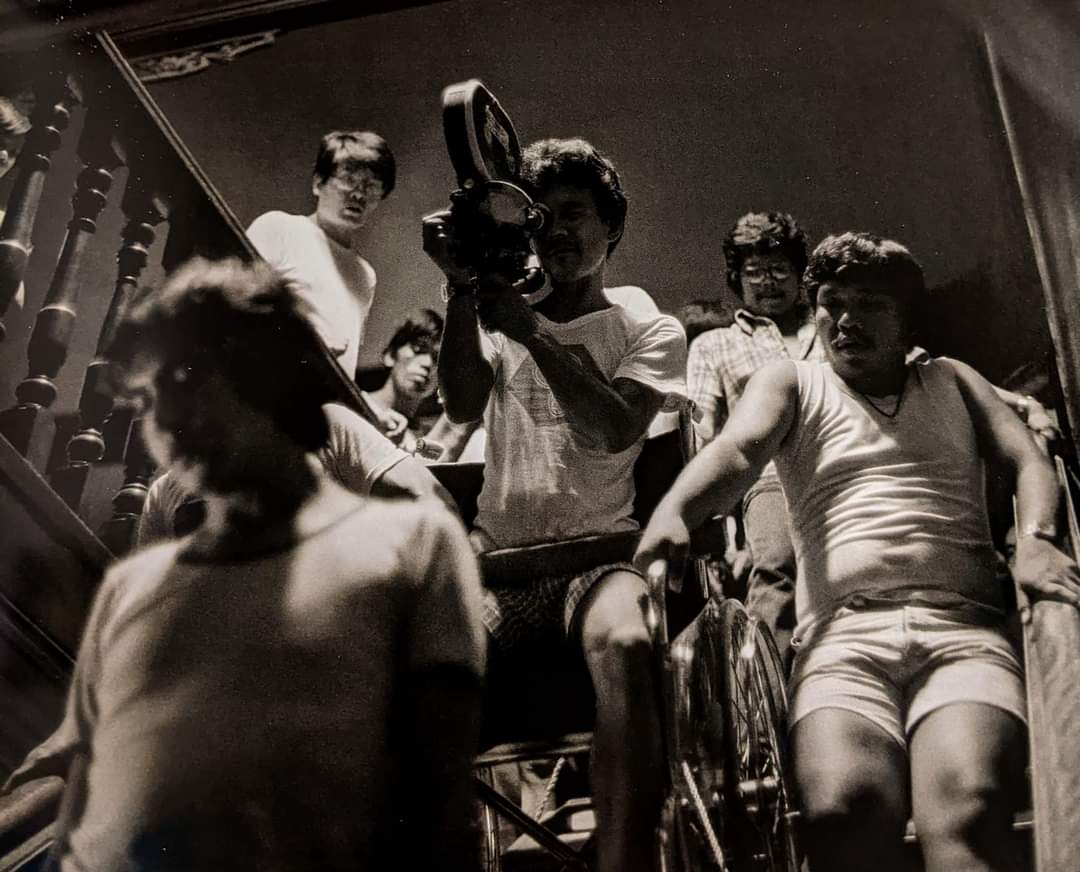
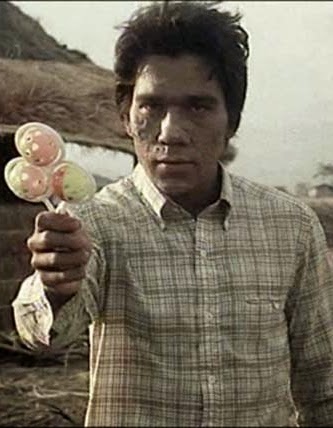
The Quiet Man: The Films of Mario O'Hara was twenty-one years in the making, a collection of pieces new and old on the filmmaker plus a fistful of photographs, some of them never seen before, with a focus on arguably his greatest muse Nora Aunor, and we're launching the book on Sat April 25 (five days after O'Hara's 80th birthday) at 3 PM in Archivo 1984, 5F Building A, Karrivin Plaza, 2316 Chino Roces Avenue, Makati City, Philippines.

Be there if you dare.


Tuesday, June 10, 2025

Bona (Lino Brocka, 1980) 4K Restoration on the big screen


Close to you

This early shot in Bona (1980) I think says it all.

What's so remarkable about Nora Aunor's face here is just how unremarkable it looks in that sea of faces, standing in the brainfrying streets of Quiapo. The biggest star in all of Philippine cinema crammed in a crowd like sardines in a can, and she doesn't just look as if she doesn't stand out, she looks as if she belonged there, milling among the pious, the pickpockets, the prostitutes, all out in force on the Feast of the Black Nazarene. After all when you think about it: what's the point of appearing as the lead in a Filipino film if you don't look like a typical Filipino?

Saturday, April 19, 2025

Tuesday, January 07, 2025

Isang Himala (A Miracle, Pepe Diokno, 2024)


It's a miracle

Let's get the million-peso question out of the way: from my limited perspective Isang Himala does not measure up to Ishmael Bernal's 1982 classic film, not quite, but does easily stand out as the best of the four films I saw at the 2024 Metro Manila Film Festival. 

"But how can this be?!" you ask. Well let me tell you.

Monday, August 12, 2024

'Mother' Lily Monteverde (1938 - 2024)


Mommy dearest

First thing you come to know when you meet 'Mother' Lily Monteverde is her laugh.

It's loud. It's raucous. It's her head tilting back, wide mouth opening wider, and that voice-- a little low, a lot rough, barking out a sound that's half-aggressive half-accepting of the absurdity of the world. Sound of a woman who holds nothing back when she laughs, same way she holds nothing back when giving her opinion or judgment or whatever needs expressing at the moment. It's the sound of a queen on her throne, ruling her little fiefdom with lively and inimitable style. 

Wednesday, May 15, 2024

Bona 44 years later (Lino Brocka, 1980)

Bona, 44 years later

There's a lovely symmetry to having the restored print of Lino Brocka's Bona (1980) screened in the 2024 Cannes Classics section, in the same city where the film had its world premiere (at the parallel Director's Fortnight) decades ago. Feels like a combination homecoming, resurrection, revelation all at the same time.

Wednesday, February 28, 2024

Tikoy Aguiluz (1947 - 2024)


Pugilist

Tattooed gangster

As Tikoy put it he grew up in a penitentiary (the Davao Penal Colony, or Depacol, where his father was prison auditor) learning how to box from one of the veteran convicts. With his six other brothers, all of them wearing shorts instead of long pants and speaking in a funny Tagalog accent instead of everyday Visayan, they attracted the attention and ridicule of all the other kids, not necessarily starting fights but finishing them wherever they went. Tikoy's ambition in life was simple: to get a tattoo, and be a gangster; he ended up working briefly in Hollywood, then coming back to the Philippines to become one of the finest filmmakers in the industry. 

Thursday, November 09, 2023

Ely Cruz, 1948 - 2023

Shadow man

Ely Cruz passed just a few weeks ago, an event little noted by newspapers or even by the studios he worked for-- a tragedy, because he was a master cinematographer who worked for filmmakers as diverse as Mike de Leon, Peque Gallaga, Gil Portes, Chito Rono, Tikoy Aguiluz. 

Friday, November 19, 2021

NIda Blanca

Nida Blanca

What made her such a memorable actress? Her smile, which was unique; it had a queer twist to one side as if wanting to turn into a sneer, something worthy of Barbara Stanwyck in a noir thriller. It didn’t, not quite; it accompanied eyes that opened wide in surprise and wonder, or narrowed into an intense laser stare. The problem with those eyes--or the glory of them whichever way you saw it--was the twinkle you saw, a twinkle that said she was only kidding, that the near-sneer was a put-on, that the tough-girl image was merely a façade defending her from a tough world.

Thursday, July 01, 2021

The state of Philippine Cinema (from Cahiers' L'Atlas du Cinema 2004)


(I forgot I even wrote this--my brief contribution on the state of Philippine cinema to Cahier's L'Atlas du Cinema 2004)

Miracle in Manila

Several elements caused 2003 to be a poor year in Philippine cinema, continuing a trend that started years back. President Joseph Estrada, a former actor, was loyal to the local industry and allowed it to flourish a little, but his management of the national government was so confused and corrupt that he was overthrown by a popular revolt in 2001. His successor, Gloria Macapagal-Arroyo, was far less sympathetic, the eventual result of which was that film production rate hit a plateau, and began to recede. With presidential elections coming this May 2004, and a new actor, Fernando Poe Jr., again aspiring to the presidency (and, according to polls, has a good chance of winning) the local industry might receive better treatment but, paradoxically, the rest of the country fears the possibility of further chaos.

Thursday, March 11, 2021

Federico Fellini's '8 1/2' (1963), Mario O'Hara's 'Babae sa Bubungang Lata' (Woman on a Tin Roof, 1998)


Through the looking glass

(Plotlines of both 8 1/2 and Woman on a Tin Roof discussed in detail)

Federico Fellini's 8 1/2 (1963) is one of the most gorgeous black-and-white films ever made not to mention one of the most influential: it has inspired at least one terribly expensive (and terrible, period) musical (Rob Marshall's Nine), one great dance musical (Bob Fosse's All That Jazz), a royal flush of filmmakers (Martin Scorsese, Woody Allen, David Lynch among many many others). If I admire it I admire it for the way the camera--like its protagonist filmmaker Guido--dances nimbly past all the men and women in his (its) life attempting to lay claim to his (its) attention. It's a heady swirl of delicate Prosecco and robust Chianti--of the enigmatic and intimate, the personal and metaphysical.

Tuesday, August 23, 2016

Six Degrees of Separation From Lilia Cuntapay (Antoinette Jadaone) -- RIP Lilia


 Rest in peace, Lilia (1935 - 2016)

Who in the world was Lilia Cuntapay?

Possibly the most famous Filipino face you've never heard of, a minor actress who has appeared in forty films and television series to date (plus a few that the Internet Movie Database might have missed), and one of the more outre characters I've met on the fringes of the Filipino movie industry--never got her name completely right, but never forgot her, either. And she's the unlikely, bizarrely brave yet startlingly serene heroine of Antoinette Jadaone's 2011 feature debut mockumentary Six Degrees of Separation from Lilia Cuntapay.

Sunday, April 10, 2016

The Last Pinoy Action King (Andrew Leavold)


Meat and potatoes

Filipino film enthusiast and fledgling documentarian Andrew Leavold's The Last Pinoy Action King, his sophomore feature, doesn't have the bizarre vibe of his The Search for Weng-Weng--doesn't feature at its center a three-foot-plus strangely charismatic enigma, who remains a cipher by film's end but whose story has at least been given a good going-over. No, Leavold's subject this time is a hardworking, undeniably pretty, quietly charismatic action-movie star with bona-fide boxing skills, a relatively low-key personal life, and no real scandals to speak of.  

Fernandez made a career of what assets he had--in terms of popularity if not boxoffice* second only to the inimitable Fernando Poe, Jr.. Leavold apparently took his cue from Fernandez and serves up a meat-and-potatoes documentary, no artsy-fartsy frills (though at one point he does use jittery video footage to suggest hopelessly blinkered love), just a story simply told.


Friday, April 24, 2015

Segurista (Dead Sure; Tikoy Aguiluz, 1996)


Some 19 years ago: an old article about a remarkably deft erotic thriller from Tikoy Aguiluz, freshly banned by the MTRCB (the Movies and Television Review and Classification Board--basically the Philippines' once and still powerful censorship authority)

The Dirtiest Movie of The Year 

It's been the year of the bold: Priscilla Almeda pulled off her top in a horse's stable (Sariwa (Fresh)); Ruffa Gutierrez strutted across the screen in a wet t-shirt (Pinakamagandang Hayop sa Balat ng Lupa (The Most Beautiful Creature on the Face of the Earth)); Rosanna Roces modeled ladies' underwear in Patikim ng Pina (Taste My Pineapple) while co-stripper Natasha Ledesma mashed her breasts; Amanda Page swallowed the outflow from a phallic showerhead (Sobra-Sobra, Labis-Labis (Too Much is Just Enough) while co-star Ina Raymundo suffered rape via vibrator.

According to the MTRCB, the aforementioned titles are nothing compared to Segurista (Dead Sure). After all, those movies made it to the theaters, more or less intact; this film was given an X rating, effectively banning it from exhibition.

So--why Segurista and not Patikim ng Pina? Good question.

Thursday, June 26, 2014

Mario O'Hara 1946 - 2012


An old interview (reproduced from my book Critic After Dark) I did, the very first time I met him:

Three Men Drunk In A Dimsum Shop

WE MET OUTSIDE of Shakey's, which was Mario O'Hara's suggestion. "Then I thought 'Wait a minute,'" he told me, "'Shakey's, on a Friday night--a basketball night. We won't get a table.'" Indeed we didn't: there was a line of customers waiting to be seated. We ended up in a dim sum shop outside of Glorietta's Streetlife, ordering pitchers of beer from a nearby bar.

I was with my friend--call him Mang Philip--and we had collared the elusive Mario O'Hara backstage of the last performance of his latest play, Wilfredo Ma. Guerrero's Ulilang Tahanan (Orphan Home). Mang Philip took one arm, I took the other, and we twisted until O'Hara agreed to meet us: which is, it turns out, the only way you can convince him to give an interview.

Backtrack one year: when I had first met Mang Philip, we had spent the whole night talking about, well, everything you can imagine; one of the things we talked about was films. "Everyone is a thief and a fake," he informed me. "Celso (Ad. Castillo), Mike (de Leon), Ishmael (Bernal), Lino (Brocka), Gerry (de Leon)--all thieves and fakes."

"I don't know," I told him, "They're not that bad."

Mang Philip shook his head. "The only one who's any good is Mario O'Hara. I can't remember the title of the movie I saw of his--what's the matter?"

The matter was, I had just seen Tatlong Taong Walang Diyos, (Three Years Without God) and I was more or less thinking the same thing--not that O'Hara's the only one who's any good, but that he's the best filmmaker we have. 

Wednesday, June 26, 2013

Tribute to Mario O'Hara (1946 - 2012)

 
The Quiet Man passes 

Mario Herrero O'Hara was known, if he was known at all, as legendary filmmaker Lino Brocka's collaborator; more malicious wags called him Brocka's lover (for the record--no, and there's a reason why). 

Friday, August 24, 2012

Ike Jarlego, Jr. (May 3, 1944 - August 24, 2012)

Mario O'Hara once called Ike Jarlego, Jr. one of Philippine cinema's best editors, easily making him in my book one of the world's finest. He began his career cutting the most famous work of the most notable filmmaker of the '70s and '80s Golden Age of Philippine cinema: Lino Brocka's Maynila sa Mga Kuko Liwanag (Manila in the Claws of Neon, 1975). He went on from there: O'Hara's Mortal (1975) and Tatlong Taong Walang Diyos (Three Years Without God, 1976); Mike de Leon's Itim (Rites of May, 1975) and Kakabakaba Ka Ba? (Are You Worried?, 1980); Ishmael Bernal's Aliw (Pleasure, 1979), Himala (Miracle, 1982), Working Girls (1984) and Working Girls 2 (1987); Butch Perez's Haplos (Caress, 1982), and Balweg (1986); Maryo J. Delos Reyes' Bagets (1984). 

Jarlego was born into a moviemaking family--his father Enrique Jarlego, Sr. was an editor who worked for Vicente Salumbides (Ibong Adarna (Adarna Bird, 1941) and Lamberto Avellana (Huk sa Bagong Pamumuhay (Communists in a New Life, 1953); five of his brothers (he had thirteen siblings) also became editors, most notably his brother Efren (Mario O'Hara's other best Filipino editor, who also worked on Tatlong Taong Walang Diyos and then went on to do Kastilyong Buhangin (Castle of Sand, 1980), Condemned (1984), Bagong Hari (The New King, 1986); Laurice Guillen's Salome (1981) and Init sa Magdamag (Midnight Passion, 1983); Lino Brocka (Hot Property, 1983)). 

It was while Jarlego Sr. was working for Avellana that Jarlego Jr. got his big break--Ike was a little boy playing on the LVN Studios compound when Avellana asked him to appear in Pag-asa (Hope, 1951), running  towards a gate and yelling "shoeshine!" He had a small subsequent career as child actor before turning editor later in life. 

At his very best Jarlego managed to translate the editing styles of some of the greatest Filipino filmmakers to the big screen: the precise cutting of Itim, the stream-of-consciousness flow of Mortal, the witty brevity of Kakakbakaba Ka Ba?--none of these would have been possible without Jarlego's skill on the Moviola and Steenbeck machine.

He debuted as a director in 1992 with Andres Manambit; his direction of Lualhati Bautista's script for Nena (1995) was lean, intense, noirish--a no-nonsense, totally unpretentious means of realizing Bautista's allegory on female empowerment. The film along with Mario O'Hara's Bulaklak sa City Jail (Flowers of the City Jail, 1985) was easily one of the most effective interpretations of Bautista on the big screen--both succeeding, notably, without resorting to direct adaptation of some of her more famous literary works.

(Some information in this post taken from the CCP Encyclopedia)

Monday, January 02, 2012

Get real, Get Real Philippines

First of the year and already I'm compelled to write a less-than-friendly post.

Before anything, a caveat: as of today, have not yet seen any of the films at the 2011 Metro Manila Film Festival (MMFF)--would like to, but am having a time trying to arrange a viewing. So, yes, I'm putting that out for the record, up front.

Reason for this cobbled-together post, though, is a budding website called Get Real Philippines, a series of articles written mostly by the webmaster, with a handful of fellow writers (well, one other, apparently). For the most part the articles seem well-written, lively, reasonably well informed, generally progressive--until this article by someone named 'Ilda,' on the recent MMFF.

Not a big fan of the MMFF; for the longest time they've enjoyed the privilege of being the only game in town in Metro Manila theaters during the Christmas season, ostensibly the biggest market in the busiest time in the Philippines, arguably one of the biggest and busiest in Southeast Asia, if not the world. There was a time when this was a good thing: the festival showed the likes of Ishmael Bernal's Himala (Miracle, 1982), and Mike de Leon's Kisapmata (Blink of an Eye, 1981). The festival has reportedly degenerated into a showcase of mostly slapdash commercial products, including the Mano Po series (I'd seen the first one--not a big fan of that either--and heard harsh words about the sequels). 

Like I said: not a big fan. But I don't think it and the entire Filipino film industry, independent and mainstream alike--deserve the general hosing-down found in that article. Statements like "Unfortunately, our films tell us and everyone else that we are shallow and superficial" seem to slam Philippine cinema in general--so are we shallow and superficial, as portrayed by Bernal, De Leon, Lino Brocka, Mario O'Hara, Lav Diaz, Brillante Mendoza? Are our films "a total waste of the people’s time and money?"

Getting down to specific titles, the article mentions three: Enteng ng Ina Mo (Enteng of your mother--but that's a rough translation, it's really a play of words on a classic Filipino profanity) I can't really comment about. It sounds like it's a wholly commercial production and sequels are usually not the greatest films in the world as a rule but I haven't seen the picture and the writer, apparently, has; she pronounces judgment on the script and dialogue, and casts aspersions on the actors and producers' motives (I know it's impossible for her to actually read their minds, but I'll call that a rhetorical tactic; been guilty of doing the same for movies I didn't like). But when it came to her takedown of Panday 2 she writes "the new Panday movie is being criticized for being a blatant rip-off of the 2010 Hollywood blockbuster remake of Clash of the Titans."

"Being criticized?" Is she repeating what she's heard from others? Is she suggesting that she hasn't seen the movie? True, she does add "There was nothing special about the “special” effects either," but is it possible she's basing her judgment on online trailers?

More damning is her take on Shake, Rattle, and Roll 13: "What else can people expect to get out of it? Not much, obviously. People are probably watching it for the eye candy." Then she goes on to disparage the starlets on the festival parade (I understand where she's coming from, but I personally can't find it in me to disparage starlets; they're often fresh young things from the provinces who've been struck blind by all the money and attention, and often lead harsh lives off-camera). Three sentences that don't really talk about the picture, but rather how people might react to the picture. When called on this in the article's comment section, the writer replies with unusual evasiveness: "It doesn’t really matter if I saw SRR13 or not."

Um--yes it does, actually. Basic rule in journalism in general, criticism in particular: know of what you write.

I can't say I can judge this installment myself but I did see the original series back in 1984; Bernal's sequence (Prigyider) in particular was a witty original. I've dipped into the series once in a while and found a few good segments (Kapitbahay, in Shake, Rattle, and Roll IV, 1992). Critic Dodo Dayao does praise this thirteenth variation in his blog--and I do trust Dayao's judgment; he's an astute writer on local and international films, and writes about the movie in close detail with considerable eloquence. Ms. Ilda has every right to disparage the picture, and she makes a good point about the laziness of film producers in general, but she must see the movies first. Anything less smacks of lazy journalism. 

Webmaster 'Benigno' defends his fellow writer in a follow-up article, helpfully titled "Filipino indie film makers need to stop whining and step up." * He succinctly summarizes the events that led up to his writing of the article; then he introduces his opinion with: "Based on the sort of comments I’ve seen so far posted in that article..."

Wow, don't people do actual research anymore?

He writes "it seems the people who lament the marginalised place “indie” films hold in the Philippines are better at whining than stepping up to said challenges" (chip on the shoulder much, hm?)" and adds "It is “impossible” only because the Philippine indie film sector lacks the sort of innovation that makes billionaires out of nerds and outcasts like Bill Gates and Steve Jobs."

Um--blanket judgment on an entire industry (this time independent) based on comments made on blogpost article. Useful information here: if one has to make a handful of sweeping generalizations on an industry, it helps to actually read up on and talk to both industry insiders and outsiders in close detail. The more research  put into the article, the more authoritative and persuasive  article can be.

Benigno then goes on in detail about the Weinstein Brothers and Miramax Films, holding them up as an example of an independent outfit that was actually profitable; actually, Miramax was not the blockbuster moneymaker it claimed to be; that aura of profitability came more out of the Weinsteins' ruthlessness and ability to manipulate contractual conditions than out of the creation of actual independent hits.**

Independent filmmakers (and you'll have to take my word for it that I'm talking from experience about people I know well) are some of the hardest-working and most innovative people I know. They do miracles; they create art out of impossible budgets, and in impossible circumstances. Asking them to market their films brilliantly and well is one more impossible task to add to their basket, and I agree this much with Benigno: this just might be what the filmmakers need to do. This isn't the first time it's been said, nor is he the first one to say it; he just needs to do the research, and it wouldn't hurt to dial down the obnoxious, know-it-all tone (him apparently not knowing it all, at least about this industry).

The question of making Filipino independent or art films pay has been around for a long, long time, and no one has come up with any definite answers. Lino Brocka's Insiang (1974) was a box-office flop, despite being screened in the prestigious Director's Fortnight in Cannes, despite being made for a low budget; Mike de Leon's Sister Stella L. was welcomed with glowing praise, and standing-room only previews; when it was released it flopped, despite the name of Philippine star Vilma Santos in the marquee. 

Independent filmmakers today actually have a somewhat better record at the boxoffice; unlike Brocka, they can leverage digital technology to make their films cheaper, faster, easier to make, and in the case of a few titles, they have made some profit (if I remember right, Auraeus Solito's Ang Pagdadalaga ni Maximo Oliveros (The Blossoming of Maximo Oliveros) did modest business and Ang Babae sa Septic Tank (Girl in Septic Tank) did huge business (roughly 20 million pesos, or over $400,000).  In the case of Zombadings the big studios reportedly attempted to repress the picture, keep it out of theaters so it wouldn't threaten their mainstream product.

But--comedies and zombie pictures? What about Sari Dalena's Ka Oryang (see image above), this year's Cinema One Best Picture, and in my opinion one of the best and most important film I've seen this year, Filipino or otherwise? Not to put down the two titles (haven't seen them, but have heard good things), independent films are also meant to deal with things commercial product won't touch (that's why they're independent). If it's difficult to market independent films, that's a combination of a system rigged against the independent filmmaker, an often difficult to market subject matter, and--let's throw this in as well--Filipinos who if they don't frequent Filipino films often condemn said films to the trash heap ("If it's Filipino it must be trash (and no, I don't watch Filipino films)"). This particular segment of Filipinos is crucial to the indie filmmaker; he's the kind of viewer who might appreciate an innovative independent film--if he can be troubled to actually view it.

The attitude isn't new; Gerry De Leon, Lamberto Avellana, Manuel Conde had to contend with this in their time; so did Lino Brocka, Ishmael Bernal, Mario O'Hara.

I'm not trying to completely put down or thoroughly trash Benigno and Ilda and their like; I enjoyed reading their blog, and think they have the right position on some issues (the need for better reproductive health, holding Aquino accountable, and so on). I think their hearts are in the right place, and their effrontery appropriate--when targeted at those that deserve that effrontery, like corrupt government or conservative institutions. The Metro Manila Film Festival? For the most part, yes--I've seen my share, no, more than my share of their garbage; I've also seen a few gems, though, and I'm careful to make the distinction. More power, Get Real Philippines, only--get it right, too. It'll help you in the long run. 

* I know, I know, my sarcasm's showing.

** Old joke: 

Q: How do you make a small fortune in Filipino filmmaking?

A: Start with a big fortune.


Sunday, December 25, 2011

All I want for Christmas is the Director's Cut


Everybody pauses and stares at me
The Director's Cut is gone as you can see
I don't know just who to blame for this catastrophe!
But my one wish on Christmas Eve is as plain as it can be!

All I want for Christmas
is the Director's Cut,
the Director's Cut,
see the Director's Cut!

Gee, if I could only
have The Director's Cut,
then I could wish you
"Merry Christmas."
It seems so long since I could say,
"Action movies are so good!"
Gosh oh gee, how happy I'd be,
if I could only see it (shhhh, shhhh, I'm watching)!

All I want for Christmas
is the Director's Cut,
the Director's Cut,
see the Director's Cut.

Gee, if I could only
have the Director's Cut,
then I could wish you
"Merry Christmas!"
 
Please sign the petition: LET OUR ASIONG GO!!! 

Saturday, December 24, 2011

Have yourself an 'Inasiong' Christmas

(For a recap of what happened, please check out this blog post, its sequel, and its second sequel

And just like that, apparently, game over.

Aguiluz had managed to file a court case against the producers of Asiong Salonga. A TRO (Temporary Restraining Order) was issued against the film's December 25 screening. It looked as if Aguiluz's complaints were finally to be taken seriously. 

And they were, to a point--the producers agreed to remove Aguiluz's name from the credits. No print of the director's cut, however, is forthcoming, and the MMFF will be screening the reportedly butchered and tarted-up producer's version. The same version will be sent to film festivals and film markets all over the world; as far as the rest of the world is concerned, the producer's cut is the one and only version of Manila Kingpin: The Asiong Salonga Story in existence...

And that, apparently, is that. 

It was pointed out in a comment to one of my previous posts that Aguiluz should have expected what happened to him when he dealt with Governor Ejercito--one thinks of the saying "He who sups with the Devil should have a long spoon.

Well--one tries; the thing about the Devil is that he can make things happen for you, or at least that's the well-known motivating detail that accompanies the classic narrative. Yes, you're going to get burned, yes the outcome is never worth the trouble, and yes you only realize this when all has been said and done (or at least that's how the classic narrative goes). But in the real world, if you want to wait for a decent, straightforward producer to hand you the money to do your dream project, you'll never get started--that's the nature of the business. At least Aguiluz dared and nearly succeeded.

The real loser here, of course, is the Filipino people. As far as Philippine cinema is concerned, the action genre is dead; has been for some time. Aguiluz hoped to clear away the hoary cliches, the l, the ridiculous acting tics and gestures that have encrusted the genre like so many barnacles on an outdated sailing vessel; he had hoped to do a radical redesign, and came close to succeeding. 

It may be small comfort to him, but when it comes to filmmakers who have attempted to remake a genre and were undone by their producers, he is in good company (Erich von Stroheim, Orson Welles; Sergei Eisenstein--and that's just including the obvious few).

Maybe someday that director's cut will be seen and, better yet, appreciated. Someday.

Have yourself an 'Inasiong' Christmas, folks. 

(As for the online petition, it may have little to no effect, but I for one would like to be on record as wanting that Director's Cut released in whatever form. I'm not planning to have my signature removed; if anything, I'm proud to keep it there. You can see it in if I remember correctly the number five position on the list...and you're invited to add your own anyway, for principle's sake)