Sunday, October 31, 2010

Babies (Thomas Balmes)


Little rascals

Thomas Balmes' Babies (2010) is charming entertainment, of that there's no doubt. Four charismatic little tykes, from their birth to their first year of existence howl and crawl and pee their way through a large and often bewildering world, and you follow them with little introduction or explanation, other than titles at film's start that give us their names (Ponijao, who lives in Opuwo, Namibia; Bayar, who lives in Bayanchandmani, Mongolia; Mari, who lives in Tokyo, Japan; and Hattie, who lives in San Francisco, the United States). There's an admirable simplicity to the concept, a purity that you can't at one level help but admire: no commentary, no politics, no social observation, just babies, trying to live one day at a time.

The film begins with stark differences: Ponijao's mother rubs a red powder she ground herself on her belly, and that's pretty much all she does by way of preparation; Bayar's mother takes their child home for the first time, and she has to struggle to sling her leg across her husband's bike; Mari and Hattie, on the other hand, enjoy the last word in modern medical technology when being delivered, and you can't help but feel that if a fly dared to show its bacteria-infested face in their presence some laser defense protocol would fry it to cinders.

Each family pays a price for their choice of lifestyle (though you wonder if Bayar and Ponijao and their parents had much choice about their lifestyles). Bayar and Ponijao were born and live under the most primitive conditions (Bayar less so--you see a satellite dish standing beside Bayar's family yurt), and are entirely comfortable with sharing living space with roosters and goats and cows; Hattie and Mari do meet (and mash, and maul) the occasional cat, but brought near larger animals--a gorilla, say, or a tiger in a zoo--they scream their heads off. Possibly they're bored, or for some reason uncomfortable, but I'm guessing the presence of huge creatures you've never seen before glaring at you as if you were their next meal probably didn't help their dispositions. Likewise, you can shudder with dismay at the level of hygiene practiced--Ponijao, having no diaper, simply squirts fecal matter on her mother's knee who, just as nonchalantly, scrapes it off with a corn cob. But Ponijao also gets to sit in a river stream and dip her face in its water; she gets to kiss a dog full in the mouth, lolling tongue and all. I don't know if it's me or a bias in Balmes' choices in assembling his footage, but on the whole Ponijao seems to be enjoying the lion's share of fun and adventure. Bayar isn't close behind--he gets to step on a goat's face, and when a herd of cows approaches, has a moment of panic where he can't decide if he wants to stay atop the tub he's sitting on, climb down and crawl away, or teeter precariously in between (no that doesn't sound like fun, but it's definitely not boring).

One can imagine all the parents watching this on DVD and exclaiming "Yuck!" or "Watch out!" Part of the appeal of the film is in observing these youths learn how to handle their environments as best they can, however they can (it helps to remember that exposure to bacteria and dirt and grime are part of growing up, and that a too-sanitary environment leaves a child relatively helpless and unprepared). Again it might be me, or the filmmaker's bias, but Ponijao comes out all right--she's had a rough-and-tumble physical education, and her sense of balance (as you see towards the end) develops just fine, perhaps even sooner than the others. Bayar--don't cry for him; he's gotten a roll of toilet paper and is having a ball with it, all over the yurt's floor. I think it's telling that the film's funniest moment is at the expense of Mari--she tries to fit a pole in the hole of a toy and when this doesn't work, throws a fit worthy of James Cameron ("I want my quarter of a billion dollars and I want it NOW! NOW! NOW!"). Balmes has his biases, and while I'm sympathetic (what's wrong with scraping off crap with a corncob?), it does throw the nobility of his enterprise into questionable light.

The best one can say of the film is that it looks gorgeous: the differing tints and hues and most of all texture of baby skin--their smoothness, moistness, oiliness, the rolls of fat, the dewy fur--are vividly captured. Of the locations, the most memorable has to be Mongolia--seeing Bayar stand against that magnificent brilliant blue sky, that's a moment worth taking with you out the theater. The worst one can say of the picture is that it has a certain callowness, a playing for laughs, a safeness and benignity that frankly, undermines its verite ambitions. Why go through all this effort to film four babies from four corners of the Earth when the only message you come away with is "babies are happy, babies have fun, babies round the world are basically one?" There's nothing here that we don't already know, though there is much that is fresh to the eye and ear; the premise and execution could have been so much better, perhaps even great (include the parents' point of view, perhaps?), that you feel as frustrated as Mari, trying to jam her poor plastic pole into that poor plastic disc.

First published in Businessworld, 10.21.10

Saturday, October 16, 2010

The Killer Inside Me (Michael Winterbottom, 2009)

I say 'whip it!'--Jessica Alba in The Killer Inside Me

Bad to the bone

Michael Winterbottom's The Killer Inside Me (2010) is a mess. It largely misses the import of noir writer Jim Thompson's gleefully evil 1952 novel the same time it visualizes the book's most violent setpieces with unflinching courage. It's strong in many ways, yet seems completely clueless about the inimitable Thompson flavor--the sulfurous taint you taste with every helping of his bleakly funny fiction.

It's a perilous task, adapting Thompson; he seems so deceptively easy, so surprisingly difficult to bring to the big screen (Sam Fuller once said of Thompson's 1959 The Getaway that the book could serve as the movie's own shooting script--it's full of intricate plot, memorable dialogue, and little fat). But Burt Kennedy's 1976 version of The Killer Inside Me turned out to be a mostly toothless affair (despite featuring Stacy Keach as a massive Lou Ford), and Sam Peckinpah--"Bloody Sam" he's sometimes called, whose balletic slow-motion despair might have beautifully realized Thompson's terminal nihilism--ended his 1972 The Getaway at the point when it should have gotten really interesting. Critic and poet Geoffrey O'Brien called Thompson a "Dimestore Dostoevsky" and while Thompson's writing doesn't have the magnitude and complexity of Dostoevsky's moral vision, he does seem to share Dostoevsky's uncanny understanding of abnormal and criminal minds.

Stephen Frears did a good job adapting The Grifters (1990) from Thompson's 1963 novel--the whirling, fast-talking world of malignant gamblers, crooked businessmen, and money-grubbing con artists served as a seductive, glittering facade against which moved a figure of pure evil. Bernard Tavernier managed an even more difficult feat, transposing Thompson's 1964 work Pop. 1280 from a racist town in what is possibly Texas to the equally racist French West Africa (where the first slaves were shipped to the Americas) in Coup de Torchon (Blow to the head, 1981), and shooting what is said to be Thompson's darkest novel in the relentless African sunshine. Tavernier captures much of the dark humor, throwing in a few jokes of his own--the film's opening states that it was adapted from Pop. 1280; the end credits say it's from Pop. 1275, and it takes us a few moments to remember five whites died during the course of the picture.

The Killer Inside Me is not quite on the level of Pop. 1280, but builds up considerable irony on its own--the narrator Lou Ford, the town's deputy sheriff, presents himself as an affable bumpkin; the book's essential action strips away that facade to reveal an opportunistic schemer not above committing murder to exact revenge or protect himself, then peels away that layer to reveal a psychopath, pure and simple. Winterbottom sets himself a difficult task, attempting to replicate this action mostly without the use of Thompson's first-person voiceover; besides a few lines of narration taken from the book, Affleck's Ford keeps his thoughts to himself.

The task proves too difficult; without that constant voiceover we feel little empathy for the character, fail to follow close his descent down Thompson's noir hell. Possibly Robert Bresson, a master of the voiced narrative, could have done something about evoking the vast distance between what Ford says and what he does (or what he eventually says in an attempt to explain what he does)--Bresson's 1959 Pickpocket (basically Crime and Punishment set in the streets of Paris) could be seen as spiritually connected to Thompson's book, the eponymous criminal a distant cousin of Lou Ford. Winterbottom is no slouch at adaptation, but where I think he's brilliant at bringing a writer like Thomas Hardy to vivid cinematic life (as witness his 1996 and 2000 adaptations of Jude the Obscure" and The Mayor of Casterbridge), Thompson seems to keep a step or two ahead of him, playing existential games in a way Winterbottom can't quite understand, much less capture on film.

That said, the film isn't a total botch--in many cruder ways, it's a powerful experience. Casey Affleck's Lou Ford is a hoarse-voiced softshoe seducer whose tired-looking eyes bring to mind someone who just woke up and hasn't caught up with what's really going on--perfect guise for a killer. When he goes into action, the disconnect between his tired eyes and his efficient, economical moves helps evoke some of the disconnect Thompson was striving for in his novel.

Where I think Winterbottom really comes into his own is in the casting and directing of Jessica Alba as Joyce Lakeland: Thompson pictured a hardened pro, Winterbottom casts a waiflike angel with a stripper's bod (her sex scenes with Affleck have real sexual heat to them, and Affleck bends and clutches and mauls her body in ways that seem both playful and painful). Winterbottom exploits Alba's eagerness to please her director and win critical respect the way Lou exploits Joyce's eagerness to please him, and the parallels are doubly unsettling. When Lou pulls back and delivers a blow to Joyce's face, her response of hurt bewilderment is every bit as horrific as the beating that follows--it's like looking at a bright child prodigy, model student and teacher's pet who doesn't understand why she's being punished. She waits patiently, uselessly for an explanation that will never come. 

Alba's Joyce helps put some kind of alternate complexion to Thompson's nihilism, bring it closer to what Dostoevsky had in mind. It wasn't just human depravity that was the Russian novelist's unique province; he insisted on writing about human grace and redemption, on the light as well as the shadow, arguing that in many ways one cannot exist without the other. Winterbottom seems to want to suggest that kind of dichotomy, risking huge plot imponderables along the way. A brave attempt--not quite successful, but worth seeing, even acknowledging as such.

First published in Businessworld, 10.07.10

Monday, October 11, 2010

Z-Man on Senses of Cinema!


My more or less comprehensive article on Rico Ilarde (I hadn't been able to catch Villa Estrella (2009) at the time of this writing, unfortunately) is on Senses of Cinema:

Z Man, or: how do you solve a problem like Rico Ilarde (A horror filmmaker? An indie artist? Pinoy?)?

Excerpt:

Rico Ilarde is that strange, strange creature, the filmmaker that flits in and out of both independent and mainstream studio system with apparent ease. He is not your classic idea of the “indie” or “art-house” filmmaker—when critics or journalists write about him, he’s usually characterized as a “horror / fantasy” director, with elements borrowed from the martial arts / action genre.
 
He has worked as an independent filmmaker in one sense—he has directed at least three features (his first, and his two latest) without the resources of a mainstream Filipino film studio behind him. One is tempted to ask, is Ilarde a true Filipino independent filmmaker—meaning, I suppose, do his films embody the spirit of Filipino independent filmmaking? Are his films Filipino in the first place? Art, perhaps? What is an independent film, a Filipino film, an art film, and how do we distinguish from the various categories involved?

.

Sunday, October 10, 2010

Thriller


NPR's audience picks 100 top 'thriller killers'  
 
Some thoughts (partly revised, with second to the last paragraph newly added, at 10.10.10, at 11 pm):

That number one choice, it's not bad. Thomas Harris writes well enough, knows his crime and law enforcement, even knows his weapons--guns, knives, killing techniques, so on. Have a problem with his writing such a monstrous hit that the 'genius serial killer' has become a tired, creaking-old cliche; have an even bigger problem with the subsequent books that turn his genius killer into tragic hero (it's not that Hannibal Lecter's appetites are so abnormal, Harris seems to say, but that we are so narrow-minded). 

To his credit, Jonathan Demme's movie adaptation added two elements that I think improve on the original: a grounded portrait of middle-class America (the landscape across which the killer operates, middle America being a Demme specialty), and a realization of Harris' thriller setpieces so cleanly staged that it pretty much renders the original novel redundant (I'm not even going to try touch on the charges of homophobia leveled at the picture--that's a whole other can of worms).

I wouldn't call it great; lacks heft and substance, I think. But can a thriller be great? By definition a thriller should cause one to turn the pages quickly; can it acquire enough mass (thematic, social, political) to be substantial as well? Some tangential questions: can a thriller book provide more or better thrills than, say, a film? Perhaps offer something a film might not be able to offer, and hence be unadaptable?


Survival of the Dead (George Romero, 2009)


Family feud

For decades George Romero's Dead films have been cracked funhouse mirrors held up to present to us our ever-changing visage. Night of the Living Dead (1968) introduced us to Romero's zombies, and his basic apocalyptic scenario: a group of survivors trapped in a farmhouse whose relations with each other--as fellow humans, as family members, as men and women--warp under the pressure of relentless siege. Dawn of the Dead (1978) was the same scenario set in a shopping mall, a deadpan (literally and figuratively) satire on consumer culture where the zombies mimicked our urge to aimlessly wander the mall floors.


Saturday, October 02, 2010

Antichrist (2009) Lars von Trier


She shred, he bled

LARS VON TRIER strikes again! As a response to a bout of depression and reportedly two months’ stay in a mental hospital, he comes up with this, basically a man (Willem Dafoe) and a woman (Charlotte Gainsbourg) in a menacingly huge forest, a little hut, and a lot of home improvement tools just waiting to be misused.

Saturday, September 18, 2010

Two Directors: Akira Kurosawa Festival (Sept. 15 - 30, CCP and UP Film Center) and Claude Chabrol, 1930 - 2010


Starting this week at the Cultural Center of the Philippines (CCP) Dream Theater and continuing from September 22 onwards in the University of the Philippines (UP) Film Institute is a massive retrospective on the Emperor of Japanese Cinema, Akira Kurosawa--twenty-one of his thirty feature films, on the occasion of his 100th birth anniversary, the only such festival to be held in Southeast Asia.

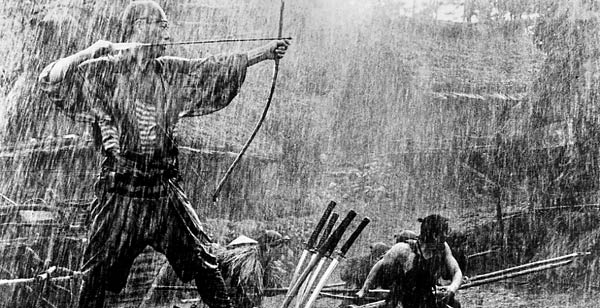
Not many of us non-Japanese realize that the nickname "The Emperor" was not meant as a compliment. Kurosawa was criticized for being a perfectionist, for always trying to gethis own way all the time on the tiniest of details. He reportedly had an entire medieval set rebuilt for Throne of Blood (1957) because a nail head was partially visible in one shot; he had expert archers shoot real arrows at Toshiro Mifune for the same film's climax, a scene re-created with bullets instead of arrows in Brian De Palma's Scarface (1983); he is famous for making his cast and crew wait weeks to capture on film the perfect cloud formation.

Kurosawa was also criticized for his extravagant budgets and old-fashioned sensibility--by the '60s Japanese cinema had seen the arrival of young mavericks like Nagisa Oshima, Shohei Imamura, Hiroshi Teshigahara, and Seijun Suzuki among others, and while his Red Beard (1965) was a big hit, its overt moralism was already seen as dated, its director out-of-touch with the distinctly younger, more radical, less ethically obsessed moviegoers.

That would be the last money-maker Kurosawa would direct for decades. He made a recovery of sorts with Kagemusha (1980) and Ran (1985) but it's really with his films of the late '40s and '50s that his reputation rests--and what films! Kurosawa is possibly the easiest of great directors to love--his action films are filled with breathtaking movement and whirling violence, his dramas are intensely felt collisions of outrage, grief, despair. His camera is rarely static, and he will often cut only at the last minute, to capture as much of the motion as possible. When he does cut, it's often to expressive effect: to punctuate a moment, fragment a movement (doing the opposite of his long tracking shots), or piece together a giddy concatenation of images--in Seven Samurai (1954) when the alarm is sounded, the warriors run out to defend the village, and Kurosawa gives us seven brief shots of each warrior in quick succession. The gesture does little to advance the narrative, but the moment--a sort of salute to each as he rushes out to possibly die in battle--never fails to quicken one's pulse.

If I wanted to be facetious, I'd say Kurosawa was the precursor to Hollywood's James Cameron--both made big-budgeted productions, both had a dictatorial directing style, both liked to create elaborately shot and edited action sequences. Unlike Cameron Kurosawa knows how to cut coherently, to maintain spatial clarity--in Seven Samurai you always knew where you were in the village (thanks to Kurosawa's use of maps, spatially consistent shots, elaborate tours of the locations prior to battle). Unlike Cameron, when the cutting got hot and heavy Kurosawa always knew how to time the duration of a shot: short enough to eliminate fat and create urgency, long enough to inform the eye what's going on.

Moreover, Kurosawa's films were always about something--in Ikiru (1952) the meaning of a man's life in the world; in Rashomon (1950) the terrifying relativity of truth; in Yojimbo (1961) the bitter embrace of nihilism as the only valid response in a world gone mad. Cameron dabbles in relevance--Avatar is reportedly about the survival of indigenous natives and the preservation of the environment--but Cameron's message feels more like window dressing draped on expensive action sequences to give them dignity. With Kurosawa the action--and every other element in the picture including the acting, the intricate photography, the often massive production design, the at times magnificent weather--swirl and shudder and gather about to bow in total submission to his overarching theme. Said this before and I'll say it again: Cameron is basically Kurosawa after a Jarvik 7 implantation and prefrontal lobotomy.

I'd recommend watching every one of the films but if you can't I recommend watching the more difficult-to-find works--Sanshiro Sugata (1943) for one, his first directorial feature, which at first glance is Japanese propaganda thinly disguised as a judo sports film, on second glance reveals Kurosawa already exercising his muscular visual style (jump cuts, radical angles, expressive use of light, shadow, weather) to tell the story of a man's conquest not just of an external foe (staged in a raging windstorm) but of his inner self (staged in a still lotus pond at night). The Most Beautiful (1944) is Kurosawa doing his best with an imposed assignment--a patriotic propaganda piece about women working hard in an optics factory (Kurosawa turns it into an acting triumph for the workers, particularly Yoko Yaguchi, who eventually became his wife). Sanshiro Sugata 2 (1945) is the first of only two sequels in Kurosawa's career; here he pits Sanshiro against an American boxer, then against an opponent in heavy snow. They Who Tread on the Tiger's Tail (1945) is fascinating for its poverty-row production values (it was made at the end of the war, when Japan was short on every resource), its single set, and its director's use of that one set, shot mostly in long takes with Noh music and distinctive Noh acting style.

No Regrets for Our Youth (1947) should be seen for two reasons: to disprove the notion that Kurosawa is exclusively an action director, interested only in matters male and macho; and to view a Setsuko Hara you've never seen before--not the unfailingly cheerful daughter of Ozu films, but a passionate young woman determined to express her idealism and love for her politically active husband no matter what the cost. One Wonderful Sunday (1947)--well, not a big fan, but if you insist, sit and watch out for the uninhibited Peter Pan ending (Kurosawa is almost always intense and this can sometimes be a mixed blessing).

Of the better-known works--what more can one add to what has already been said, except to say Seven Samurai is war in a single massive volume, from inception to preparation to actual execution; Rashomon is the enigma of human existence wrapped in a mystery thriller; Yojimbo is the apocalypse achieved through fire and samurai blade, and Ikiru is the single clearest expression of Kurosawa's personal philosophy--Dostoevsky neat, no chaser (though if you want Dostoevsky done literally, as a straight adaptation, you should seek out his much underrated The Idiot (1951), with a jaw-dropping performance (again) from Setsuko Hara).
I won't even bother to tell you to enjoy yourself; that's a given. This is a feast beyond anything you're likely to see this year, a festival of pleasures that can only end in disappointment once the last screening is done and gone, and you're left with a lost weekend of a hangover. So what are you waiting for?

Claude Chabrol, 1930 - 2010 

A little something I wrote about one of his late films:

Claude Chabrol's La fille coupee en deux (A Girl Cut in Two, 2007) invites, as usual, comparisons to Hitchcock, but from where I'm sitting the most distinctive quality the two share, at least at this stage in Chabrol's career, is elegance in storytelling, elegance in all elements of storytelling, from characterization to dialogue to mis-en-scene to soundtrack (the opening credits roll to the strains of Puccini's Turandot, the plot of which suggests interesting sidelights to the plot of Chabrol's film). Even the title works overtime to raise questions in the viewer's mind--just why is the eponymous girl (local TV weather girl Gabrielle, played by Ludivine Sagnier) cut in two? Because she's of two minds? Because she's desired by two men? Because a whirling blade literally cuts her in half?

One often thinks when thinking of Hitchcock of visual challenges solved with brilliantly, sometimes breathtakingly elegant solutions (the problems of confined space in Lifeboat or Rope or Rear Window; of a shower-stall murder in Psycho; of wide-open spaces and sustaining tension through a cross-country odyssey in North by Northwest). Chabrol in this case solves one kind of challenge: the suggestion of perverse sexual appetites with the least amount of fuss (a head sinks below a table; a girl crawls on all fours in shadow; a private club is visited, and one member asks another a pointed question: "does she know what goes on here?").The story is loosely based on the killing of architect Stanford White by Harry K. Thaw, for a long-ago affair White had with Thaw's wife Evelyn Nesbit, updated with a bit of class rivalry.

Central to the film is the mystery of Gabrielle: is she corrupted innocent or cruel sadist? Middle-class victim or social-climbing instigator? In Turandot, the two main female characters are the eponymous princess and the slave girl, Liu, and Gabrielle seems to embody qualities of both women--she is by turns loyal and loving to her elderly lover, cruel and distant to her young husband. By combining the two in one woman, does Chabrol make his heroine more or less convincing, more or less complex--both, maybe? Sagnier plays her as a cool blonde in the best Hitchcockian tradition (I have to take back I suppose what I said earlier about Chabrol's resemblance or lack of to Hitchcock). Towards the end she's revealed as more innocent and less guileful than she seems--or is she instead completely at the mercy of her own inner demons? She's the lure, the McGuffin, the enigma that draws both men--and herself--to their irrevocably entangled dooms.


.