Showing posts with label Akira Kurosawa. Show all posts

Monday, August 04, 2025

Ran (Akira Kurosawa, 1985)


Burning down the house

Been years since I saw Akira Kurosawa's Ran (1985) and decades since I saw it projected (an unimpressive 16 mm print in an improvised theater). Watching the 2016 4K UHD restoration on the big screen forty years after its premiere is like watching a storm surge approach shore: you're confronted with an unstoppable wall stretching from end to end, and you're not sure whether to run (where to?) or fall on your knees in worship. 

And then you realize, after so many viewings, like a shock of saltwater to the face: damn, but this film is funny.

Thursday, January 16, 2025

High and Low (Akira Kurosawa, 1963)


Heaven and hell

Akira Kurosawa's High and Low (1963) may not be on the level of Seven Samurai but it is a great crime thriller, perhaps one of the greatest.

Thursday, September 20, 2018

I Live in Fear (Akira Kurosawa), Europa '51 (Roberto Rossellini)

The impossible dream

(Warning: narrative details and plot twists explicitly discussed) 

Fantasy double feature: Akira Kurosawa's I Live in Fear (1955) and Roberto Rossellini's Europa '51 (1952) both ask the question: how should we deal with the man who holds extreme views on life? Humor him or condemn him? Or--unsettling thought--listen to what he has to say?

Wednesday, November 25, 2015

Hakuchi (The Idiot, Akira Kurosawa, 1951)

In tribute to Setsuko Hara 1920 - 2015

Forgotten masterpiece

Akira Kurosawa's 1951 film Hakuchi (The Idiot), his adaptation of Dostoevsky's novel, is pretty much forgotten now, or is rarely mentioned when talking about the filmmaker or his masterworks. The work is seriously flawed--about a hundred minutes were chopped off before the film was released, and you can see Kurosawa trying to make up for this with lengthy expository titles and voiceover narrations, trying to explain the characters' complex relationships in a few minutes of screen time. Critics who do get past the rushed, awkward beginning note the film's literalness, its director's apparent need to get as much of the novel as possible up on the big screen.

Sunday, May 06, 2012

Django (Sergio Corbucci, 1966)

The flick that fathered a hundred sequels

Sergio Corbucci's Django (1966) might be called the bastard son of a bastard remake of a bastard parody. 

Arguably it was Sergio Leone's fault. He did not strictly speaking make the first Spaghetti Western (or as Italians call them western all'italiana)--Raoul Walsh did The Sheriff of the Fractured Jaw in 1958; Mario Amendola did Terrore dell'Oklahoma (The Terror of Oklahoma) in 1959; and you might say Puccini's 1910 opera La Fanciulla del West (Girl of the West) was an Italian production set in the California Gold Rush...

But--trying to stay on-topic here--Leone's A Fistful of Dollars (1964) took Akira Kurosawa's jidai-geki samurai comedy Yojimbo (The Bodyguard, 1961), transposed it to the American West, and produced a hugely influential hit that turned genre conventions upside-down, morphed the noble white-hatted protagonist into a dark, cigarillo-chewing anti-hero, basically created a whole new mythology for a bastard new genre.

Which is doubly ironic--Yojimbo itself was a parody, Kurosawa's subversion of the chambara (or swordfighting, a subset of the jidai-geki) genre, his way of sending up ossified conventions that he himself helped establish (Of course Yojimbo would became a hit and revitalize the genre, spawning its own sub-genre with countless imitators). Adding just one more twist is the fact that Kurosawa himself was heavily influenced by classic western filmmakers--John Ford, Howard Hawks--and all we need to complete the circle is a Japanese ripoff of A Fistful of Dollars or Django (arguably Takashi Miike's Sukiyaki Western Django (2007) is just such a picture)...

Coming back to Django (and trying, again, to stay on-topic), Corbucci's film doesn't even try very hard to disguise its influences--as with Yojimbo and Fistful we have the lone hero; as with the previous pictures the hero comes between two warring factions (the Mexican bandits and a troop of renegade Confederates (needless to say, they're racists)). Corbucci does away with the cyclical nature of violence, the vision of man outdoing fellow man in greed and depravity--he probably felt the two previous pictures wasted a lot of running time and effort keeping the complicated plotline coherent, and damned if he wasn't right: Django lives or dies on its extravagant setpieces of sadism and suffering and little else (there's a subtext involving racism, a topic Corbucci would develop further in other films, particularly Navajo Joe (1966), but it's more subtext here--an additional sharpness to the stink in the air, almost--than anything bold, or especially memorable).

Corbucci's visual style unlike Leone's doesn't try capture the action through sweeping tracking shots, nor does he try create a sense of outsized scale (the vast barrooms, endless cemeteries, gigantic closeups of Leone's films). Corbucci's action is mostly fast and functional, stitched together with quick (but coherent) cutting; when Django faces off with a bandit Corbucci intercuts handheld, high-angled footage of the two struggling with even shakier footage of the breathless onlookers, giving the viewer a strong sense of you-are-there immediacy. 

When called for, however, Corbucci can serve up cinema as grand and operatic as anything from Leone. He introduces one confrontation with the sparely beautiful image of standing fences and a spindly water tower, a lonely flute playing in the background; renegade Confederates strut into view and Luis Enriquez Bacalav's baleful trumpets take over, a snare drum giving crisp accompaniment. 

Corbucci (unlike, say Leone) doesn't have his camera track backwards, following the soldiers; instead he shows us Django's patient point of view, angular rail fences pointing as if in alarm at the approaching soldiers, the reverse shots showing Django's doomed position, perched atop his coffin behind a gigantic felled tree trunk (remarkable the contrast in imagery--the soldiers' unstoppable approach, the tree trunk's implacable solidity). More soldiers appear, wearing Klansmen-type hoods, only (a baroque touch) dyed a bright blood-red. Django continues to sit on his coffin behind the tree trunk; the music, the editing, the emotions escalate to the point where the very frame vibrates with tension--you know the climax when it comes will be something...

It comes, and it is something; it's also the punchline to a long and elaborate joke, one that began preparations from the moment we set eyes on our hero. Here's another difference between Leone and Corbucci: Leone's Man Without a Name (played with lanky minimalism by Clint Eastwood) shows a trace of faint amusement at Leone's complex shenanigans; said Man embodies Leone's point of view, an Olympian sense of distance flavored with irony. Corbucci's Django (played with soulful earnestness by Franco Nero) isn't nearly as interesting a character--he's totally immersed in his situation, no distance or irony to his posture, a classic western all'italiana hero. If there is any humor in the film--and there is, considerably--it comes from Corbucci himself, who gleefully sets up intricate visual and narrative pranks which detonate, then with ceaseless enthusiasm begins preparations for the next gag. 

I'd earlier said there's little more to Corbucci here than sadism; I'm not a little wrong. Hands are a significant motif, from a bandit spitting into his hands preparatory to whipping a helpless prostitute, to a Confederate major pulling a blood-red scarf from his pocket to wrap round the neck, to Django tenderly slipping a woman's camisole off her shoulder...later clutching desperately at his coffin, and being as desperately clutched in return. Hands, Corbucci seems to say, are arbiters of one's fate and expressive of one's inner state; to damage them is a grave sin, to have them damaged a great suffering.

So, Corbucci or Leone--who is better? Leone is an epic lyricist, Corbucci a baroque sadist; Leone likes to build complex narratives that resolve themselves smoothly, in ingenious fashion; Corbucci can barely be bothered with narrative bumps (he can't even be bothered to hide the fact that his narrative was lifted from somewhere else). Leone is a poet, Corbucci a near-madman; the world is a richer place for having both artists, and I for one refuse to pick between them. 

5.5.12

Saturday, September 18, 2010

Two Directors: Akira Kurosawa Festival (Sept. 15 - 30, CCP and UP Film Center) and Claude Chabrol, 1930 - 2010


Starting this week at the Cultural Center of the Philippines (CCP) Dream Theater and continuing from September 22 onwards in the University of the Philippines (UP) Film Institute is a massive retrospective on the Emperor of Japanese Cinema, Akira Kurosawa--twenty-one of his thirty feature films, on the occasion of his 100th birth anniversary, the only such festival to be held in Southeast Asia.

Not many of us non-Japanese realize that the nickname "The Emperor" was not meant as a compliment. Kurosawa was criticized for being a perfectionist, for always trying to gethis own way all the time on the tiniest of details. He reportedly had an entire medieval set rebuilt for Throne of Blood (1957) because a nail head was partially visible in one shot; he had expert archers shoot real arrows at Toshiro Mifune for the same film's climax, a scene re-created with bullets instead of arrows in Brian De Palma's Scarface (1983); he is famous for making his cast and crew wait weeks to capture on film the perfect cloud formation.

Kurosawa was also criticized for his extravagant budgets and old-fashioned sensibility--by the '60s Japanese cinema had seen the arrival of young mavericks like Nagisa Oshima, Shohei Imamura, Hiroshi Teshigahara, and Seijun Suzuki among others, and while his Red Beard (1965) was a big hit, its overt moralism was already seen as dated, its director out-of-touch with the distinctly younger, more radical, less ethically obsessed moviegoers.

That would be the last money-maker Kurosawa would direct for decades. He made a recovery of sorts with Kagemusha (1980) and Ran (1985) but it's really with his films of the late '40s and '50s that his reputation rests--and what films! Kurosawa is possibly the easiest of great directors to love--his action films are filled with breathtaking movement and whirling violence, his dramas are intensely felt collisions of outrage, grief, despair. His camera is rarely static, and he will often cut only at the last minute, to capture as much of the motion as possible. When he does cut, it's often to expressive effect: to punctuate a moment, fragment a movement (doing the opposite of his long tracking shots), or piece together a giddy concatenation of images--in Seven Samurai (1954) when the alarm is sounded, the warriors run out to defend the village, and Kurosawa gives us seven brief shots of each warrior in quick succession. The gesture does little to advance the narrative, but the moment--a sort of salute to each as he rushes out to possibly die in battle--never fails to quicken one's pulse.

If I wanted to be facetious, I'd say Kurosawa was the precursor to Hollywood's James Cameron--both made big-budgeted productions, both had a dictatorial directing style, both liked to create elaborately shot and edited action sequences. Unlike Cameron Kurosawa knows how to cut coherently, to maintain spatial clarity--in Seven Samurai you always knew where you were in the village (thanks to Kurosawa's use of maps, spatially consistent shots, elaborate tours of the locations prior to battle). Unlike Cameron, when the cutting got hot and heavy Kurosawa always knew how to time the duration of a shot: short enough to eliminate fat and create urgency, long enough to inform the eye what's going on.

Moreover, Kurosawa's films were always about something--in Ikiru (1952) the meaning of a man's life in the world; in Rashomon (1950) the terrifying relativity of truth; in Yojimbo (1961) the bitter embrace of nihilism as the only valid response in a world gone mad. Cameron dabbles in relevance--Avatar is reportedly about the survival of indigenous natives and the preservation of the environment--but Cameron's message feels more like window dressing draped on expensive action sequences to give them dignity. With Kurosawa the action--and every other element in the picture including the acting, the intricate photography, the often massive production design, the at times magnificent weather--swirl and shudder and gather about to bow in total submission to his overarching theme. Said this before and I'll say it again: Cameron is basically Kurosawa after a Jarvik 7 implantation and prefrontal lobotomy.

I'd recommend watching every one of the films but if you can't I recommend watching the more difficult-to-find works--Sanshiro Sugata (1943) for one, his first directorial feature, which at first glance is Japanese propaganda thinly disguised as a judo sports film, on second glance reveals Kurosawa already exercising his muscular visual style (jump cuts, radical angles, expressive use of light, shadow, weather) to tell the story of a man's conquest not just of an external foe (staged in a raging windstorm) but of his inner self (staged in a still lotus pond at night). The Most Beautiful (1944) is Kurosawa doing his best with an imposed assignment--a patriotic propaganda piece about women working hard in an optics factory (Kurosawa turns it into an acting triumph for the workers, particularly Yoko Yaguchi, who eventually became his wife). Sanshiro Sugata 2 (1945) is the first of only two sequels in Kurosawa's career; here he pits Sanshiro against an American boxer, then against an opponent in heavy snow. They Who Tread on the Tiger's Tail (1945) is fascinating for its poverty-row production values (it was made at the end of the war, when Japan was short on every resource), its single set, and its director's use of that one set, shot mostly in long takes with Noh music and distinctive Noh acting style.

No Regrets for Our Youth (1947) should be seen for two reasons: to disprove the notion that Kurosawa is exclusively an action director, interested only in matters male and macho; and to view a Setsuko Hara you've never seen before--not the unfailingly cheerful daughter of Ozu films, but a passionate young woman determined to express her idealism and love for her politically active husband no matter what the cost. One Wonderful Sunday (1947)--well, not a big fan, but if you insist, sit and watch out for the uninhibited Peter Pan ending (Kurosawa is almost always intense and this can sometimes be a mixed blessing).

Of the better-known works--what more can one add to what has already been said, except to say Seven Samurai is war in a single massive volume, from inception to preparation to actual execution; Rashomon is the enigma of human existence wrapped in a mystery thriller; Yojimbo is the apocalypse achieved through fire and samurai blade, and Ikiru is the single clearest expression of Kurosawa's personal philosophy--Dostoevsky neat, no chaser (though if you want Dostoevsky done literally, as a straight adaptation, you should seek out his much underrated The Idiot (1951), with a jaw-dropping performance (again) from Setsuko Hara).
I won't even bother to tell you to enjoy yourself; that's a given. This is a feast beyond anything you're likely to see this year, a festival of pleasures that can only end in disappointment once the last screening is done and gone, and you're left with a lost weekend of a hangover. So what are you waiting for?

Claude Chabrol, 1930 - 2010 

A little something I wrote about one of his late films:

Claude Chabrol's La fille coupee en deux (A Girl Cut in Two, 2007) invites, as usual, comparisons to Hitchcock, but from where I'm sitting the most distinctive quality the two share, at least at this stage in Chabrol's career, is elegance in storytelling, elegance in all elements of storytelling, from characterization to dialogue to mis-en-scene to soundtrack (the opening credits roll to the strains of Puccini's Turandot, the plot of which suggests interesting sidelights to the plot of Chabrol's film). Even the title works overtime to raise questions in the viewer's mind--just why is the eponymous girl (local TV weather girl Gabrielle, played by Ludivine Sagnier) cut in two? Because she's of two minds? Because she's desired by two men? Because a whirling blade literally cuts her in half?

One often thinks when thinking of Hitchcock of visual challenges solved with brilliantly, sometimes breathtakingly elegant solutions (the problems of confined space in Lifeboat or Rope or Rear Window; of a shower-stall murder in Psycho; of wide-open spaces and sustaining tension through a cross-country odyssey in North by Northwest). Chabrol in this case solves one kind of challenge: the suggestion of perverse sexual appetites with the least amount of fuss (a head sinks below a table; a girl crawls on all fours in shadow; a private club is visited, and one member asks another a pointed question: "does she know what goes on here?").The story is loosely based on the killing of architect Stanford White by Harry K. Thaw, for a long-ago affair White had with Thaw's wife Evelyn Nesbit, updated with a bit of class rivalry.

Central to the film is the mystery of Gabrielle: is she corrupted innocent or cruel sadist? Middle-class victim or social-climbing instigator? In Turandot, the two main female characters are the eponymous princess and the slave girl, Liu, and Gabrielle seems to embody qualities of both women--she is by turns loyal and loving to her elderly lover, cruel and distant to her young husband. By combining the two in one woman, does Chabrol make his heroine more or less convincing, more or less complex--both, maybe? Sagnier plays her as a cool blonde in the best Hitchcockian tradition (I have to take back I suppose what I said earlier about Chabrol's resemblance or lack of to Hitchcock). Towards the end she's revealed as more innocent and less guileful than she seems--or is she instead completely at the mercy of her own inner demons? She's the lure, the McGuffin, the enigma that draws both men--and herself--to their irrevocably entangled dooms.


. 

Friday, November 16, 2007

Yojimbo (Akira Kurosawa, 1961); Ikiru (Akira Kurosawa, 1952)

(Yet another contribution to filmsquish's Kurosawathon)

Yojimbo (1961)—about a wandering super-samurai (the late Toshiro Mifune) who cleans up a lawless town—is supposed to be Kurosawa’s comic masterpiece, but it’s easy to overlook that fact. The film is overwhelmingly grim, dealing as it does with violence, murder, and wholesale genocide. In the opening sequences, Kurosawa swiftly establishes a mood of threat and sudden danger—a dog walks by with a human hand in its jaws; minutes later someone’s entire forearm is chopped off, and presumably the same dog will carry away the even bigger trophy. The only clues Kurosawa allows in the picture suggesting that the whole thing is really a comedy are the bouncy, sardonic music and the editing, the kind of precisely timed cutting you find in slapstick, or in great silent comedy.

Thursday, December 28, 2006

Shichinin no samurai (Seven Samurai, Akira Kurosawa, 1954)


From Forum with No Name:

Sitting down to a three hour-plus Japanese film with a ten and six year old is actually not impossible, particularly when said film is directed by Akira Kurosawa.

They loved it, of course. They loved the introduction of Kambei (Takashi Shimura) shaving his head in preparation for his daring rescue of the child (this may have been the point where they really got hooked, I think); they loved the antics of Kikuchiyo (Toshiro Mifune, their hands-down favorite); they even loved Katsushiro (Isao Kimura) and his relative cluelessness.

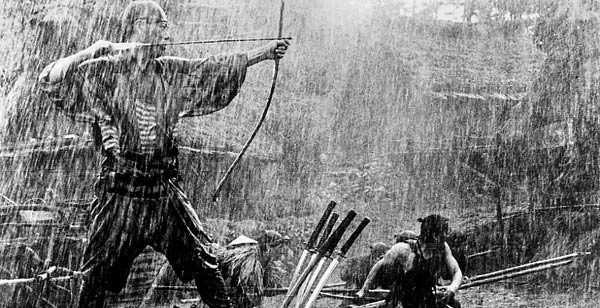
They loved it that through maps, a quick reconaissance tour, and careful organization of shots (cut together so that the movement from one location to another or vice versa is always consistent) they come to know the layout of the entire village--the field of conflict, in effect. They loved it that the action sequences are clear and coherent (my six-year-old walked out of The Descent because, as he put it "they keep cutting and shaking the camera, and I'm getting dizzy"). They love it that Kurosawa as much as was possible didn't cheat--one bandit (as I pointed out) was really struck in the chest by an arrow (shot by an expert archer into a wooden plank the actor wore under his armor (Kurosawa wouldn't go so far as to actually kill his actors, I had to explain)); Kyuzo really swings his sword with masterful skill (a skill all the more impressive since (I pointed out to their amazement) before this film the actor, Seiji Miyaguchi, had never picked up a sword in his life).

It was a pleasure watching two kids experiencing the pleasure of watching a master filmmaker at his best. They laughed when he wanted them to laugh, oohed when he wanted them to ooh, sat sombre when he wanted to show them something sombre. When the movie was finished, they shook their heads; they couldn't believe they just saw a three-hour Japanese film.