Showing posts with label Rico Ilarde. Show all posts

Friday, October 30, 2015

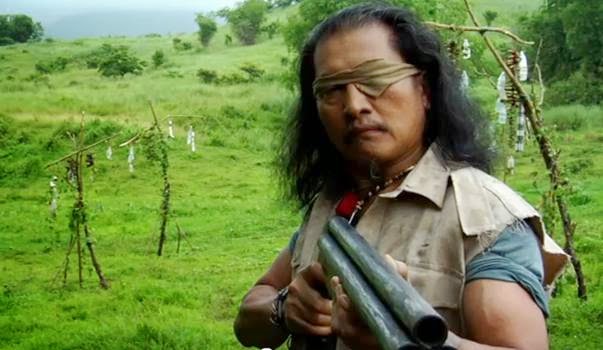
Altar (Rico Ilarde, 2007)


Human sacrifice

Rico Maria Ilarde's an odd creature of a filmmaker. From Z-Man (1988), his comic-book no-budget independent-action-flick take on Ridley Scott's Blade Runner, to Dugo ng Birhen (Blood of the Virgin, 1999), his fantasy throwdown between zombies and Taekwondo champion Monsour del Rosario, to Babaing Putik (Woman of Mud, 2000), his unholy mutant union between Brian de Palma's Carrie and John McTiernan's Predator, to Sa Ilalim ng Cogon (Under the Cogon Grass, 2005), his lyrically spare reinterpretation of H.G. Wells' classic novel The Island of Dr. Moreau (grass; silence; monster), Ilarde (son of Filipino radio and TV personality Eddie Ilarde) mixes and matches genres and movies till the films feel as disorienting (and disoriented) as he himself must at times feel, his narrative spinning and hurtling in many directions at once.


Friday, October 24, 2014

Pridyider (Rico Maria Ilarde, 2012)


Chilling me softly

Let's settle one thing: this is not Ishmael Bernal's Pridyider, the master filmmaker's memorable contribution to Regal's monstrously successful horror anthology franchise Shake, Rattle 'n Roll (1984)--thirteen sequels and counting (they seem to propagate like the undead), its fifteenth incarnation to haunt movie screens this coming Christmas. Bernal's film was a throwaway, a trifle concocted with veteran screenwriter/bank officer Amado Lacuesta to, y'know, entertain the kiddies, so they came up with the nuttiest premise possible: a killer fridge that swallows its prey whole.

And yet for all its disposable qualities it's solidly (if implausibly) built, its chrome trimmings gleaming under the kitchen flourescents with flashes of genuine wit. A cabbage head in a sink turns into a severed head; a household maiden yanks open the icebox door and cools herself in its lusty exhalations (talk about sensual and chilling at the same time). Does any of it mean anything? Probably not (well, maybe a sharp jab at Filipino consumerism), but sophisticated humor is so rare in Filipino films, sexy sophisticated humor even more rare, and sexy sophisticated horror-comedy rarest of all one is more than willing to forgive this short's weaknesses, its very improbability. It's like a snowball in hell--shouldn't be there, shouldn't last, but there it remains, defying all expectations with the stubborn fact of its existence. 


Which is why when the announcement was made back in 2012 that Bernal's minor gem of a classic was to be remade into a full-length feature by young-punk horror filmmaker Rico Ilarde I wondered; I had my doubts. But Ilarde is another kind of throwaway improbability--an '80s film brat who suckled on the milk of Steven Spielberg and John Carpenter and Walter Hill, but works with the primitive sets and limited resources of a Filipino film studio, sometimes less (a significant portion of his output being no-budget independent digital features). His films have an arthouse cunning sprouting out of a pop-culture sensibility, are often a chimeran combination of various genres--comedy, romance, action, science fiction, fantasy, horror. Behind the bewildering facade are indie filmmaking smarts (creating action sequences and special effects practically out of spit and shoestring and off-the-shelf digital software) and behind that I submit is a kind of Spanish-Filipino mindset that (for one) tends to pit mestizo heroes against ancient (read: colonial/mythological/authoritarian) evils.

Only for this project the hero is not mestizo but mestiza--Andi Eigenmann (daughter of the late great Mark Gil) as Tina, a beautiful balikbayan returning to her family home after an absence of years, trying to learn more about the mysterious traumatic event that vanished her parents and sent her to the United States to stay with her aunt. 

Ilarde complicates Bernal and Lacuesta's elegant setup, of predatory fridge claiming lovely lass' unwary bod. Here the lass still (unwittingly) offers her bod, but the spirit possessing the fridge is less predatory than it is jealous, setting up a crosscurrent of psychosexual drama streaming from that long-ago traumatic event (Ilarde in his recent scripts often locates the source of emotion in his horrors either in ancient family histories or long-ago personal tragedies, the memory of which is constantly being repressed). In this particular case possessive mother (Janice de Belen) and inquisitive daughter find themselves vying for the love of a melancholic father (Joel Torre)--shades of Mario O'Hara's Halimaw sa Banga, another horror psychodrama where the daughter-and-mother (stepmother, actually) rivalry erupts with supernatural fury. 


Interesting direction to go, not entirely successful (Ilarde's most effective, most moving work for me remains his claustrophobic / romantic / comic / tragic / horrific genre-bender Altar (2008)) but Ilarde piles on the improbabilities with prodigious enthusiasm, from a shamelessly endearing meet-cute between young lovers (Eigenmann's Tina with her childhood friend-turned-police officer James (JM De Guzman), to a series of disappearances punctuated by the fridge door swinging open to reveal the victims' heads screaming in obvious discomfort, to a scuttling spidercrab creature that seems to have wandered in from the set of John Carpenter's The Thing, to hentai-sized tentacles shooting out of either side of the fridge (the better to snarl you up with, my dear!). Ilarde's apparently a firm believer in that old adage: "if it's worth doing it's worth overdoing, oversplattering, overwrapping in slimy tentacles." There's something refreshingly retro--antediluvian, almost--about the filmmaker's faith in the genres he's so gleefully combining and recombining, a mad scientist playing with his mail-order gene-splicing set.

By the time Ilarde shows us the depths of depravity and despair festering within the appliance (said depths a metaphor for the complexity of the human heart--oh, the wonderful literalness of horror movies!) we've long since checked our sense of credulity at the fridge door and are free to wander about, have a disturbingly good time.  I'll say this much, though: Ms. Eigenmann is perfectly welcome to yank my icebox door open anytime, bask in the gusty exhalations of my admiration. Oh yeah.

First published in Businessworld, 10.16.14
 

Monday, October 11, 2010

Z-Man on Senses of Cinema!


My more or less comprehensive article on Rico Ilarde (I hadn't been able to catch Villa Estrella (2009) at the time of this writing, unfortunately) is on Senses of Cinema:

Z Man, or: how do you solve a problem like Rico Ilarde (A horror filmmaker? An indie artist? Pinoy?)?

Excerpt:

Rico Ilarde is that strange, strange creature, the filmmaker that flits in and out of both independent and mainstream studio system with apparent ease. He is not your classic idea of the “indie” or “art-house” filmmakerwhen critics or journalists write about him, he’s usually characterized as a “horror / fantasy” director, with elements borrowed from the martial arts / action genre.
 
He has worked as an independent filmmaker in one sensehe has directed at least three features (his first, and his two latest) without the resources of a mainstream Filipino film studio behind him. One is tempted to ask, is Ilarde a true Filipino independent filmmakermeaning, I suppose, do his films embody the spirit of Filipino independent filmmaking? Are his films Filipino in the first place? Art, perhaps? What is an independent film, a Filipino film, an art film, and how do we distinguish from the various categories involved?

.

Sunday, April 11, 2010

Altar vs. Avatar


Altar vs. Avatar

At first blush the two pictures couldn't be more different--one is a gigantic Hollywood production with a quarter of a billion dollar budget and fifteen-year development period (two months of which were devoted to live-action photography); the second is a tiny independent production with a thirty thousand dollar budget (barely enough to cover the cost of laundering the former's dirty underwear), two months pre-production period and eight days to actually shoot the movie.

Thursday, February 12, 2009

Hungry ghosts in Rotterdam

Shinya Tsukamoto's Nightmare Detective 2


I had already mentioned about writing for the 'Hungry Ghosts' program in Rotterdam. Well, here's the actual article, nicely done with all the photos and gewgaws and what-have-you.

(For the record, the latter link is what I wrote for Rotterdam, the former my own opinion about the films I saw)

Excerpt:

It's easier, I think, to enjoy Asian horror in its multivaried forms than to explain why one enjoys it, or why it's perceived to be generally better than the Hollywood kind. Is it that Asians have a more profound, more widespread belief in the supernatural? Is it that their many cultures are more open to matters mythological, irrational, metaphysical?

One thing I learned while writing a piece for a film magazine that had asked critics and writers to sum up their thoughts about Asian cinema, is that the cinema is basically impossible to summate. Too many cultures, with too much history behind them, expressing their passion and skepticism and terror in too many ways. Do Asians have a stronger belief in ghosts? Yes, but they at times show an equally strong rationalism, a belief that there are other things to worry about besides phantoms (see Joko Anwar's impressive "Pintu Terlarang" (Forbidden Door, 2009)). Is Asian culture more open to the supernatural? Yes, at the same time it's equally open to technological change (observe the swift rise of digital filmmaking in the region in recent years) and our complexly ambivalent response to them (see, among others, Hideo Nakata's "Ringu" (Ring, 1998), Kurosawa Kiyoshi's "Kairo" (Pulse, 2001), Takashi Miike's "Chakushin ari" (One Missed Call, 2003), Masayuki Ochiai's "Shutter" (2008) (funny you can't help but notice most of these tech horrors are Japanese). Are Asian horror films better than Hollywood? Yes, usually--with the qualifier that many of these Asian films are often inspired by or take off from or are clever variations of their Hollywood equivalents (both a good and bad thing, I think). When it comes to writing about Asian horror, much less Asian cinema in general, one is well advised not to attempt too many generalization--chances are there'll be a handful of films somewhere, sometime, that will prove you wrong.


Sa Ilalim ng Cogon (Rico Ilarde)