Showing posts with label Hong Kong. Show all posts

Thursday, June 05, 2025

Mission Impossible 2 (John Woo, 2000), Rosetta (the Dardennes, 1999)


Midget Impossible

Movie begins with Cruise climbing an impossibly sheer cliff. He slips; he recovers; he hangs ten several thousand feet off the ground. This being a John Woo film, credibility is not a very big issue, but “cool” is--as it turns out, the entire elaborate rock-climbing sequence was staged just so Cruise can rendezvous with a pair of telecommunicating Ray-Bans, shot at him via rocket launcher from a hovering helicopter. The shades instruct Cruise on what he is to do for the next two hours…which, come to think of it, pretty much sums up how Cruise has handled his acting career to date.

Friday, March 01, 2024

David Bordwell (1947 - 2024)

David Bordwell (1947 - 2024)

I remember him in the Hong Kong Film Festival, always at his preferred spot: first row, at the exact center, the screen filling his eyes.
I remember talking to him in between screenings, and on the ferry between Hong Kong and Kowloon: when I mentioned that 30s Hollywood films lost their visual dexterity thanks to the advent of sound he took exception; turns out he was right because he's seen practically every film ever made, or at least more than I ever did.

And while I'm trying to catch the latest and hottest films he's running off to some far-flung theater to catch the screening of a rare Hong Kong or Chinese film I've never heard of. If I was smart I'd have been trailing him.

I remember writing about his book Planet Hong Kong and having fun not just reading it but writing about it.

I still read his blog, an encyclopedic and authoritative resource for detailed analysis on everything from The Dark Knight (he hated it) to Hou Hsiaou Hsien (loved him) to Hunt for Red October (loved it).
I remember helping him access a few Filipino films, and him sending me in turn a copy of his book Poetics of Cinema. He was wonderful company, and an amazing (and amazingly thorough) film writer

Monday, December 04, 2023

Silent Night (John Woo, 2023)

When you have to shoot shoot, don't talk 

John Woo's latest brings to mind Norma Desmond's immortal lines: "There was a time when I had the eyes of the whole world. But that wasn't good enough for them O no-- they had to have the ears of the whole world too. So they opened their big mouths and out came talk talk talk...

"You'll make a rope of words and strangle this business. With a microphone to catch the last gurgles and Technicolor to photograph the red swollen tongue."

Thursday, August 26, 2021

In the Mood for Love (Wong Kar-wai, 2000)


In the Mode for Love

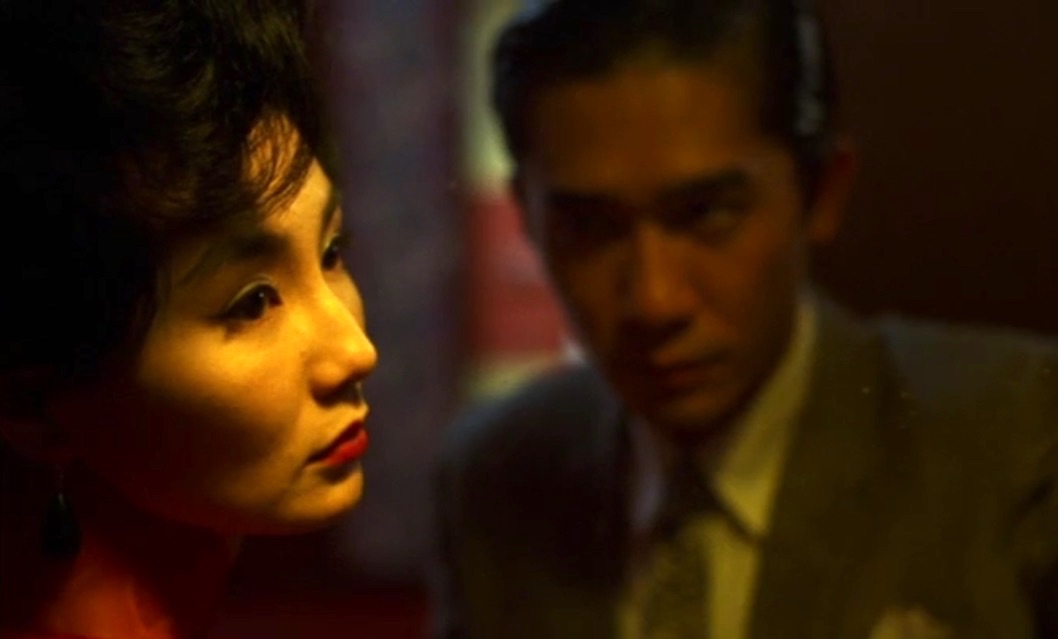
In Wong Kar Wai's latest In the Mood for Love Tony Leung plays Mr. Chow, Maggie Cheung plays Mrs. Chan. He's a newspaper reporter; she's a secretary. They're both married and suspect their respective spouses are having affairs; it's when they learn that Mrs. Chow is having an affair with Mr. Chan that their eyes finally turn to each other, in mutual hurt and longingA neat premise, neat enough to make you sit up and want to know what happens next. 

Thursday, September 13, 2018

Don't Go Breaking My Heart (Johnnie To, Wai Ka-fai)


Crazy Rich A**hole

If we're talking lighthearted romantic fare involving insanely prosperous Asians I don't see why we need to go all the way to Hollywood when Hong Kong has been doing fine for years. 

Thursday, September 06, 2018

Loving You (Mou mei san tamm, Johnnie To, 1995)

Bullet in the head

Back in the mid-90s found myself hooked on a particularly intense habit: Johnnie To movies. I'd seen A Hero Never Dies and The Barefoot Kid (his one period martial-arts film) had been digging through various DVDs ever since, hoping to find more. 

Found this: Loving You (Mou mei san taam, 1995) what To considers his first real directing job (he'd made his first feature in 1980; by the time he did this he had some sixteen films under his belt). A crime flick with an inordinate focus on a failing marriage, a marriage melodrama with a terrifically tense confrontation thirty minutes in--I mean how would you handle being pinned in an alleyway by a villain on a fire escape, gun pointed down at you? He'd already fired a shot at your head and in the confusion the bullet had somehow missed its mark. Then your nose starts bleeding. 

Thursday, June 21, 2018

Manhunt (John Woo); Three (Johnnie To); Sky on Fire, Wild City (Ringo Lam)

Four by three

Playing catchup: in the everchanging landscape of World Cinema, what happened to Hong Kong's 'heroic bloodshed' movement--those action filmmakers who featured slow motion, balletic action sequences, guns pointed at each others' faces? 

Thursday, September 26, 2013

The Grandmaster (Wong Kar Wai)

Once upon a time in China

Watching this one wants to ask: why would Wong Kar Wai want to do a film on Yip Kai-man (also known as Ip Man)--the famed martial-arts master who taught Wing Chun to Bruce Lee--in the first place? 

Thursday, February 12, 2009

Hungry ghosts in Rotterdam

Shinya Tsukamoto's Nightmare Detective 2


I had already mentioned about writing for the 'Hungry Ghosts' program in Rotterdam. Well, here's the actual article, nicely done with all the photos and gewgaws and what-have-you.

(For the record, the latter link is what I wrote for Rotterdam, the former my own opinion about the films I saw)

Excerpt:

It's easier, I think, to enjoy Asian horror in its multivaried forms than to explain why one enjoys it, or why it's perceived to be generally better than the Hollywood kind. Is it that Asians have a more profound, more widespread belief in the supernatural? Is it that their many cultures are more open to matters mythological, irrational, metaphysical?

One thing I learned while writing a piece for a film magazine that had asked critics and writers to sum up their thoughts about Asian cinema, is that the cinema is basically impossible to summate. Too many cultures, with too much history behind them, expressing their passion and skepticism and terror in too many ways. Do Asians have a stronger belief in ghosts? Yes, but they at times show an equally strong rationalism, a belief that there are other things to worry about besides phantoms (see Joko Anwar's impressive "Pintu Terlarang" (Forbidden Door, 2009)). Is Asian culture more open to the supernatural? Yes, at the same time it's equally open to technological change (observe the swift rise of digital filmmaking in the region in recent years) and our complexly ambivalent response to them (see, among others, Hideo Nakata's "Ringu" (Ring, 1998), Kurosawa Kiyoshi's "Kairo" (Pulse, 2001), Takashi Miike's "Chakushin ari" (One Missed Call, 2003), Masayuki Ochiai's "Shutter" (2008) (funny you can't help but notice most of these tech horrors are Japanese). Are Asian horror films better than Hollywood? Yes, usually--with the qualifier that many of these Asian films are often inspired by or take off from or are clever variations of their Hollywood equivalents (both a good and bad thing, I think). When it comes to writing about Asian horror, much less Asian cinema in general, one is well advised not to attempt too many generalization--chances are there'll be a handful of films somewhere, sometime, that will prove you wrong.


Sa Ilalim ng Cogon (Rico Ilarde)

Thursday, May 10, 2007

Jeonju 9: Artavazd Peleshian, Johnnie To's 'Exiled'


(Post re-edited, 9.10 am, 5/10/07)

Artavazd Peleshian's films mostly run not longer than ten to thirty minutes, the longest (Mer dare (Our Century, 1983)) going on for almost an hour. They're what he (describing his Vremena goda (The Four Seasons, 1975)) calls a "cardiogram of the national soul and character" of Armenia, his native land.

He's considered the inventor of distance montage--what that is, I'm not quite sure, though I've googled it a little. Judy Bloch, writing for the
Berkeley Art Museum/Pacific Film Archive, calls it a "counterpoint over time of images and sounds," claiming it creates "rhythms and moods his predecessors (Vertov, Eisenstein) never attempted." Gregory Pearse and Maria Wagner in cinemaseekers notes that he's often categorized as an "experimental documentary" filmmaker, but seem to subscribe more to fellow Armenian filmmaker Sergei Paradjanov's view that he's "one of the few authentic geniuses of cinema;" that his cinema--or the cinema he creates by means of distance montage--is really "built entirely on the intuitive association between the images." In short, "it utilizes the ability of the spirit to "understand" reality instead of the ability of the brain/intellect."

Asking Peleshian himself doesn't seem any more helpful; his answers are as maddeningly vague. "In Eisenstein every element means something. For me the individual fragments don't mean anything anymore. Only the whole film has the meaning."


Mm-hmm, yep, sure; now I get it. The JIFF catalogue describes it as "A piece of montage. There is no meaning of pieces; it has a full meaning only when each scene is put together," which seems to take off (however awkwardly) from what Peleshian himself is saying. So it's with this headful of confused and contradictory notions that I sat down (with Mr. Peleshian and his wife some rows behind me) to watch some of his films.

Obitateli (Inhabitants, 1970) intercuts footage of birds taking flight--thousands of them spreading their wings across the screen in such a woosh! of air you want to cover yourself--with huge closeups of caged animals (you catch glimpses of bars here, there), wet, dark eyes staring straight at the lens; the contrast between freed and incarcerated creatures is striking, dramatic. Vremena goda (Four Seasons, 1975), his first to eschew archival footage in favor of footage shot by his cinematographer Mikhail Vartanov, opens with a shepherd in a raging river, struggling to keep hold of his sheep; the rest of the film continues its downward plunge with more shepherds sliding down cliff faces with more sheep, farmers dragging huge haystacks down alarming inclines, and so on. The sense of hurtling motion, of life unstoppable, of energy and will pulling and shoving forward and down is overwhelming. Peleshian scores the whole thing to Vivaldi's Four Seasons, of course (with additional use of Armenian folk music); I can't imagine anything else will do.


Kyanq (Life, 1993) is one of his simplest, his first and only one in color, and easily his most moving--a record of a childbirth. A lesser filmmaker would train his camera downwards, below the waist, and chronicle the child's passage out the birth canal; Peleshian focuses his lens on the mother's face, on her suffering and pain, with a heartbeat (hers?) pulsing on the soundtrack. To call it a great performance would be to cheapen it, demean it; it's simply a mother giving birth, no more, no less, and half the art (I think) is in Peleshian recognizing that in her face is the source of the film's true power.

Verj (End, 1992) is often (and it would be appropriate) called his last film (on this point things get confusing--both the JIFF catalogue and some websites say it isn't (that would be Kyanq), imdb.com says it is). The film's almost as simple as Kyanq: a train rushing through a tunnel, and in the distance is the suggestion--the merest hint--of a light. The finale is inevitable, almost superfluous, but Peleshian builds up to so much tension--with engine roar and whistle shriek and tiny blob of light--that when it finally comes, it's a stunning epiphany.

I can almost see what people mean when they say what they say; it is an intuitive cinema. Peleshian connects images together but not in a logical or narrative sense--beyond narrative? Supra logical? For want of a better term one might have to settle on the word "spiritual." The separate shots cohere and gain full meaning when the puzzle pieces are in place, and the picture is seen whole (think Susan Alexander and her endless puzzles--or, if you will, the structure of Kane itself). What's missing from these and other explanations, really, is what's missing when you get up to leave, that little je ne sais quoi that spells the difference between talking about the film and experiencing it, and it's on that difference, I think, that most of us founder when trying to talk about what Peleshian has done.


What I can say about his films is that there's a grandeur, a magnificence that doesn't put itself above its subject--no, it's clear that despite the amplitude or magnification of motion, size, intensity, Peleshian's sympathies are with what he's shooting. He doesn't assume the godlike viewpoint, though there are qualities of that in his imagery (thanks to the use of telephoto lenses--"for candid shots" as he puts it), but by avoiding voiceover narration, by refusing to pronounce judgement on them, by instead depending on music, or an accepting silence, he, well, exalts the images, lends to them a more intense appreciation ('Exalt?' 'Godlike?' Is it possible that religious connotations are unavoidable, perhaps should even be embraced?). Not many novelists can do that--I can think of Tolstoy, maybe, and parts of Hugo; not many filmmakers too--oh, Renoir comes to mind, as well as Welles, Ozu, Mario O'Hara.

And that was that. The house lights came up. I saw Mr. Peleshian, leaning on his wife, glumly making his way to the exit. I had to do it; I put out my hand--"I enjoyed your films very much, sir!" He shook hands, smiled briefly and nodded, and left. Feeble tribute, I know, but as I've been trying to say all along, it was hard--impossible, maybe--to put it all in words.


Johnnie To's Fong juk (Exiled, 2006) is easily the most fun I've had of any film in the festival--but I've always been partial to To; he's a more dependable storyteller than John Woo, a more intense dramatist than Tsui Hark, and a wilder fabulist than the low-key Ringo Lam. I've always thought he'd be the shoo-in for a Hollywood career, and wondered why he's never taken the plunge, unlike his filmmaking brothers.

In the letter To wrote for the JIFF's closing ceremonies, he had said he wanted to "relax, make a fun film" and I think it shows; unlike the grimly realistic Hak se wui (Election) films this one is almost all bombast and romanticism, Sergio Leone style; it even has some of the European architectural motifs you'd catch in the corner of your eye in Leone's work (the film was shot in Macau, and makes full use of the exotic Chinese-Portugese ambience), some of his sweeping camera moves (a character doesn't just walk into a room, he glides into it, with the camera as his magic carpet), and of course the harmonica (you almost expect to spot Charles Bronson hidden away in the shadows with his legs crossed).

The spirit may be Leone, but the plot is almost pure Peckinpah--the criminals past their prime, the hunt by a higher power, the desperate heist, the heroic turnaround and rescue--all are there. If you ever wondered what The Wild Bunch might have looked like if Leone had directed, wonder no more; To has done it on behalf of both legends.

The film's self-referential nature isn't as annoying as if, say, Quentin Tarantino does it; with Tarantino, you get all references and little else (well, a mysognistic, rather sophomoric sense of humor, I suppose). With To you get style, and the smarts to play the references with or against that style. Hence the climactic shootout--you go in primed by all the parallels to The Wild Bunch expecting a grand bloodbath, in slow motion; To plays it the other way, perversely, almost tosses the whole thing off one shoulder, and focuses on two details: the fate of a wife and child (strange, how Hong Kong cinema is so much like Filipino cinema in that respect--the survival of the family being of prime interest), and the development of an instant photo. It might be argued that this is what the film really is about, actually--the collecting or gathering together of photos for an album filled with unforgettable memories. Wonderful, wonderful stuff.