Showing posts with label Quentin Tarantino. Show all posts

Thursday, April 03, 2025

Pulp Fiction (Quentin Tarantino, 1994)


"Ulp!" fiction

Movie opens with Tim Roth sitting in a diner telling Amanda Plummer the story of a man who walked into a bank. Hands a cellphone to a bank teller; voice tells teller man's daughter is held hostage and will die unless teller gives up money. Roth and Plummer then exchange endearments, pull out guns to announce a stickup. Blackout: guitar on soundtrack while titles in bright red and yellow crawl up the screen.

Welcome to the world of Pulp Fiction, one of the more memorable American films of 1994. Five were nominated for Best Picture Oscars last year: Four Weddings and a Funeral (lightweight); The Shawshank Redemption (pretentious); Quiz Show (plodding); Forrest Gump (simpleminded). Of the five Pulp stands out for being Not Nice, an aggressive, in-your-face ride through the fairly tangled mind of one Quentin Tarantino.

Thursday, March 30, 2023

Kill Bill: Vol. 2 (Quentin Tarantino, 2004)


Vengeance is mined

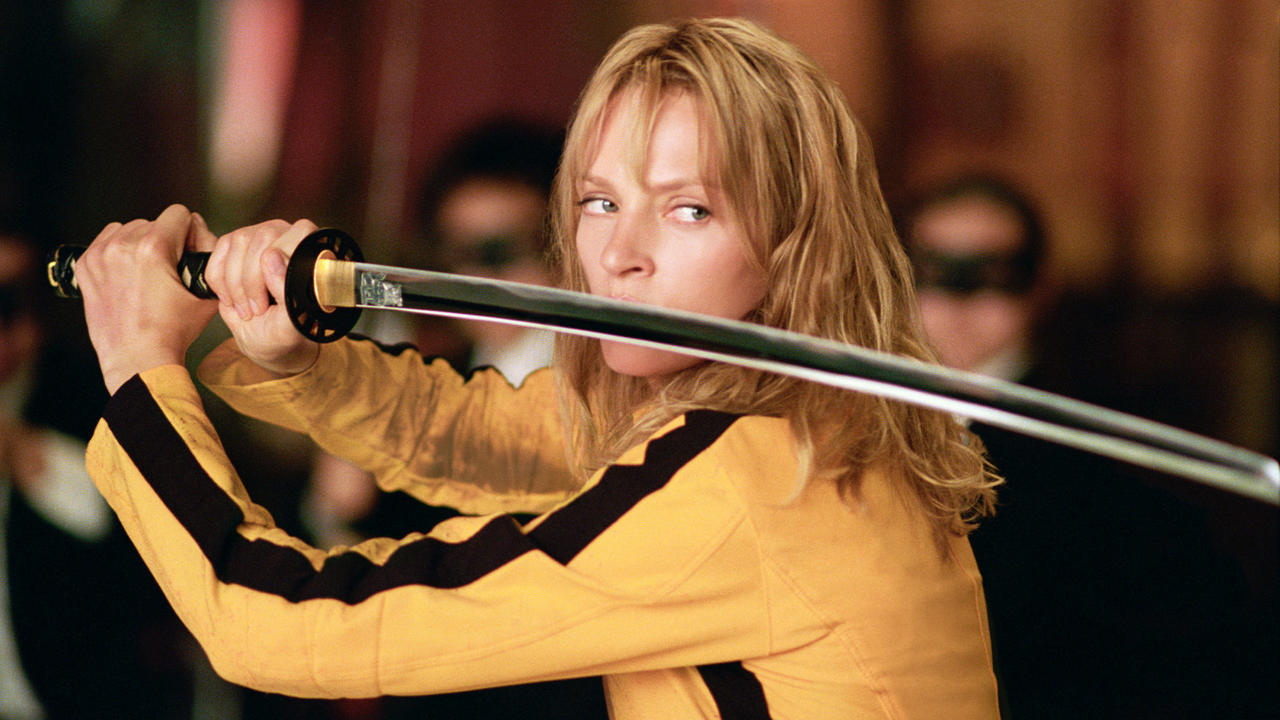
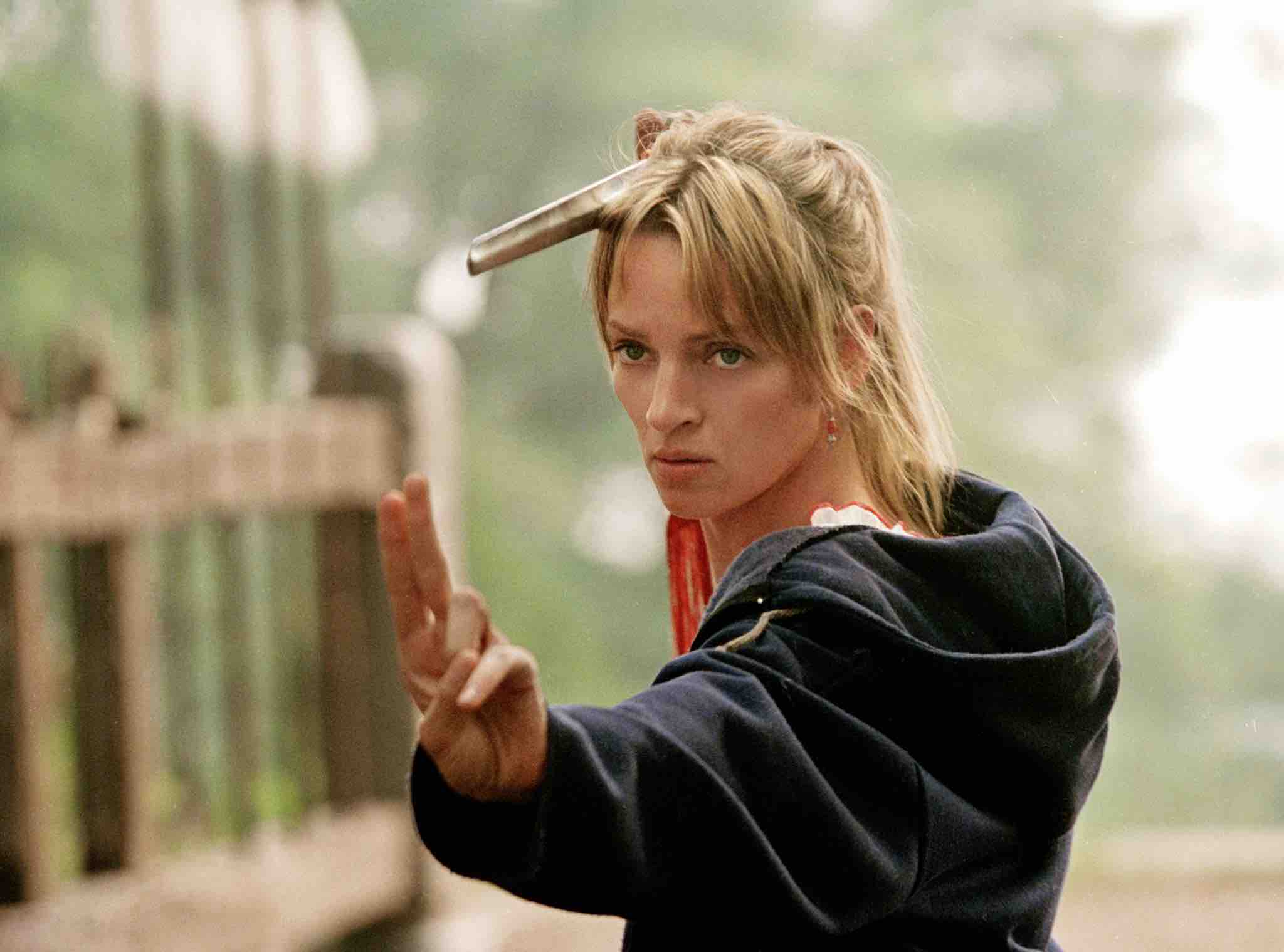
With Kill Bill: Volume 2 Quentin Tarantino completes what for better or worse represents his vision for the new millennium-- a three-hour chick-takes-revenge flick with obscure allusions to martial arts movies, gunslinger movies, pulpy genre fare of all kinds. 

Thursday, March 16, 2023

Kill Bill: Volume 1 (Quentin Tarantino, 2003)


Kill swill

Quentin Tarantino's Kill Bill: Vol. 1 is about as basic as you can get-- The Bride (Uma Thurman) once upon a time badly beaten and shot in the head by people she once worked with and loved; falls into a coma, sleeps a couple of years, wakes up demanding payback, big time.

Thursday, September 05, 2019

Once Upon a Time in Hollywood (Quentin Tarantino, 2019)

Pulp fanfic

(WARNING Plot twists and story details explicitly--but what isn't explicit in this picture?--discussed

Finally Quentin Tarantino's mildly racist markedly misogynistic mostly masturbatory Once Upon a Time in Hollywood has hit Filipino screens and if all indications prove correct it will be a major hit. Maybe not as big a hit as Marvel's Avengers: Endgame--which I didn't much like either--but do love the way folks have spun the popularity of Tarantino's wankfest: as one of the rare non-sequel non-franchise pictures to open to good boxoffice. 

Which is funny because the spin 1) assumes boxoffice truly madly deeply matters, and 2) assumes (correctly in my book) that our standards have fallen so sharply when something successful isn't a sequel or a franchise it must be The Second Coming. Or in this case The Second Self-Coming.

Monday, August 29, 2016

The Hateful Eight (Quentin Tarantino)


Eight is enough

Quentin Tarantino's The Hateful Eight (released on DVD earlier this year) is reportedly his most middling production yet, with decent (not great) boxoffice numbers, with critics divided more than usual-- some calling it "a high-wire thriller" and "quintessentially American," others declaring it "Tarantino's worse." 


Sunday, February 03, 2013

Zero Illuminated, Django Unzipped

Zero Illuminated

After writing extensively on Zero Dark Thirty and the literature surrounding it, I'm struck by one other article that ingeniously and even brilliantly squares away its lack of context or characterization, pointing an accusing finger at the film's true antagonist--not UBL or Osama Bin Laden, not the American industrial-military complex and its complementary intelligence organizations, but something much bigger, the forces of history itself. 

If we take this essay to have finally solved the riddle of Bigelow's film and its ambivalent (some would say confused) stance towards torture, then Bigelow's persistent apolitical posture turns out to have been a prescient aesthetic choice, one consistent with her film work since she met Susan Sontag back in the '70s. As the article puts it, the film is not postmodern, but post-postmodern, where it puts out a view, a sensibility, a story that competes for legitimacy in the public mind. 

The article even puts to rest the suspicion that the film endorses torture--not really according to Rombes; it merely suggests that history itself demands the torture of suspects, with all the attendant consequences to be paid for and endured (the delays, the subsequent fall from moral grace). The film in effect notes that history itself is responsible, not us--I suppose as big a cop-out as any I can think of ("The Devil (history) made me do it!"), unless the film makes this statement in a state of dismay, not mere resignation or relief, and here (again) the film remains stubbornly silent. At this point Bigelow's narrowly focused POV starts to look less willfully ignorant and more heroically honest--when one character in the film profanely demands targets to eliminate, Rombes writes: "his words ring with a hot, burning truth about power rarely spoken in American mainstream films."

Like I said, brilliantly put; it actually made me pause to try rethink my thoughts about the film

Maybe the biggest problem I have with Rombes' thesis is that looking at Bigelow's other work I don't quite see consistent aesthetic choices: just a lot of stylistic ones that help prop up a usually muddled script, Hurt Locker included (as I pointed out in my earlier article it's excellently made, but the central character doesn't make much sense). Strange Days begins with a fantastic single-shot action setpiece that runs for around ten minutes and says--I don't know what, exactly; the rest of the picture is far less coherent. Blue Steel is full of dread and cool metallic blue imagery that in retrospect feels ridiculous; Near Dark--arguably my favorite of her early work--is compellingly violent vampiric poetry that sometimes contradicts its own rules. Give me a more consciously nihilistic pessimist like late Bresson (Lancelot du Lac and L'Argent comes to mind)--he's every bit as deadpan and ambivalent, but you at least get from him the sense that he knows what he's doing; this stumbling along in the murky waters of political controversy clouds the waters more than clears them, and really doesn't help anyone much, least of all Bigelow.

Django Unzipped

(Warning: plot of several Tarantino movies discussed in explicit detail)

I'd already talked about how I think Tarantino's Django Unchained was sexist; now I've been asked to explain why I think the movie's racist.

I thought just linking a few perceptive articles would be enough; but just to humor those in question, I'll point out the highlights, and add a few thoughts of my own:

Keli Goff's Huffington Post article questions the violence--why, comparing this to his previous pictures, did he feel the need to amp up the overall suffering of African Americans in his picture? Why, for example, does he show Jews killed in Inglourious Basterds and Uma Thurman suffering in the Kill Bill movies but not in such voyeuristic length and with so much creative detail? Why single out black slaves, hm? As a kind of stinger finale, Goff also points out the telling detail that in his most famous film, Pulp Fiction, the black man is raped, and saved by a white man.

Don't totally agree with Ms. Goff in everything; she professes to be a Tarantino fan, and thinks the violence in Kill Bill "on par with watching ballet"--so speaketh an otherwise thoughtful writer unfamiliar I'm guessing with the works of Liu Chia-Liang and Johnnie To (In my book the first Kill Bill is Tarantino's amateur stab at the martial arts epic, its sequel only marginally better).

More damning I would say is Jelani Cobb's article, which begins by showing the injustice inflicted on the Russians by Tarantino's previous picture (I personally thought it oververbose and less than inventive myself).  Cobb goes on to discuss both the use of the "N" word and the depiction of a black hero in the movie, noting that while the word in question was used during the time, here it's used so excessively, unconvincingly often it has practically been raised to "the level of a pronoun;" he goes on to talk about how the slaves offered continued resistance against their white masters to the point that the "slaveholding class existed in a state of constant paranoia about slave rebellions, escapes, and a litany of more subtle attempts to undermine the institution"--a reality that Tarantino not only ignores, but overturns with the notion that Django is the only non-passive slave out there. In effect, Tarantino reinforces the myth, the stereotype--and, Cobb insists, it is a myth and stereotype--that the slaves never fought back; they mostly shuffled along clad in their leg irons and esoteric metal neckware.

I'd go further on this: with all the suffering endured onscreen and in reality, with the wide variety of experiences and stories to tell, with all the strength and intelligence the enslaved can muster--is bloody payback the only response Tarantino can have them take? I'd like to ask African-American filmmaker Charles Burnett his reaction to the Tarantino flick, only I suspect it isn't necessary; he's already done his take, and a subtler, finer, more nuanced response I doubt can be found. 

I'd especially point to a key dialogue that takes place between two slaves, concerning the power and importance of reading and writing and, beyond that, knowledge (a discussion I'd have with my students, many of whom seem unaware of this aspect of history and their ancestors' role in that history). At its lowest level, that of reading words, an educated slave can help his flight by reading maps and street signs. When a slave learns to write words he can forge a day pass (a note authorizing his passage through public roads)--allowing the runaway, oh, at least a day's head start. If said slave could read, write, and compose, why he could actually begin to strike at the heart of the institution itself, which is basically a set of laws printed on paper. So when I say "is that all Tarantino can think for them to do?" I'm serious--the fight against slavery took many forms, and that of blowing a white man's head away with a shotgun is the least imaginative I can think of.

2.3.13

Saturday, December 29, 2012

Django Unchained, Les Miserables, The Snowmen (Dr. Who Christmas Special), Jiro Dreams of Sushi, Angel Face, Christmas Holiday

(WARNING: Plot of the two recent films discussed in close detail)

Too cool for school

Quentin Tarantino's Django Unchained is basically a cartoon; a well-acted, fairly well-produced and even for moments well-directed (Tarantino continues to improve on his action sequences, this time borrowing from the shootout finale in Johnnie To's Exiled) cartoon on slavery, the way Inglourious Basterds is a cartoon--something funny and sometimes clever and occasionally amusing--but to regard it as anything more than an insubstantial contribution to a mostly disreputable genre is, to my mind, insane. 

He's clever, I'll give him that; he surrounds himself with spells, charms, the basic accoutrements to make his movies critic-proof (opportunistically assumed liberal agenda--check; outlandish violence--check; genre-bending--check; sophomoric humor--check; excellent actors mysteriously buffaloed into participating in his 'vision'--check). He even adds historical details that give his movie the outer appearance of being serious about the subject (the 'hot box' torture, the vicious hunting dogs, the various esoteric neck gear meant to keep a slave docile). He stops short of actually saying something serious but the man probably, as another fictional vigilante might put it, "knows his limits." He does, but one wonders--does his fans?

God--or the Devil--is in the details, and Django gets off on a spectacularly wrong foot early in the picture: the man (Jamie Foxx) is rescued by an improbable walking plot function, a German dentist turned bounty hunter named King Schultz (Christoph Waltz, who totally gets Tarantino's 'let's bullshit the audience' spirit). They strike a deal--Django will help Schultz find his bounty, an endeavor that may take several months, and Schultz will eventually help Django find his wife. 

So what do they do, this pair on a mission to hunt down a band of dangerous criminals--do they look around quietly, gathering information, perhaps sending out feelers as to where said criminals may be? Nope--they ride into town and straight into a bar, shoot up the sheriff in front of the entire town, and demand two hundred dollars for the privilege (apparently they do get the money as opposed to getting killed, which is another crazy development). Later they shoot up a plantation, and blow up a posse of proto-Klansmen in the bargain.

Now I'm aware this is a cartoon but there's "pushing the limits of plausibility" to milk a gag and there's following a pair of boneheaded morons who don't know the meaning of the word 'discreet.' Bad enough that a white and black man have partnered together to go bounty hunting--that certainly won't attract any attention--but judging from the rather loud and extravagant way they progress across the countryside I doubt if anyone will be willing to sit tight and wait patiently for their arrival.

Of course the prey could be even dumber--there's always that. And I suppose this whole bit is really a minor plot loophole, but I submit to you that it's the kind of loophole that helps you buy into a scenario instead of sitting with your feet up, spitting watermelon seed shells at the screen.

Finally they find the wife; she's been busy baking in an iron box in Candyland, Calvin Candie's (Leonardo DiCaprio) plantation of horrors. They concoct a scheme to rescue her so elaborate even the head slave Stephen (Samuel Jackson) could see through it; they get caught, are forced to settle the transaction on hugely disadvantageous terms, under gunpoint (fortunately Schulz has an ace literally up his sleeve, which he saves till the last moment). Before the deal is closed, DiCaprio's Candie offers a handshake to Schulz--who suddenly is up to here with slavery. What does he do? He doesn't shoot the guy holding the gun.

Like I said--morons. 

Incidentally, about Jackson's Stephen--Tarantino was never one for making his characters sound like different people; every actor no matter how handsome or beautiful or how beautiful the diction or heavy the accent ends up sounding like Tarantino. But Stephen--yes, there were slaves who actively collaborated with their white masters, but one that talked and cussed like he was walking the streets of '70s Los Angeles ("motherfucker" incidentally became popular only about World War 2)? Really?

He's Tarantino's most entertaining conceit though, despite the howling anachronism--a kind of airing of black history's dirtier laundry (though why it has to be Tarantino and not Spike Lee--why, say, Tarantino gets the funding to do a spaghetti western version of slavery and not Spike Lee with a possibly more thoughtful approach...). It was suggested to me that the mention of Alexandre Dumas was a giveaway, that the reason Stephen was so dedicated to Calvin was because he was Calvin's real father. The theory goes something like this: Candie grand-pere had an only daughter, the girl had an affair with Stephen, got pregnant, and when grand-pere died (presumably from a heart attack), the daughter left the plantation in her son's care, with the biological father as overseer slave. Got to say that if this is true, it somewhat weakens Tarantino's picture--Stephen doesn't do what he does for the sheer perversity of it; there's a biological basis.

Interesting idea, thought I'd air it here, and beyond that--well, that's it for interesting ideas found in Tarantino's latest.

Along the way I'd like to file an unofficial protest on behalf of Kerry Washington (who plays Broomhilda, Django's girl) and the way her character is wasted in this picture. She's a pretty actress--maybe talented; I wouldn't know, because Tarantino doesn't give her a single thing to do except scream and flash a nipple or two. By picture's end she's on a horse smiling confidently and swinging a rifle like she's been doing that all her life--where did that come from? Far as I know she's been spending her time in Candyland either baking underground or spreading her legs for every guest to come visiting (the last because her beloved husband would rather spend a few months of quality time with his newly befriended bounty-hunting partner than focus on saving her). A chance for the girl to target practice with rifles, in short, seem a tad unlikely. 

Maybe Tarantino's a one-issue guy. He tackled sexism in his previous movie Kill Bill (well, feels he has tackled it; I beg to differ), and needs to focus his limited attention span on racism this time--maybe that's why his Broomhilda is such a thin creation, thinner than even the other cartoon sketches populating his picture. 

Perhaps the best argument against watching a Tarantino flick is to watch the far superior if less expensive originals he stole from. I mean--Corbucci's Django for all its lack of production values and haphazard construction (Corbucci talked his brother Bruno into dashing off a quick story outline in place of an actual script) has a deadpan demented sense of humor and outlandish cruelty, plus subtle taint of melancholic loneliness (women--and men even, come to think of it--are drawn to Django, who rarely let them in) that Tarantino just can't quite capture. The director also borrowed the Mandingo idea from Richard Fleischer's film--arguably the most accurate portrait of slavery committed on celluloid--but couldn't reproduce the lurid tone (Susan George beats Washington up and down the block for onscreen sensuality), or visual elan (Fleischer against Tarantino? Gheddafakouddahere), or thematic complexity (the suggestion that Mede is more animal than man, and eventually acquires the dignity of a man, at the cost of horrific sacrifice).

Far as I can see Tarantino doesn't borrow from the most famous title to deal with the subject, the mini-series adaptation of Alex Haley's Roots. Maybe he considers the show inferior product, irredeemably cheesy and uncool--a pity, because despite the low budget and occasionally clumsy TV mini-series style storytelling the treatment has its moments of grandeur and dramatic power, and is by far the most comprehensive fictional treatment to date. 

Arguably my favorite title from the genre is Charles Burnett's Nightjohn, a small film that possesses every virtue Django Unchained does not--subtlety, grace, a kind of unblinking yet unbowed humanity, a stubborn belief in the superiority of human intelligence over violence. Too cheesy, I suppose, too uncool. Of Burnett's influence I see not a trace. 

Do you hear the people sing?

Tom Hooper's Les Miserables, about relentless Inspector Javert's (Russell Crowe) hunt for ex-convict Jean Valjean (Hugh Jackman) is (for the first hour or so anyway) the absolute worse movie I've seen all year. Chop-suey editing; canted camera angles; relentless gigantic closeups (director Hooper had gone through great trouble and expense to record the cast's singing live, and wanted to make sure you knew it), a narrative that seems to jump, skip, leap across years without even a by-your-leave. The first hour or so is an encyclopedia of slovenly, speeded-up storytelling (apparently Hooper wanted to skip through Valjean's life to arrive at the Fantine storyline and barricades), like watching a movie on fast-forward while the disc skipped every other scene. 

Doesn't help that Crowe--playing Javert--makes it plain to everyone who can hear that he can't sing. Not a note. Oh, he has a nicely solemn speaking voice, but the moment it tries to follow a melody to the higher registers it falls flat on its face and just lies there, twitching.

...actually got a cat like that, a big tabby weighing twenty pounds who when stalking towards strangers with his massive size and big eyes can be a tad unsettling; then he opens his mouth, the tiniest 'mew' pops out, and all sense of intimidation flies out the window. Crowe's voice has exactly that effect--and unlike say Marlon Brando (who had to deal with a nasal whine and unfortunate lisp in A Streetcar Named Desire)--Crowe has yet learned to draw attention back to him with sneaky bits of stage business.

The film starts becoming fairly good when Hooper settles down long enough to allow us to listen to Anne Hathaway as Fantine singing her one dramatic solo. Problem is, this is Hathaway intent on remaking her Princess Diaries image into something edgier, playing a character shredding her soul to pieces in private, and it would help (maybe even nudge her performance into actual poignancy) if Hooper's camera and microphone weren't six inches away from her mouth. It's like listening to someone pour their heart out straight into your ear canal, at full volume--at some point you're bound to go deaf. 

I'd like to go on comparing this to the Broadway and London East End hit (in summation: not a fan of the musical and still the movie doesn't come out well), but I'd rather compare it to Victor Hugo's original novel. Les Miserables the book has plenty the matter with it--endless passages of obscure French politics, a seemingly bottomless cistern of bathos (not to mention the courage to wield said bathos frequently and shamelessly). It does enjoy two advantages: Hugo's prose, which is tremendously detailed and eloquent (at least as translated to English), and his canvas--a thousand five hundred pages' worth, at least in my single-volume paperback, able to spread any sentimental detail or unlikely plot twist across days and months and years even, to the point that it looks like a relatively realistic facsimile of life. 

The musical can't indulge in that kind of luxury; it has to compress over a thousand pages of passion, violence, hatred, sadism, comedy and sacrifice into roughly two hours and forty-five minutes of singing, and the net effect is that what looked impressive and grand on the printed page smacks of rank melodrama on the theater stage. Add a movie camera that refuses to back away more than ten inches for most of its hundred and fifty minute running time and you have a serious problem. Do I hear the people sing? I sure do. Now back off.

Let it snow let it snow let it snow 

Arguably the finest Christmas present one can get is a Steven Moffat-penned Dr. Who Christmas special, and Saul Metzstein's The Snowmen is no exception. Victorian England, this time; sinister psychic snow; ladders dropping down in the middle of parks at night, leading to winding iron staircases topped by bright blue police boxes.

Madam Vastra (Neve McIntosh) the lesbian Silurian detective is back and so is the Sontaran Strax (Dan Starkey), two allies the Doctor recruited in A Good Man Goes to War; new companion Clara Oswin Oswald is back after first appearing in Asylum of the Daleks. The stocking is stuffed full to overflowing so it's probably churlish of me to suggest that the episode as a whole is too overstuffed, that after the surprise twist to Clara happens about midway through the episode the whole thing begins to unravel, that her ultimate fate loses its impact because we aren't adequately prepared for it, or we irrationally think (after all the twists Moffat throws our way, here and elsewhere) that what's about to happen won't happen  (it's Christmas, after all). 

I don't know--somewhat unsatisfying Moffat is in my book still head and shoulders better than most anything out there on TV (I include The Walking Dead and exclude Neil Gaiman), and I just might like the episode better on second viewing (was looking at The Wedding of River Song again and the realization that it's really both a variation and elaboration of the Peter Pan parable of never growing up or getting married--with anachronistic  (anarchically anachronistic) England being Moffat's version of Wonderland--sharpens the poignancy considerably). Time will tell, I suppose. 
 
The cold thin air of perfection


David Gelb's Jiro Dreams of Sushi isn't food porn, I think; it isn't that vulgar, and there's art involved in the depiction (unlike video porn nowadays, which consists of anatomical closeups plus repetition ad nauseam). Call it food erotica: Jiro Ono seems to suggest with his simple craft an entire panoply of arts, from the precise shaping of sushi rice and topping (sculpture) to the final application of a lacquerlike layer of gleaming, viscous soy sauce on the finished morsel (painting) to the maintenance of a minimalist blonde-wood chapel dedicated to undenatured seafood in the basement of a Ginza office building (performance and Surrealist set design).

Can't help but think of a New York Times review that complained the film insisted more than proved with the use of "explanations, demonstrations, context" the excellence of Jiro's skill. Don't know what with the film's slim 81-minute running time if you have much room for an introductory course on the basics of quality sushi-making. I'm thinking the time is better spent nibbling on the edges of the more interesting issue of what kind of person Jiro is: a lonely, craft-obsessed man (as suggested by the title, seafood haunts him even in his sleep) who despite his lofty Olympian position exhibits remarkable humility spiked with a deftly applied dollop of directness--a wasabi-like arrogance, if you like. The tension between him and his sons is perhaps the most intriguing element (well there's the mouthwatering fish, but it's to be expected that erotica trade on our Pavlovian responses)--the younger is shunted to one side and allowed to do a more accessible if less well-regarded form of sushi, the elder is in the unenviable, not unterrifying position of picking up the knife and taking over when the father eventually passes. 

Talk about Lear's dilemma. Ultimately, there's a poignant tang to this ostensibly irrelevant--it's all about food, for chrissake (on the other hand it's all about food, for chrissake)--subject; it speaks to the transitory nature of art (Jiro must eventually have a successor, and the fish itself cannot remain on its plate forever) same time it pleads for the permanency of more intangible virtues (the pursuit of excellence, the need for ruthless and consistent quality assessment). Jiro seems totally aware of his status the same time he seems aware of the frivolousness of his endeavor same time he seems determined to carry on, nevertheless. As good a recent example of heroism as anything I can think of. 

Sunshine noir 

Angel Face is Jean Simmons as the wealthy stepdaughter Diane Tremayne, all deadpan mystique and soft-spoken voice hiding a steely blade of a will; Robert Mitchum as Frank Jessup, the don't-give-a-damn ambulance driver slowly dragged into the uncomfortable awareness that yes he does, very much; and Preminger as the ruthless filmmaker who brings the two together in a seductive dance to destruction in this noirest of noir, paradoxically shot in some of the most brightly-lit, luxurious sets Hollywood money could buy (even the chauffeur's more modest apartment is pointedly comfortable). 

Key to Diane's character I think is her reaction to the infamous slap Frank gives her early in the film. Preminger reportedly ordered take after take of the slap (he was possibly encouraged by studio boss Howard Hughes, who resented Simmons' rejection of his sexual advances), to the point that Simmons' eyes watered from the pain--Mitchum to his credit finally delivered one at the director instead, asking afterwards if the man would like another. Preminger however might have been right, despite his cruel impulses and sadist methods--the slap was important enough to require multiple takes (he totally deserved Mitchum's retribution, though, and more). 

The preparation leading up to the moment is elaborate enough: after opening titles Jessup drives the ambulance out of its garage, up the hills, into the Tremayne mansion's courtyard. All the while Jessup is curt, no-nonsense; Mitchum's disdainfully heavy-lidded eyes make it clear that all the high-class trappings surrounding him don't impress him one bit. When he finally meets Diane she's hysterical, and he doesn't have the patience--it had been a wasted run, the supposed patient didn't need his care at all--so he applies the simplest method of dealing with hysteria: he slaps her.

The effect is startling: Diane's eyes go wide, she flashes a look of naked hurt; then the eyes narrow and she strikes him back. The few minutes of action summarizes the dynamic between the two: Jessup's having none of it, but neither is Diane--and that finally and fatally catches Jessup's interest. 

Diane is a sociopath, of course, not to mention liar and manipulator with an unhealthy fixation on her father (played with memorably understated pathos by Herbert Marshall). She's also not too smart; she isn't the calculating, cold-hearted bitch Phyllis Dietrichson was in Double Indemnity--she's too firmly ruled by her passions. One of the great ambiguous moments occur when a car crashes in the middle of the film, and she's playing the piano--does she know who died exactly, does she even care? And if she does care, what does it cost her to sit so calm? What makes Diane vivid is that she's not just sexy, she's sympathetic. We feel for her as a person, miscalculations and all, and we stay on her side even when she does ghastly things, especially when Mitchum turns on her with his belatedly developed sense of moral self-disgust--a femme fatale who remains fatally, enchantingly femme.

This is Sunshine Noir at its sunniest, the darkness tucked neatly away behind the glamorous facades of Beverly Hills, of which easily the most gorgeous and most deceptive is Simmon's. Preminger's approach mirrors Diane's: bright studio lights that apparently hide nothing yet the camera sidles here, there with a seductive grace, picking out this or that detail, harboring an always ulterior motive in its indirection, providing a visually silken, seductive contrast to the literally brutal finale. 

I'll be home for Christmas
  
One of my favorite Christmas films has to be Robert Siodmak's Christmas Holiday, from a Herman Mankiewicz script based on a Somerset Maugham novel, with Deanna Durbin as lounge singer/prostitute/failed housewife Jackie Lamont/Abigail Manette, and Gene Kelly as crazed killer Robert Manette (I know--Kelly as a killer? Really?). The film seems disturbing in a not-altogether good way, being at first glance too leisurely, too waywardly structured (it begins with a jilted young officer in an army camp) to be effective noir, favoring a gliding camera more appropriate to Max Ophuls than Fritz Lang, lingering over architectural details like New Orleans' ornate grillwork and water fountains rather than noir's standard barred windows and towering urban edifices. More, Gene Kelly is pretty much Gene Kelly--we're told over and over again that Robert is not quite right in the head, that his relationship to his mother (the icily magnificent Gale Sondergaard) is "pathological," but we don't get much onscreen evidence from the actor himself. Could Siodmak be protecting his film, trying to keep the actor out of the way because the man for all his talent couldn't do menacing?

Then Kelly escapes from jail, and we're suddenly confronting a full-blown psychopath with switchblade fast moves. This is the famed Kelly from dance musicals, the athleticism and speed coiled up inside like a snake poised to strike, the usually exuberant manner pushed up a notch to the kind of abrasive paranoia one always sensed lurked underneath his cheerful veneer (reportedly Debbie Reynolds suffered a dose during the filming of Singin' in the Rain). Then for the last three minutes Siodmak drops all pretense and dialogue, and reveals the film for what it really is: a tremendous operatic melodrama about one woman's suffering, the heights and depths to which her all-consuming love will rise or sink. Lars Von should sit down and take notes, or simply hang his head in shame; for all his not inconsiderable skill and arthouse pretension, he couldn't even begin to touch the intensity of this film. 

12.29.12


Monday, October 29, 2012

Seven Psychopaths, The Master, Frankenweenie

A Few Good Men

Martin McDonagh's Seven Psychopaths is cinematic Cherry Coke--sweet and tasty, but basically lacking emotional nourishment. It's not just as previous critics have noted that this is recycled Tarantino, it's Tarantino recycled at his least expressive, early enough in his career that Roger Avary still shared writing credit, and the pose Tarantino struck (itself secondhand) was so cool it started a fashion trend in filmmaking, hence the hideous term "Tarantinoesque." 

Well, this film is "Tarantinoesque," and that's a good and bad thing. Good in that on several counts McDonagh writes sharper, funnier dialogue, or at least sharper, funnier punchlines, and serves up twists every bit as witty and entertaining as said punchlines, not to mention the original source. Plus, unlike Tarantino, and as evidenced by the oft-promised shootout that ends the picture, McDonagh seems to know a thing or two about staging, shooting, and cutting action. 

Otherwise, it's largely disposable (there's a subplot about a Vietnam psychopath that's so transparently a bid to transcend the label 'disposable')--except for Christopher Walken. Walken's psychopath seems to linger in memory because he seems to be the only character in the movie to actually care about something or someone, and we can't help but respond to that in this otherwise emotionally arid wasteland. What makes his performance even better is that he owns a pair of eyes more frightening than even Lucifer's. In Rosemary's Baby the Devil glared through several pounds of prosthetic fur and a satanic pair of contacts; Walken without wearing even an ounce of makeup much less contacts can gaze effortlessly back and you know who's gonna blink first. A pair of tired, loving, psychopathic eyes pouched in a cadaverously pale face--what's not to like?

The Matter

I came away from Paul Thomas Anderson's The Master thinking it's a collection of superb film moments--sequences, even--that don't really come together much. Anderson proudly and famously never attended a class for scriptwriting and I suspect this creates the tense energy in his films--he's basically a high-wire act, trying his best not to break his fool neck. But it also means a lot of floundering about, and sometimes you suspect it's the floundering audiences come to watch in an Anderson (Paul Thomas, not W.S.) and not the actual film--that, and the chance to maybe see him break his fool neck. 

Oh, but what an act! Overhead shots of the ocean swirling behind a ship; a group of Filipino workers chasing a man across a vast dusty field; Joaquin Phoenix draped lazily past the boundary of a ship's railing, threatening to fall over and not caring; Phoenix later in the film, pressing his lips longingly to the windowpane (he appears to be trying to break through--to what? And why?). Anderson knows how to whip up a striking image, knows how present it--big, baleful, portentous--on the big screen (and I mean big--65 mm on traditional film stock, instead of the standard 35 mm digital video), knows to the microsecond how long to hold an image: long enough that you begin to wonder if you aren't perhaps missing some extra layer of meaning in what you're seeing, but not so long that you start to suspect maybe he's faking it with all the pregnant pauses.

It's not about Scientology--well, not directly about Scientology, which takes a few glancing blows to the rib; it's more about the dynamics that exist within a group not unlike the Scientologists, complete with fanaticists, doubters, and those that vacillate back and forth between the two extremes. And it's about the uneasy friendship that develops between Phoenix's Freddie Quell and the cult's founder Lancaster Dodd (Philip Seymour Hoffman, in a low-key yet authoritative performance). Most of all it's about what two men--one a wandering alcoholic, the other the multi-million dollar founder of a cult religion--have in common, and the answer is unsettlingly simple: both arrive at their respective positions in life (near ruin, great success) through hard struggle, and they will respond with rejection, anger, even violence, to anyone who threatens to topple that position. They recognize the same angry, fearful man inside each other, and they can't help but acknowledge that man, even lend him a kind of uneasy support. 

Is it a great film? Hell no; least I don't think so. Anderson could go so much further if he actually knew what he was doing; then again, if he knew what he was doing, he wouldn't be the special flavor that is Anderson--Paul Thomas, not W.S.

A Boy and His

Talk about yet another unconscious, instinctive artist, Tim Burton's Frankenweenie is an expansion of the live-action short of the same name. Presumably Burton had his reasons for turning to stop-motion for the remake: more control over the overall look and the characters' gestures, a stylization that helps sell the sweet-natured premise (which is arguably too sweet, though Disney deemed the original short too frightening for kids) and, well, stop-motion don't need no reason--it's just awesome all its own. 

The film starts with a short film that somehow manages not just to suggest its handmade nature (this in a $40 million Hollywood feature), but one with crude yet innovative special effects--pterodactyl swinging on a string, menacing cardboard buildings; toy artillery firing styrofoam muzzle flash; infantrymen made of cheap green plastic (what boy growing up back then didn't have an odd platoon or two forgotten in his toy chest somewhere?).

The story isn't much more than that: boy loves dog, boy loses dog, boy resurrects dog using recycled household appliances (our protagonist Victor improvises with a ironing board as operating table, an aquarium as battery, and a kite as lightning rod). It's Frankenstein recast as a iconic suburban creation myth, and it's arguably the film's money sequence, its reason for being--all throughout Burton's career there's been an uneasy tension between idyllic suburban home and doomed Gothic melancholy, and as shown in his short Vincent he's not averse to spoofing either sensibilities. With this film's first half, he's finally stitched both into a perfectly monstrous creation that lurches about the attic with gleeful abandon. 

And then there's the rest of the film. After Victor creates the dog, Burton doesn't seem to know what to do next--he fills the picture with busy plotting and made-up conflicts that don't really threaten the status quo (a Gothic child growing up in an essentially benign suburban community), or at the last minute tosses in sketchy characters that shake things up without really clarifying why they do so, though even this has its moments--love the shout-out to Godzilla, and better yet, the classic animated short Bambi vs. Godzilla. The narrative really regains its footing only after the windmill sequence, after which all is right with the world. 


Which doesn't really mean the ruination of the film. Burton was never a consistent or especially skillful storyteller; I suspect that he spent years and millions of dollars to do Planet of the Apes, for example, as an excuse to shoot the moment when man and ape kiss, sending a sexual charge straight up your spine. I suspect he did Frankenweenie to pour all of Disney's considerable resources into producing that creation myth--expressing his love for his long-ago animated short, for the James Whale original, for the neverending tension between Goth and suburb in his life. Everything else was pretty much an afterthought. 

10.29.12
 

Saturday, November 14, 2009

Inglourious Basterds (Quentin Tarantino, 2009)


Tarantino's talkathon


Quentin Tarantino's Inglourious Basterds is a clever melange of violence, suspense, slapstick, wit, movie references both arthouse and grindhouse, talk, talk, more talk, even more talk; seems to me he is more in love than ever with the sound of his own words coming out of the mouths of about a dozen different men and women, in several accents and twice as many acting styles.

Saturday, September 26, 2009

Inglourious Basterds, The Hurt Locker, 9


Tarantino's latest, Inglourious Basterds is an entertaining enough and harmless enough movie; what I don't get are all the hosannas proclaiming it (and Tarantino) as the Second Coming.

Tarantino may be comfortable in exploring "everything troubling and uncomfortable about the fact that a love of movies has no inherent virtue," but I don't see why that gives him power over us (who mostly knew it all along, if our heads were screwed on right).

"To claim that Tarantino's films are empty and self-referential is to ignore the obvious truth. Tarantino has already achieved relevance simply by being good at making something we like. Movies." But Meis attributes something to Tarantino I just don't see. He is, as I've said before, a middling director, a deft scriptwriter, a brilliant assembler of soundtracks, and arguably the greatest casting agent alive, in that order. I'll go see his pictures but I'm not expecting anything extraordinary--that way I'm neither blown away nor let down by what I see onscreen.


Friday, December 28, 2007

Death Proof (Quentin Tarantino, 2007)

Dreck on wheels

Death Proof (2007), Quentin Tarantino's contribution to the Grindhouse omnibus released together in the USA earlier this year, is having its solo premiere in Manila's commercial theaters. How does this slightly longer version play, so many months later?

Pretty much the same. Tarantino has added a few minutes of eye candy--Vanessa Ferlito manages to do her lap dance for Kurt Russell (who luckily isn't wearing his Escape from New York eyepatch) instead of having the entire scene written off as a 'missing reel' (the film for those that need the explanation replicates every aspect of the grindhouse theater experience including scratched prints, mismatched footage (the film's midpoint sequence is in black and white), and lost scenes). Russell later manages to caress Rosario Dawson's dangling toes while passing her car door ("He accidentally brushed against my feet. It was creepy"); I'm assuming the director is indulging his fetish for feet (many of the women wear flip-flops or walk about shoeless or prop said limbs up high at the slightest excuse, purely for our delectation) and perhaps Latina women (Russell closely studies Ferlito's lap dance, enjoys the feel of Dawson's soles).

Tarantino does his level best to reproduce '70s style cinematography, from the garish colors to the bright lighting to the racking focus practiced by
Laszlo Kovacs and Vilmos Zsigmond. More anachronistic are the stealthy tracking shots that glide across rooms past people and furniture (a trademark move by a director who (presumably) likes the sense of foreboding), not to mention the numerous long takes of people speaking pages of his dialogue to each other.

The dialogue--Tarantino's talk is more or less enjoyable, but the rhythms, the way his people chat and curse have become (from the eight previous feature films I've seen) terribly familiar. "You know," says Stuntman Mike (Kurt Russell), "how people say 'You're okay in my book' or 'In my book, that's no good?' Well, I actually have a book. And everybody I ever meet goes in this book. And now I've met you, and you're going in the book." Rhythm and repetition and recycled twists of syntax are the tricks of his trade, the word 'book' like a regular beat to each sentence (my book, a book, this book), the word 'have' a kind of exclamation point changing the nature of the statement, referring not just to a theoretical 'book' but an actual, physical object Russell produces in his hand. Said dialogue can be funny ("I don't wear their teeth marks on my butt for nothing"), it can be chilling ("It would have been a while before you started getting scared"), but it all sounds as if it had been spoken by the same mouth, composed by the same mind. Tarantino really needs to listen more to the great variety of speech patterns and accents found in the United States at the very least, maybe throw in a foreign accent or three, maybe even a deaf-mute (maybe not; his Bride in Kill Bill, Vol. 1 didn't talk, and she was a dull, dull girl before she was allowed to express herself more in
Kill Bill Vol. 2).

I've always declared that Tarantino was a better writer than filmmaker, and perhaps a genius at casting (John Travolta in Pulp Fiction; Robert Forster and Pam Grier in Jackie Brown, David Carradine in Kill Bill Vol. 2)), that his default style (sinuous or static long takes) was mostly a way for him to present his dialogue properly. The first half of Death Proof doesn't do much to change my assessment--talk, talk, talk, mostly in the one bar, with maybe Ferlito's lap dance thrown in to relieve the verbiage. Midpoint in the movie, when Russell's Chevy Nova smashes into an oncoming car, the collision is all repeated slow motion and (I'm assuming) digitally enhanced carnage (a severed leg, a tire wheel literally rubbing someone's face out). The second setpiece sequence, a faceoff between Russell in a Dodge Charger and a second set of girls in a white Dodge Challenger ("Kowalski!" exclaims Tracie Thoms, recognizing the reference to Richard Serafian's great 1971 road movie Vanishing Point) is a different creature altogether; I wouldn't blame anyone for skipping the film's first hour to sit in at this far superior second one, a duel between two muscle car classics that's shot (far as I can see) entirely without computer effects or even an undercranked camera--just real cars racing at real speeds, a real stuntwoman (Bell playing herself) clinging with near-real panic to the hood of the car.

As an advertisement for feminine empowerment the movie is a dodgy proposition: we're asked to accept the dismembering of the first set of girls by Russell's Stuntman Mike as setup for the second set of girls to take vengeance, with the second set's main justification for surviving being that they don't do booze or drugs, that two of them (like Mike) are professional stuntmen, and (most importantly) that one of them (Thoms) carries a gun. An earlier exchange between the girls ("You can't get around the fact that people who carry guns, tend to get shot more than people who don't." "And you can't get around the fact that if I go down to the laundry room in my building at midnight enough times, I might get my ass raped.") is entirely justified by Mike's appearance on the scene ("See?" you can imagine the less skeptical in the audience pointing out to each other, "Good thing they were packing."). I won't go so far as say Tarantino is anti-gun control, only that he's simply following the anarchically amoral conventions of the genre; it follows, then, that just because an innocent biker gets brutally thrown against a roadside signboard and the girls leave one of their own (Lee, played by Mary Elizabeth Winstead, whose only crime seems to be a serious case of stupidity) behind, presumably to be raped, one shouldn't be upset; such elements are only to be expected in these kinds of pictures.

Sure, fine; whatever. Perhaps my biggest problem with this tribute to those kinds of pictures is that it seems so superfluous, at least to us Filipinos. We have grindhouse-type theaters showing grindhouse-type fare, in Cubao, in Manila; we have prints full of scratches and missing reels, moldering away in our unairconditioned warehouses. We have politically incorrect movies--brutal rapes, shameless melodramas, slipshod action vehicles, rubbery monster suits splashing about in gallons of patently faux blood (for some reason, possibly budgetary (and for all I know they've since corrected this), our fake blood is pinker than Hollywood's) of a number and variety to rival any American filmmakers' most outrageous, most perverse tastes.


Here comes Tarantino spending over thirty million dollars (over sixty if you count Robert Rodriguez's contribution) faking what we've been doing for decades and you want to ask--couldn't he just hand all that money over directly to our filmmakers instead? It would be less trouble for everyone all around.

(Published in Businessworld 12/14/07)

Friday, August 17, 2007

Death Proof (Quentin Tarantino, 2007)

Dodge 'em

Quentin Tarantino's something of a strange case--he's an enthusiast without much discrimination, a director who cares more about framing his dialogue than his images, an auteur wannabe more interested in cramming allusions and homages into his works than actually fusing them into a unique voice. He's got so many references in his movies the frame operate more like hypertext (click on this hat and it's the same type hat used in so-and-so kung fu flick; click on that pack of cigarettes and it's the same brand used in one of the director's previous works)--that much he's up-to-date. To be fair, he does have a fondness for the classic and antiquated that may, after all is said and done, be his finest trait (though his uncritical passion for junk takes a bit of the gloss off that love).

In effect, he's not the greatest thing since apple pie, but he's not cow flop, either. In 1992 he took the plot of Ringo Lam's great Lung fu fong wan (City on Fire, 1987), shuffled the time scheme for variety, dumbed down the understated desperation, and presented it as Reservoir Dogs; two years later he took Godard's declaration that "every film has a beginning, a middle, and an end... but not necessarily in that order,” made Pulp Fiction, and won a Palme d'Or in Cannes (funny Godard never got credit for the idea, nor brought home his own Palme d'Or). The 1996 From Dusk Till Dawn might be my favorite Tarantino, if only because the man wrote a clever, genre-bending script for his more visually talented friend, Robert Rodriguez (Rodriguez's problem is in constructing a narrative that moves in reasonably smooth motion, and comes to a satisfying resolution; the two should do more projects together, preferably with Tarantino at the keyboard, Rodriguez behind the camera).

Perhaps his most admirable work was an adaptation of Elmore Leonard's novel Rum Punch. Tarantino moved the action from Florida to California and changed the main character from white airline stewardess to black, mainly so he could use blaxploitation queen Pam Grier in the role. May all directors' whims be so effective--Tarantino's genius has always been in casting (witness Tierney in Reservoir Dogs, or Travolta in Pulp Fiction); with Jackie Brown (1997) the iconic Grier is handed her meatiest role onscreen to date. Grier's Jackie isn't quite like the usual female Tarantino character, either sexual tease, or invincible killer, or wallpaper--she's tough and independent, has accumulated considerable mileage both literal and metaphorical, and is vivid yet likeable enough a presence that you care what happens to her. She's perfectly matched by Robert Forster as a shy bail bondsman attracted to Jackie and aching to help (Grier's scenes with Forster are like a delicate pas de deux, where both parties are presumably too embarrassed (By the racial and sexual implications? Maybe not--they look too sensible for that) to take the relationship to the next level), and she's surrounded by a small constellation of stellar performances--Bridget Fonda as the annoyingly sexy (sexually annoying?) Melanie; Samuel Jackson as the relatively subdued (for Jackson, anyway) gun and drug dealer Ordell; Robert De Niro as Ordell's slyly funny right-hand man Louis; Michael Keaton, trailing just a step behind Jackie as ATF agent Ray Nicolet.

Tarantino drops much of his mannerisms here: the fractured time schemes, the playful devices, the wince-inducing violence; some critics at the time the picture was released complained that this wasn't the typical Tarantino flick, that he'd sold his soul to the Devil to become a more commercially successful (and more conventional) director. Truth is much simpler, apparently: Tarantino is so enamored of Leonard he's assigned himself the task of actually bringing the material onscreen, not twisting it beyond recognition to fit his usual sniggering, wiseguy notions of entertainment.

Of Kill Bill the less said the better. The first half is Uma Thurman as the vengeful Bride, cutting a wide swathe of death and destruction across the American landscape to reach the eponymous Bill (it's a panoramic variation on Bruce Lee's Game of Death (1978) only with clunkier action choreography and filmmaking); the second half is fairly more interesting, a kind of retread not so much of Sergio Leone's motifs, as of his music and emotional tone--at least when David Carradine's Bill finally confronts Thurman's Bride, there actually seems to be a subtext of long-felt pain between the two that they have to deal with before they start trying to kill each other.

Death Proof (2007), Tarantino's contribution to the Grindhouse omnibus (the other is Robert Rodriguez's sleazier, slimier
Planet Terror) is easily his best work as a filmmaker yet, mainly on the basis of the climactic showdown between the black Dodge Charger and white Dodge Challenger, with the added bonus of stuntwoman Zoe Bell perched precariously on the Challenger front hood. Tarantino had said he deplored the recent trend towards CGI effects in place of real stunts (a sentiment I share), and proceeds to practice what he preached, using white-knuckle driving and Bell gripping the edges of the Challenger's hood to create real thrills. The premise is fairly engaging if a little outlandish, with Kurt Russell as 'Stuntman Mike' a serial killer who uses his 'death-proofed' cars to kill women (though why, after making an earnest attempt to kill a second batch of women, does he leave his car and try talk to them?), but the duel of the Dodge muscle cars is the movie's main attraction--fact is, if you come in an hour late to catch only the duel, you haven't missed much.

What I do miss, though, is the kind of purity that created something like Richard C. Serafian's Vanishing Point (1971). Barry Newman plays Kowalski, a car delivery man assigned to take a Dodge Challenger (yes, the same one--down to the white paint--used in Tarantino's picture, and several characters explicitly refer to the film at several points) from Boulder, Colorado to San Francisco, California.

He never makes it to San Francisco (mainly, as Serafian reveals, because they didn't have the budget to shoot there); instead he side-swipes police cars, barrels the wrong way down divided lanes, runs up inclines, down country roads, and pretty much out-turns, outsmarts and just plain outraces anything on wheels. Perhaps the most haunting aspect of all this is--why? Kowalski has the entire weekend to deliver the car; why risk life and limb to try do it in fifteen hours (which would take an average speed of 85 mph for the length of the trip)? Serafian offers fascinating hints and glimpses in Kowalski's former life--he's a war hero, a bike and car racer, a former police officer discharged for beating his partner (the man was trying to blackmail a young girl into having sex). The question looms larger and larger as Kowaski rushes nearer and nearer to his ultimate fate, and almost effortlessly acquires philosophical and metaphysical dimensions. Tarantino's movie is good, trashy fun, but Vanishing Point leaves you stunned, a tragic fable unfolding a hundred miles an hour on a two-lane blacktop.

(First published in Businessworld, 8/10/07)