(WARNING: plot twists and surprises in the films may and often are revealed in the course of discussion)
What next?
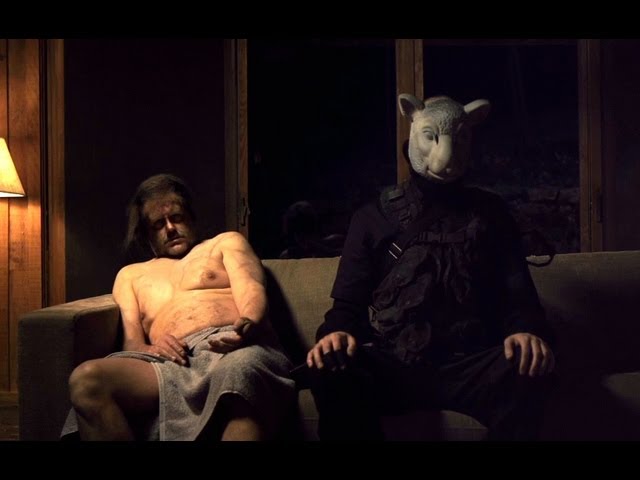
Adam Wingard's You're Next is a nasty, fairly well-made house-invasion flick, with the added kick of animal masks for that extra dose of surrealism. Wingard is a horror veteran, and knows how to stage shocks and suspense as well as anyone out there, maybe a little better than most; if he still cuts too fast and shoves his camera too closely at the action for my taste--well, we're not talking high standards for the genre as a whole here, especially nowadays.
A bigger problem in my book are the characters, mostly repulsive upper-class types blessed with faintly amusing dialogue (you find your entertainment where you can) and a level of sadism that suggests twisted motives behind their cruelty--which sadly isn't the case; turns out the driving force behind the murders is good ole-fashioned greed. All this--the elaborate planning, the archaic weaponry, the serene animal masks (single best detail in the whole picture)--just for daddy's money? Really? Couldn't they just have purchased assault rifles from the nearest gun shop and stormed the house? At the very least, couldn't the writer develop the contrast in class and background between the movie's Addams Family and the she-Rambo (whose father is, conveniently, a survivalist) acting as the movie's putative champion? At one point things begin looking interesting when sex is offered on a bed next to a dead relative's body--but the offer is swiftly rejected. We're fucked up, but not that fucked apparently (and unfortunately).
As for that ending: I suppose the
writers were trying to make a metaphysical point--that we're all killers
or become killers given the right circumstance, or that we're pawns played by an infinitely more cunning chess master--but by then I was just waiting for the end credits to roll. The finale
pretty much came out of nowhere, connected with nothing, and apparently
isn't meant to be anything more than a cheap punchline to the
picture.
Unfair to use another film to bash the one you're discussing but Michael Haneke's Funny Games is so much better at playing the same game it isn't even funny. Haneke doesn't so much avoid as completely drop any pretense of making a horror movie--no fast cutting, no tilted camera (which glides with stately aplomb through the large if low-key home), no waiting for night to start twisting one's nerves into little knots, only a smooth deadpan which intensifies the horror. He operates on the more interesting proposition that psychological suffering is crueler and harder to watch than any mere crossbow bolt to the skull.
I pretty much realized the movie wasn't going to be all that when I saw "YOU'RE NEXT" painted with blood in sloppy giggling-psychopath handwriting, all over the bedroom wall. Aside from the corniness of announcing the title of the picture, the sheer conventionality of the cliche was overwhelming: couldn't the handwriting be neater at least, perhaps in cursive? The threat was a blatant promise of standard-issue horror cliches to come; sadly, the filmmakers deliver.
Cerveau en gelee
Once upon a time, long before he started remaking the Pink Panther films to disastrous effect, Steve Martin (especially in collaboration with Carl Reiner) was a one-of-a-kind wonder, and while my favorite might be the comically complex and surprisingly coherent All of Me, not far behind and coming fast up the ladder of regard is the demented The Man with Two Brains. Suppose I still love the former--watching Steve Martin argue with the Lily Tomlin side of him is an indispensable pleasure--but the latter is Martin and Reiner at their unfettered undiluted best, without the benefit (or limitation) of a conventionally structured script. Mad scientists depicted by mad filmmakers--what more can anyone ask?
It's unexpectedly erotic, with the faithless Dolores (Kathleen Turner) in the habit of driving her neurosurgeon husband Dr. Hfuhruhurr (extended running gag where various people mispronounce his name) wild by not sleeping with him--roughly the first half of the film is about building up a massive case of blue balls, and the film is all the sexier for it. Turner was fresh off the success of Body Heat where I felt her femme fatale newcomer (it was her debut feature film role) was stilted and stiff, more focused on looking good onscreen with little to no clothes on than she was on delivering a sensual performance (hint: it's more important to relax than focus). Comedy seems to release something inside her; she's more assured here, more playful, a tease rather than a tart (though we get plenty evidence of the latter), and for single sexiest image in the film--or most of '80s cinema for that matter--it's hard to think of anything more potent than Turner's eyes aglow with the thrill of power as she leaves Martin hard up--literally--and throbbing with sexual frustration.
Also helps that Michael Chapman--Rainer Werner Fassbinder's old collaborator--handles the camerawork. Reiner (Carl) is no visual stylist, and comedy as a genre rarely if ever pays lip service to the art of cinematography (look at the entire career of Mel Brooks, or--arguably--Woody Allen), but with the not inconsiderable help of Chapman the film achieves a darkly handsome subterranean ambiance, adds conviction (and an unholy Gothic grandeur) to the film's mad-scientist shenanigans, lends credence to the possibility that the doctor is mad, maybe dangerous.
Just check the above still: Martin is surrounded by jars of brains--a staple for the genre--only here the brains float in what seem like various enticing flavors of phosphorescent Kool-Aid, from Purple Passion Grape to Bubble-Gum Pink to Certified Cherry; one is almost tempted to tilt a jar lid, stick in a flexible drinking straw, and sip.
Perhaps most surprising of all is how sweet-natured the film turns out to be: Dr. Hfuhruhurr meets Anne Uumellmaehaye (voice of Sissy Spacek) and it isn't just that their surnames somehow feel appropriate together, Anne also happens to be a brain in a jar, which of course is catnip to a brain surgeon. From a perfectly incarnated if faithless wife the doctor learns the true value of facial beauty (basically not much more than the silicon it's built on); he finds himself falling for a woman who's all mind, literally transcending the limitations of flesh. We feel the force of his delight at discovering how every detail of her fits neatly into the sharp edges of his eccentric if essentially gentle character; we're charmed at how neatly a bizarrely comic horror-movie plot premise is deftly pretzeled to insert a bizarrely apt romantic-comedy plot twist (added bonus: hilarious commentary on the shoddy construction of modern apartment dwellings). We're conquered, seduced by these lovers; we feel (swoon, pine, fear) for them almost as much as they feel (swoon, pine, fear) for each other.

Love you long time
Anatole Litvak had a varied career ranging from costumed films (Mayerling, Anastasia) to harrowing dramas (The Snake Pit) to noir thrillers (Sorry, Wrong Number). Act of Love is a lesser-known work, a wartime melodrama about a homeless French girl (Dany Robin) stranded in Paris without papers, forced to pretend that an American GI (Kirk Douglas) is her husband. Robin gives a fine understated performance as a naive girl trapped in a sordid situation--reacting to fellow Frenchmen leering at her and her 'husband,' her face registering every humiliating moment quietly yet indelibly, like rice paper on a barroom floor. Douglas is Douglas, a straight-shootin' soldier who plays bitter and cynical when the script demands it but is ultimately sincere in his declaration of marriage (of course fate decrees otherwise); he's at his best I think years later, as a lounge lizard in a south-of-France seaport--more thoughtful, more conscious of the burden of memory, and of possibly having exchanged roles with the girl he once loved.
Litvak's camera is stylish as ever, and delivers various memorable flourishes: a riff on the marriage scene in Citizen Kane where various French folk give their thoughts on the American occupation before a whirling camera; a harrowing point-of-view shot of a disillusioned Frenchman wielding a sharp knife. The tragic finale (with stories of this sort the finale has to be tragic) is delivered with graceful simplicity: the camera stands at a corner and gazes at the people going to and fro, running and missing their various fateful appointments with destiny.
 Monkey do
Otto Preminger's The Man with the Golden Arm has a gorgeous title, its protagonist a beautifully intimidating name; no wonder Frank Sinatra wanted the role, would probably have killed for the role (for all we know he did).
Admittedly the film pales in comparison to Nelson Algren's dark novel; admittedly what was shocking in the '50s--the necktie looped tight round the arm, the slim syringe--seems mild today; admittedly the film is regarded nowadays as more a historically important curio than an artistically significant film, mostly for breaking the Hollywood taboo on onscreen drug use.
But is it still relevant? Does it still have the power to startle, at least unsettle?
I think so. Drug movies like Darren Aronofsky's Requiem for a Dream draw on an arsenal of pyrotechnic effects, from giant close-ups to shock cuts to time lapse to slow motion, to suggest the diabolically distorting nature of drug use; all Man needs is Preminger's classically oriented eye, Elmer Bernstein's music, and Sinatra.
Sinatra owns Frankie Machine; that's him onscreen, or as much of him as careful research and a volatile acting talent untainted by formal training can muster. The sweat on Sinatra's brow and upper lip when he's shooting up could have been sprayed there for all I know but he makes you believe he squeezed them out through sheer effort; the dilated eyes are simple to achieve, but when co-star Kim Novak lights a match and shoves it at his face the sight can still make the flesh crawl, like finding maggots writhing beneath an upturned stone.
As for the clearly studio-constructed apartment and street sets--I submit to you that they are (intentionally or not) Preminger's most cunning effect, his way of suggesting the city of Chicago is a flimsy extension of Frankie's fevered mind, row upon row of balsa and plywood piled high and ready to fold at the slightest shove. Do the apartment, the very streets seem unreal? They do to Frankie--nothing is solid, nothing registers, nothing matters to him save that needle in his arm.
And Sinatra pushes past everything as if propelled by Preminger's camera (barely making it through before everything round him collapses), his progress marked by Bernstein's hot jazz score (performed by Shorty Rogers and His Giants). He approaches Louie (Darren McGavin, decades before taking up nightstalking), who throws coy looks; follows the dealer to an apartment; watches shivering as the spoon packet and so forth are (like an elaborate dinner setting) meticulously laid out. Preminger's camera rushes up to Sinatra's face as his jaw slackens and his pupils flare wide, brass horns blaring heedless triumph; it's a hell of a high, one even the unlikely happy ending (arguably a fantasy like the rest of Chicago, who's to say it isn't?) can't quite squelch, a monkey that--as Louie puts it--you can't quite pull off your back.
9.19.13
(WARNING: Plot of the two recent films discussed in close detail)
Too cool for school
Quentin Tarantino's Django Unchained is basically a cartoon; a well-acted, fairly well-produced and even for moments well-directed (Tarantino continues to improve on his action sequences, this time borrowing from the shootout finale in Johnnie To's Exiled) cartoon on slavery, the way Inglourious Basterds is a cartoon--something funny and sometimes clever and occasionally amusing--but to regard it as anything more than an insubstantial contribution to a mostly disreputable genre is, to my mind, insane.
He's clever, I'll give him that; he surrounds himself with spells, charms, the basic accoutrements to make his movies critic-proof (opportunistically assumed liberal agenda--check; outlandish violence--check; genre-bending--check; sophomoric humor--check; excellent actors mysteriously buffaloed into participating in his 'vision'--check). He even adds historical details that give his movie the outer appearance of being serious about the subject (the 'hot box' torture, the vicious hunting dogs, the various esoteric neck gear meant to keep a slave docile). He stops short of actually saying something serious but the man probably, as another fictional vigilante might put it, "knows his limits." He does, but one wonders--does his fans?
God--or the Devil--is in the details, and Django gets off on a spectacularly wrong foot early in the picture: the man (Jamie Foxx) is rescued by an improbable walking plot function, a German dentist turned bounty hunter named King Schultz (Christoph Waltz, who totally gets Tarantino's 'let's bullshit the audience' spirit). They strike a deal--Django will help Schultz find his bounty, an endeavor that may take several months, and Schultz will eventually help Django find his wife.
So what do they do, this pair on a mission to hunt down a band of dangerous criminals--do they look around quietly, gathering information, perhaps sending out feelers as to where said criminals may be? Nope--they ride into town and straight into a bar, shoot up the sheriff in front of the entire town, and demand two hundred dollars for the privilege (apparently they do get the money as opposed to getting killed, which is another crazy development). Later they shoot up a plantation, and blow up a posse of proto-Klansmen in the bargain.
Now I'm aware this is a cartoon but there's "pushing the limits of plausibility" to milk a gag and there's following a pair of boneheaded morons who don't know the meaning of the word 'discreet.' Bad enough that a white and black man have partnered together to go bounty hunting--that certainly won't attract any attention--but judging from the rather loud and extravagant way they progress across the countryside I doubt if anyone will be willing to sit tight and wait patiently for their arrival.
Of course the prey could be even dumber--there's always that. And I suppose this whole bit is really a minor plot loophole, but I submit to you that it's the kind of loophole that helps you buy into a scenario instead of sitting with your feet up, spitting watermelon seed shells at the screen.
Finally they find the wife; she's been busy baking in an iron box in Candyland, Calvin Candie's (Leonardo DiCaprio) plantation of horrors. They concoct a scheme to rescue her so elaborate even the head slave Stephen (Samuel Jackson) could see through it; they get caught, are forced to settle the transaction on hugely disadvantageous terms, under gunpoint (fortunately Schulz has an ace literally up his sleeve, which he saves till the last moment). Before the deal is closed, DiCaprio's Candie offers a handshake to Schulz--who suddenly is up to here with slavery. What does he do? He doesn't shoot the guy holding the gun.
Like I said--morons.
Incidentally, about Jackson's Stephen--Tarantino was never one for making his characters sound like different people; every actor no matter how handsome or beautiful or how beautiful the diction or heavy the accent ends up sounding like Tarantino. But Stephen--yes, there were slaves who actively collaborated with their white masters, but one that talked and cussed like he was walking the streets of '70s Los Angeles ("motherfucker" incidentally became popular only about World War 2)? Really?
He's Tarantino's most entertaining conceit though, despite the howling anachronism--a kind of airing of black history's dirtier laundry (though why it has to be Tarantino and not Spike Lee--why, say, Tarantino gets the funding to do a spaghetti western version of slavery and not Spike Lee with a possibly more thoughtful approach...). It was suggested to me that the mention of Alexandre Dumas was a giveaway, that the reason Stephen was so dedicated to Calvin was because he was Calvin's real father. The theory goes something like this: Candie grand-pere had an only daughter, the girl had an affair with Stephen, got pregnant, and when grand-pere died (presumably from a heart attack), the daughter left the plantation in her son's care, with the biological father as overseer slave. Got to say that if this is true, it somewhat weakens Tarantino's picture--Stephen doesn't do what he does for the sheer perversity of it; there's a biological basis.
Interesting idea, thought I'd air it here, and beyond that--well, that's it for interesting ideas found in Tarantino's latest.
Along the way I'd like to file an unofficial protest on behalf of Kerry Washington (who plays Broomhilda, Django's girl) and the way her character is wasted in this picture. She's a pretty actress--maybe talented; I wouldn't know, because Tarantino doesn't give her a single thing to do except scream and flash a nipple or two. By picture's end she's on a horse smiling confidently and swinging a rifle like she's been doing that all her life--where did that come from? Far as I know she's been spending her time in Candyland either baking underground or spreading her legs for every guest to come visiting (the last because her beloved husband would rather spend a few months of quality time with his newly befriended bounty-hunting partner than focus on saving her). A chance for the girl to target practice with rifles, in short, seem a tad unlikely.
Maybe Tarantino's a one-issue guy. He tackled sexism in his previous movie Kill Bill (well, feels he has tackled it; I beg to differ), and needs to focus his limited attention span on racism this time--maybe that's why his Broomhilda is such a thin creation, thinner than even the other cartoon sketches populating his picture.
Perhaps the best argument against watching a Tarantino flick is to watch the far superior if less expensive originals he stole from. I mean--Corbucci's Django for all its lack of production values and haphazard construction (Corbucci talked his brother Bruno into dashing off a quick story outline in place of an actual script) has a deadpan demented sense of humor and outlandish cruelty, plus subtle taint of melancholic loneliness (women--and men even, come to think of it--are drawn to Django, who rarely let them in) that Tarantino just can't quite capture. The director also borrowed the Mandingo idea from Richard Fleischer's film--arguably the most accurate portrait of slavery committed on celluloid--but couldn't reproduce the lurid tone (Susan George beats Washington up and down the block for onscreen sensuality), or visual elan (Fleischer against Tarantino? Gheddafakouddahere), or thematic complexity (the suggestion that Mede is more animal than man, and eventually acquires the dignity of a man, at the cost of horrific sacrifice).
Far as I can see Tarantino doesn't borrow from the most famous title to deal with the subject, the mini-series adaptation of Alex Haley's Roots. Maybe he considers the show inferior product, irredeemably cheesy and uncool--a pity, because despite the low budget and occasionally clumsy TV mini-series style storytelling the treatment has its moments of grandeur and dramatic power, and is by far the most comprehensive fictional treatment to date.
Arguably my favorite title from the genre is Charles Burnett's Nightjohn, a small film that possesses every virtue Django Unchained does not--subtlety, grace, a kind of unblinking yet unbowed humanity, a stubborn belief in the superiority of human intelligence over violence. Too cheesy, I suppose, too uncool. Of Burnett's influence I see not a trace.
Do you hear the people sing?
Tom Hooper's Les Miserables, about relentless Inspector Javert's (Russell Crowe) hunt for ex-convict Jean Valjean (Hugh Jackman) is (for the first hour or so anyway) the absolute worse movie I've seen all year. Chop-suey editing; canted camera angles; relentless gigantic closeups (director Hooper had gone through great trouble and expense to record the cast's singing live, and wanted to make sure you knew it), a narrative that seems to jump, skip, leap across years without even a by-your-leave. The first hour or so is an encyclopedia of slovenly, speeded-up storytelling (apparently Hooper wanted to skip through Valjean's life to arrive at the Fantine storyline and barricades), like watching a movie on fast-forward while the disc skipped every other scene.
Doesn't help that Crowe--playing Javert--makes it plain to everyone who can hear that he can't sing. Not a note. Oh, he has a nicely solemn speaking voice, but the moment it tries to follow a melody to the higher registers it falls flat on its face and just lies there, twitching.
...actually got a cat like that, a big tabby weighing twenty pounds who when stalking towards strangers with his massive size and big eyes can be a tad unsettling; then he opens his mouth, the tiniest 'mew' pops out, and all sense of intimidation flies out the window. Crowe's voice has exactly that effect--and unlike say Marlon Brando (who had to deal with a nasal whine and unfortunate lisp in A Streetcar Named Desire)--Crowe has yet learned to draw attention back to him with sneaky bits of stage business.
The film starts becoming fairly good when Hooper settles down long enough to allow us to listen to Anne Hathaway as Fantine singing her one dramatic solo. Problem is, this is Hathaway intent on remaking her Princess Diaries image into something edgier, playing a character shredding her soul to pieces in private, and it would help (maybe even nudge her performance into actual poignancy) if Hooper's camera and microphone weren't six inches away from her mouth. It's like listening to someone pour their heart out straight into your ear canal, at full volume--at some point you're bound to go deaf.
I'd like to go on comparing this to the Broadway and London East End hit (in summation: not a fan of the musical and still the movie doesn't come out well), but I'd rather compare it to Victor Hugo's original novel. Les Miserables the book has plenty the matter with it--endless passages of obscure French politics, a seemingly bottomless cistern of bathos (not to mention the courage to wield said bathos frequently and shamelessly). It does enjoy two advantages: Hugo's prose, which is tremendously detailed and eloquent (at least as translated to English), and his canvas--a thousand five hundred pages' worth, at least in my single-volume paperback, able to spread any sentimental detail or unlikely plot twist across days and months and years even, to the point that it looks like a relatively realistic facsimile of life.
The musical can't indulge in that kind of luxury; it has to compress over a thousand pages of passion, violence, hatred, sadism, comedy and sacrifice into roughly two hours and forty-five minutes of singing, and the net effect is that what looked impressive and grand on the printed page smacks of rank melodrama on the theater stage. Add a movie camera that refuses to back away more than ten inches for most of its hundred and fifty minute running time and you have a serious problem. Do I hear the people sing? I sure do. Now back off.
Let it snow let it snow let it snow
Arguably the finest Christmas present one can get is a Steven Moffat-penned Dr. Who Christmas special, and Saul Metzstein's The Snowmen is no exception. Victorian England, this time; sinister psychic snow; ladders dropping down in the middle of parks at night, leading to winding iron staircases topped by bright blue police boxes.
Madam Vastra (Neve McIntosh) the lesbian Silurian detective is back and so is the Sontaran Strax (Dan Starkey), two allies the Doctor recruited in A Good Man Goes to War; new companion Clara Oswin Oswald is back after first appearing in Asylum of the Daleks. The stocking is stuffed full to overflowing so it's probably churlish of me to suggest that the episode as a whole is too overstuffed, that after the surprise twist to Clara happens about midway through the episode the whole thing begins to unravel, that her ultimate fate loses its impact because we aren't adequately prepared for it, or we irrationally think (after all the twists Moffat throws our way, here and elsewhere) that what's about to happen won't happen (it's Christmas, after all).
I don't know--somewhat unsatisfying Moffat is in my book still head and shoulders better than most anything out there on TV (I include The Walking Dead and exclude Neil Gaiman), and I just might like the episode better on second viewing (was looking at The Wedding of River Song again and the realization that it's really both a variation and elaboration of the Peter Pan parable of never growing up or getting married--with anachronistic (anarchically anachronistic) England being Moffat's version of Wonderland--sharpens the poignancy considerably). Time will tell, I suppose.
The cold thin air of perfection
David Gelb's Jiro Dreams of Sushi isn't food porn, I think; it isn't that vulgar, and there's art involved in the depiction (unlike video porn nowadays, which consists of anatomical closeups plus repetition ad nauseam). Call it food erotica: Jiro Ono seems to suggest with his simple craft an entire panoply of arts, from the precise shaping of sushi rice and topping (sculpture) to the final application of a lacquerlike layer of gleaming, viscous soy sauce on the finished morsel (painting) to the maintenance of a minimalist blonde-wood chapel dedicated to undenatured seafood in the basement of a Ginza office building (performance and Surrealist set design).
Can't help but think of a New York Times review that complained the film insisted more than proved with the use of "explanations, demonstrations, context" the excellence of Jiro's skill. Don't know what with the film's slim 81-minute running time if you have much room for an introductory course on the basics of quality sushi-making. I'm thinking the time is better spent nibbling on the edges of the more interesting issue of what kind of person Jiro is: a lonely, craft-obsessed man (as suggested by the title, seafood haunts him even in his sleep) who despite his lofty Olympian position exhibits remarkable humility spiked with a deftly applied dollop of directness--a wasabi-like arrogance, if you like. The tension between him and his sons is perhaps the most intriguing element (well there's the mouthwatering fish, but it's to be expected that erotica trade on our Pavlovian responses)--the younger is shunted to one side and allowed to do a more accessible if less well-regarded form of sushi, the elder is in the unenviable, not unterrifying position of picking up the knife and taking over when the father eventually passes.
Talk about Lear's dilemma. Ultimately, there's a poignant tang to this ostensibly irrelevant--it's all about food, for chrissake (on the other hand it's all about food, for chrissake)--subject; it speaks to the transitory nature of art (Jiro must eventually have a successor, and the fish itself cannot remain on its plate forever) same time it pleads for the permanency of more intangible virtues (the pursuit of excellence, the need for ruthless and consistent quality assessment). Jiro seems totally aware of his status the same time he seems aware of the frivolousness of his endeavor same time he seems determined to carry on, nevertheless. As good a recent example of heroism as anything I can think of.
Sunshine noir
Angel Face is Jean Simmons as the wealthy stepdaughter Diane Tremayne, all deadpan mystique and soft-spoken voice hiding a steely blade of a will; Robert Mitchum as Frank Jessup, the don't-give-a-damn ambulance driver slowly dragged into the uncomfortable awareness that yes he does, very much; and Preminger as the ruthless filmmaker who brings the two together in a seductive dance to destruction in this noirest of noir, paradoxically shot in some of the most brightly-lit, luxurious sets Hollywood money could buy (even the chauffeur's more modest apartment is pointedly comfortable).
Key to Diane's character I think is her reaction to the infamous slap Frank gives her early in the film. Preminger reportedly ordered take after take of the slap (he was possibly encouraged by studio boss Howard Hughes, who resented Simmons' rejection of his sexual advances), to the point that Simmons' eyes watered from the pain--Mitchum to his credit finally delivered one at the director instead, asking afterwards if the man would like another. Preminger however might have been right, despite his cruel impulses and sadist methods--the slap was important enough to require multiple takes (he totally deserved Mitchum's retribution, though, and more).
The preparation leading up to the moment is elaborate enough: after opening titles Jessup drives the ambulance out of its garage, up the hills, into the Tremayne mansion's courtyard. All the while Jessup is curt, no-nonsense; Mitchum's disdainfully heavy-lidded eyes make it clear that all the high-class trappings surrounding him don't impress him one bit. When he finally meets Diane she's hysterical, and he doesn't have the patience--it had been a wasted run, the supposed patient didn't need his care at all--so he applies the simplest method of dealing with hysteria: he slaps her.
The effect is startling: Diane's eyes go wide, she flashes a look of naked hurt; then the eyes narrow and she strikes him back. The few minutes of action summarizes the dynamic between the two: Jessup's having none of it, but neither is Diane--and that finally and fatally catches Jessup's interest.
Diane is a sociopath, of course, not to mention liar and manipulator with an unhealthy fixation on her father (played with memorably understated pathos by Herbert Marshall). She's also not too smart; she isn't the calculating, cold-hearted bitch Phyllis Dietrichson was in Double Indemnity--she's too firmly ruled by her passions. One of the great ambiguous moments occur when a car crashes in the middle of the film, and she's playing the piano--does she know who died exactly, does she even care? And if she does care, what does it cost her to sit so calm? What makes Diane vivid is that she's not just sexy, she's sympathetic. We feel for her as a person, miscalculations and all, and we stay on her side even when she does ghastly things, especially when Mitchum turns on her with his belatedly developed sense of moral self-disgust--a femme fatale who remains fatally, enchantingly femme.
This is Sunshine Noir at its sunniest, the darkness tucked neatly away behind the glamorous facades of Beverly Hills, of which easily the most gorgeous and most deceptive is Simmon's. Preminger's approach mirrors Diane's: bright studio lights that apparently hide nothing yet the camera sidles here, there with a seductive grace, picking out this or that detail, harboring an always ulterior motive in its indirection, providing a visually silken, seductive contrast to the literally brutal finale.
I'll be home for Christmas
One
of my favorite Christmas films has to be Robert Siodmak's Christmas Holiday,
from a Herman Mankiewicz script based on a Somerset Maugham novel, with
Deanna Durbin as lounge singer/prostitute/failed housewife Jackie Lamont/Abigail Manette, and Gene Kelly as crazed
killer Robert Manette (I know--Kelly as a killer? Really?). The film seems disturbing in a not-altogether good way, being at first glance too leisurely, too waywardly structured (it begins with a jilted young officer in an army camp) to be effective noir, favoring a gliding camera more appropriate to Max Ophuls than Fritz Lang, lingering over architectural details like New Orleans' ornate grillwork and water fountains rather than noir's standard barred windows and towering urban edifices. More, Gene Kelly is pretty much Gene Kelly--we're told over and over again that Robert is not quite right in the head, that his relationship to his mother (the icily magnificent Gale Sondergaard) is "pathological," but we don't get much onscreen evidence from the actor himself. Could Siodmak be protecting his film, trying to keep the actor out of the way because the man for all his talent couldn't do menacing?
Then Kelly escapes from jail, and we're suddenly confronting a full-blown psychopath with switchblade fast moves. This is the famed Kelly from dance musicals, the athleticism and speed coiled up inside like a snake poised to strike, the usually exuberant manner pushed up a notch to the kind of abrasive paranoia one always sensed lurked underneath his cheerful veneer (reportedly Debbie Reynolds suffered a dose during the filming of Singin' in the Rain). Then for the last three minutes Siodmak drops all pretense and dialogue, and reveals the film for what it really is: a tremendous operatic melodrama about one woman's suffering, the heights and depths to which her all-consuming love will rise or sink. Lars Von should sit down and take notes, or simply hang his head in shame; for all his not inconsiderable skill and arthouse pretension, he couldn't even begin to touch the intensity of this film.
12.29.12