Showing posts with label short. Show all posts

Thursday, March 02, 2023

Thursday, August 19, 2021

Cinemalaya 2021


Baker's dozen

Cinemalaya 2021 is the first in the longest while I've seen all of a Filipino film festival's competition entries, and that mainly because they're shorts (all available on KTX.PH). I've heard disappointment from some corners--apparently this was how Cinemalaya 2020 went and I understand how they feel but 1) I don't really consider shorts necessarily inferior to features (as with short stories vs. novels each form has its virtues and vices) and 2) I've been so hungry for new Filipino work that for me this was a sprawling table of tapas (in the Spanish not Filipino breakfast sense) featuring a wide array of flavors.
Thursday, March 14, 2019

Kangkungan (Swamp Patch, Mike De Leon)

2019 Kangkungan A Video by Mike De Leon from Citizen Jake on Vimeo.

Swamped

First the title: 'Kangkungan'--literally swamp (or water) spinach patch. A highly nutritious green that flourishes in canals and fishponds all over the Philippines, often sauteed with fermented shrimp paste and minced garlic. What's the significance?

Filmmaker Mike De Leon--one of the last surviving filmmakers from the great period of '70s Philippine cinema--breaks out of his self-imposed retirement again (he'd been inactive since Bayaning Third World (Third World Hero) came out recently with Citizen Jake) to release this short on the eve of the 1986 EDSA Revolt anniversary.


Sunday, December 02, 2007

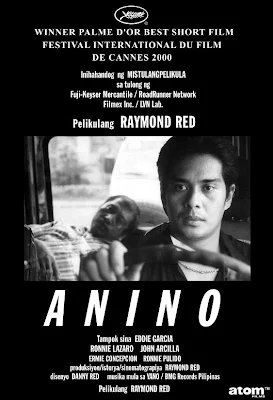
Raymond Red

This article posted as part of the Short Films blogathon:

(First published in Businessworld, 5/26/00)

The Man with the Golden Palm

Earlier this week all the newspaper articles came out about a Filipino winning an award at the Cannes International Film Festival. And not just any award; he had bagged the Golden Palm, the highest honor the festival can bestow.


Tuesday, May 08, 2007

Jeonju 8: Colossal Youth, Oshii's latest, shorts

 
Colossal Youth

Watching Pedro Costas' Juventud Em Marcha (Colossal Youth, 2006) is like diving off the deep end--I've not seen the previous two films of his Fontainhas trilogy, Ossos (Bones, 1997) and No Quarto da Vanda (In Vanda's Room, 2000) or any other film by Costas, and this is probably not the best (read: easy, convenient) introduction to his body of work.

It's maddeningly, fascinatingly obscure, that much I can tell you. Shot in DV, the film is mostly two and a half hours of a 75-year-old man named Ventura (played by an actor of the same name) wandering about, talking to what he fondly calls his 'children' (they may or may not be--the film doesn't confirm one way or another (and if they are his children, he must have been the busiest man with the most number of women this side of Noah post-deluge)). Actually, 'talk' is something of a misnomer: Ventura enters a room, exchanges a few lines of dialogue with the person in the room, and either he or that other person will relate an anecdote, usually some five to ten minutes long, on some past episode in his/her life.

The framing is almost always odd--indoors, Ventura and his fellow inmates (the term seems appropriate, given their circumstances and behavior) are often to one side of the frame, at a slightly skewed angle, the shot held a beat after or a beat before anything significant happens (one thinks of Bresson's equally off-kilter camera angles, and odd timing). At one point Ventura and a man play a game of cards, a brilliant beam of sunlight on the card table the only source of illumination (one thinks of a prison guard visiting his charge in solitary); other times Costas plays his characters off the featureless whitewash of new apartment walls, blank slates against which the people seemed poised to write their lives. Outside, we get repeated images of Ventura sitting on a red chair outside one daughter's apartment (she goes in and out without saying a word to him), or standing with an extremely patient government housing agent (you wonder why he humors Ventura, who clearly has no money with which to pay for all his vaguely ambitious plans) before the housing development into which he's moving, the building looming up behind like some modern ziggurat marking dead and buried lives.

The various monologues are not quite dull--many of the anecdotes are lovely, especially those of Vanda (Vanda Duarte, the eponymous heroine of Costas' previous film) and her tale of salvation from drugs through her husband and baby (Is this actual testimony, or a whitewashed account of how she wished her life would be like? Are any of these people--often shot with a ghostlike aura by Costas--real, or figments of Ventura's wish-fulfilling imagination? Again, the film doesn't confirm). And there's this one migrant worker (Alberto 'Lento' Barros, as Lento) who asks Ventura to transcribe a letter to his estranged wife, an assignment Ventura gradually takes over and makes his own, reciting over and over again an extravagant declaration of love that gets more and more elaborate with each repetition (a late version reads something like this):

Nha cretcheu, my love,
Being together again will make our life beautiful
For another thirty years.
As for me, I will come back full of love and strength.
I wish I could give you a hundred thousand cigarettes,
a dozen of those fancy dresses,
a car, the little lava house you've always wanted,
a threepenny bouquet.
But above all else,
Drink a good bottle of wine,
And think of me.

Here it's all work.
We're over a hundred now.
I still don't have anything from your hand.
I will soon...
Sometimes I'm afraid of building these walls,
Me, with a pick and cement
And you, with your silence.

The letter is richly referential (the title of his 1995 film Casa de Lava translates literally to "House of Lava") and in part, plagiarized: Ventura doesn't admit it to the poor man, but he takes details from
a love letter written by Robert Desnos (note Desnos' at one time close ties with the Surrealists--and keep in mind that Costas' film is filled to brimming with surreal imagery, vivid in their unnerving stillness).

The letter is also, like much of the film, stunningly beautiful. Ventura repeats the correspondence /poem over and over again, and it gradually comes to be the film's stanza--one man's forlorn plea for hope and love, in these hopeless, loveless slums, its extravagance inversely proportional to the man's powers to fulfill it, more an expression of his desperation, his will to imagine a better life for his beloved, than of anything else.

Susan Griffin in her
article on a photo exhibit on Tina Modotti tells a story about Desnos (I won't repeat it, it really belongs in that article); could Costas be thinking in the same spirit, having these lost men and women declare through their reminiscences--incantations, really--a better reality, perhaps a better future that they hope to bring about, mainly by utterance and repetition because they have little else? I don't know, I don't know; but the Desnos story is such an unlikely little anecdote you want to believe in it, the way this film and its focus on these characters seems like a willed hallucination, hoping against hope to change reality through its/their very existence.


After the near-unbearable weight of Juventud, it's tempting to say Mamoru Oshii's Tachiguishi retsuden (Amazing Life of the Fast Food Grifters, 2006) is an abrupt change of pace, but that would be perverse.

The scene: a noodle shop in Tokyo. The time: an hour before closing. Under the light of a full moon appears Moongaze Ginji, who orders a bowl of soup (the camera at one point revolves around the counter to reveal that the near-photorealistic noodle shop owner and Ginji are both digitally animated paper-thin constructs).

Ginji has specific instructions: "Put the raw egg on the noodles. Pour soup into the bowl." He swirls the soup, watching the egg--golden strands in the clear broth--quickly cook. "Nice landscape," he says. The noodle shop owner's reply: "It's only a bowl of noodles."

A narrator explains that the maverick ethonographer (his words) chooses the hour before closing because this was when the owner's psychic self breaks through his businessman's persona, when his very philosophy is apparent; the narrator goes on to note that soba was a commoner's food in the Edo era, and accompanied the spread of Buddhism.

When the noodle owner snorts "it's only a bowl of noodles!" Ginji replies that not only is it just a bowl of noodles, it's noodles made from bogus ingredients. Despite which Ginji is able to devour the bowl's contents at the zenith of its splendor, fully appreciating it the very instant before it vanishes forever. Only words can bring back the intensity of the original experience, in a manner surpassing the original.

The film (of which that opening sequence was but a sample) is a heady, dense, near-incomprehensible mix of Japanese fast-food lore, faux superhero mythology (think Justice League Unlimited animated as if it were South Park and hosted by the Food Network), postwar Japanese history, and postgraduate philosophy. It's some kind of history of con-men with absurd nicknames (the aforementioned Moongaze Ginji; Foxy Croquette O-Gin; Beefbowl Ushigoro; Hamburger Tetsu; Frankfurter Tatsu; Medium Hot Sabu--Tarantino can only dream of inventing aliases as wildly colorful as these) who put on elaborate, even philosophically didactic scams to avoid paying for their meals. Blink or be distracted for even a second, and you lose the thread of the intricate narrative; fail to see this, and you'll miss what I consider to be one of the funniest--and tastiest--films I've seen recently.

Japan-based film critic Mark Schilling seems to have the
clearest take of any non-Japanese on what the film's all about, yet is less than enthusiastic about the final product (For sources of inspiration he cites kamashibai, picture cards used to tell a story, and mentions (but carefully refrains from including) South Park (But why? Couldn't Oshii be a fan, or at least a casual viewer?). And I'd include the more recent Aqua Team Hunger Force and Terry Gilliam's animated sequences in the Monty Python series as possible influences). "Why a movie?" Schillling asks. "The short answer is that, after three largely successful decades in the animation business, Oshii can make nearly anything he wants, including this elaborate private joke. Which is, for the audience, the ultimate grift." Point taken, but it's still funny, I submit; the joke only gets better when you learn it's also on you.

*the longer answer, according to Production I.G. President Mitsuhisa Ishikawa, was that they didn't want to spend a lot of money on Oshii's next film, so they had college students do the post-production work, mainly for the privilege of doing so, and famous animators do the acting (the animators' contracts stipulated that they would help publicize the film (if they didn't their scenes would be cut), so promotional costs were small).


Europa 2005 - 27 Octobre 

Italian public television executive Enrico Ghezzi commissioned Europa 2005 - 27 Octobre from the husband-and-wife team of Danielle Huillet and Jean-Marie Straub to commemorate Roberto Rosellini's centenary . The result is this 12 minute short, a "sequel" to Rossellini's Europa '51 that at the same time refers to October 27, 2005--the day two Parisian youngsters (Bouna Traore, 15, and Zyed Benna, 17) who were fleeing the police hid in a high voltage electric transformer and burned to death, sparking an
uprising in France.

It's difficult to say anything about the film (and if I didn't know anything about the context, well nigh impossible), but the entire short consists of the camera panning right from a huge graffitti on a wall with a bloody handprint, to stop at some building. Cut to a shot starting from the building, panning left past the graffiti (the camera is now several feet further away), ending at the fateful transformers. Repeat several times.

Again, what to say? The walls, the barred gates, the silence interrupted by a barking dog, all connote private properties, to be trespassed (as the youths had done) at one's peril (which the boys were in, actually); the only sign of protest are the graffitis spray-painted on the wall. The filmmakers repeat this searching, probing movement again and again, trying to find meaning in the deaths; one thinks of Ingrid Bergman's anguish in Europa '51, and one realizes that their mute repetitions imply an answer to their probing.

Manoel de Oliveira's O Improvável Não é Impossível (The Improbable isn't Impossible, 2006) is another commissioned work, this one from the Calouste Gulbenkian Foundation to commemorate the 50th year of their musuem. Oliveira cuts images of the museum's treasures--from sculptures to artifacts to paintings to live concert performances--together without any comment save by the museum's officials. Like any master, he homes in on the tiny detail none of us would think of pointing out--the endless doors opened and closed in such institutions, implying necessary categorizing and compartmentalization (a museum's exhibits must be organized to make sense) at the same time there's access (the doors are constantly opening and closing, as prelude to and transition between galleries). Wonderful, puzzling little film.