Thursday, September 19, 2013

You're Next (Adam Wingard); The Man With Two Brains (Carl Reiner); Act of Love (Anatole Litvak); The Man with the Golden Arm (Otto Preminger)

(WARNING: plot twists and surprises in the films may and often are revealed in the course of discussion)

What next?
 
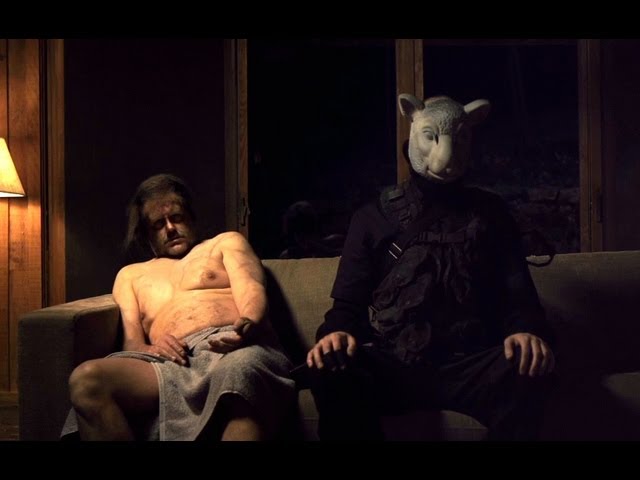
Adam Wingard's You're Next is a nasty, fairly well-made house-invasion flick, with the added kick of animal masks for that extra dose of surrealism. Wingard is a horror veteran, and knows how to stage shocks and suspense as well as anyone out there, maybe a little better than most; if he still cuts too fast and shoves his camera too closely at the action for my taste--well, we're not talking high standards for the genre as a whole here, especially nowadays.

A bigger problem in my book are the characters, mostly repulsive upper-class types blessed with faintly amusing dialogue (you find your entertainment where you can) and a level of sadism that suggests twisted motives behind their cruelty--which sadly isn't the case; turns out the driving force behind the murders is good ole-fashioned greed. All this--the elaborate planning, the archaic weaponry, the serene animal masks (single best detail in the whole picture)--just for daddy's money? Really? Couldn't they just have purchased assault rifles from the nearest gun shop and stormed the house? At the very least, couldn't the writer develop the contrast in class and background between the movie's Addams Family and the she-Rambo (whose father is, conveniently, a survivalist) acting as the movie's putative champion? At one point things begin looking interesting when sex is offered on a bed next to a dead relative's body--but the offer is swiftly rejected. We're fucked up, but not that fucked apparently (and unfortunately). 

As for that ending: I suppose the writers were trying to make a metaphysical point--that we're all killers or become killers given the right circumstance, or that we're pawns played by an infinitely more cunning chess master--but by then I was just waiting for the end credits to roll. The finale pretty much came out of nowhere, connected with nothing, and apparently isn't meant to be anything more than a cheap punchline to the picture.

Unfair to use another film to bash the one you're discussing but Michael Haneke's Funny Games is so much better at playing the same game it isn't even funny. Haneke doesn't so much avoid as completely drop any pretense of making a horror movie--no fast cutting, no tilted camera (which glides with stately aplomb through the large if low-key home), no waiting for night to start twisting one's nerves into little knots, only a smooth deadpan which intensifies the horror. He operates on the more interesting proposition that psychological suffering is crueler and harder to watch than any mere crossbow bolt to the skull.

I pretty much realized the movie wasn't going to be all that when I saw "YOU'RE NEXT" painted with blood in sloppy giggling-psychopath handwriting, all over the bedroom wall. Aside from the corniness of announcing the title of the picture, the sheer conventionality of the cliche was overwhelming: couldn't the handwriting be neater at least, perhaps in cursive? The threat was a blatant promise of standard-issue horror cliches to come; sadly, the filmmakers deliver. 

Cerveau en gelee

Once upon a time, long before he started remaking the Pink Panther films to disastrous effect, Steve Martin (especially in collaboration with Carl Reiner) was a one-of-a-kind wonder, and while my favorite might be the comically complex and surprisingly coherent All of Me, not far behind and coming fast up the ladder of regard is the demented The Man with Two Brains. Suppose I still love the former--watching Steve Martin argue with the Lily Tomlin side of him is an indispensable pleasure--but the latter is Martin and Reiner at their unfettered undiluted best, without the benefit (or limitation) of a conventionally structured script. Mad scientists depicted by mad filmmakers--what more can anyone ask?  

It's unexpectedly erotic, with the faithless Dolores (Kathleen Turner) in the habit of driving her neurosurgeon husband Dr. Hfuhruhurr (extended running gag where various people mispronounce his name) wild by not sleeping with him--roughly the first half of the film is about building up a massive case of blue balls, and the film is all the sexier for it. Turner was fresh off the success of Body Heat where I felt her femme fatale newcomer (it was her debut feature film role) was stilted and stiff, more focused on looking good onscreen with little to no clothes on than she was on delivering a sensual performance (hint: it's more important to relax than focus). Comedy seems to release something inside her; she's more assured here, more playful, a tease rather than a tart (though we get plenty evidence of the latter), and for single sexiest image in the film--or most of '80s cinema for that matter--it's hard to think of anything more potent than Turner's eyes aglow with the thrill of power as she leaves Martin hard up--literally--and throbbing with sexual frustration.

Also helps that Michael Chapman--Rainer Werner Fassbinder's old collaborator--handles the camerawork. Reiner (Carl) is no visual stylist, and comedy as a genre rarely if ever pays lip service to the art of cinematography (look at the entire career of Mel Brooks, or--arguably--Woody Allen), but with the not inconsiderable help of Chapman the film achieves a darkly handsome subterranean ambiance, adds conviction (and an unholy Gothic grandeur) to the film's mad-scientist shenanigans, lends credence to the possibility that the doctor is mad, maybe dangerous. 

Just check the above still: Martin is surrounded by jars of brains--a staple for the genre--only here the brains float in what seem like various enticing flavors of phosphorescent Kool-Aid, from Purple Passion Grape to Bubble-Gum Pink to Certified Cherry; one is almost tempted to tilt a jar lid, stick in a flexible drinking straw, and sip.

Perhaps most surprising of all is how sweet-natured the film turns out to be: Dr. Hfuhruhurr meets Anne Uumellmaehaye (voice of Sissy Spacek) and it isn't just that their surnames somehow feel appropriate together, Anne also happens to be a brain in a jar, which of course is catnip to a brain surgeon. From a perfectly incarnated if faithless wife the doctor learns the true value of facial beauty (basically not much more than the silicon it's built on); he finds himself falling for a woman who's all mind, literally transcending the limitations of flesh. We feel the force of his delight at discovering how every detail of her fits neatly into the sharp edges of his eccentric if essentially gentle character; we're charmed at how neatly a bizarrely comic horror-movie plot premise is deftly pretzeled to insert a bizarrely apt romantic-comedy plot twist (added bonus: hilarious commentary on the shoddy construction of modern apartment dwellings). We're conquered, seduced by these lovers; we feel (swoon, pine, fear) for them almost as much as they feel (swoon, pine, fear) for each other. 


Love you long time

Anatole Litvak had a varied career ranging from costumed films (Mayerling, Anastasia) to harrowing dramas (The Snake Pit) to noir thrillers (Sorry, Wrong Number). Act of Love is a lesser-known work, a wartime melodrama about a homeless French girl (Dany Robin) stranded in Paris without papers, forced to pretend that an American GI (Kirk Douglas) is her husband. Robin gives a fine understated performance as a naive girl trapped in a sordid situation--reacting to fellow Frenchmen leering at her and her 'husband,' her face registering every humiliating moment quietly yet indelibly, like rice paper on a barroom floor. Douglas is Douglas, a straight-shootin' soldier who plays bitter and cynical when the script demands it but is ultimately sincere in his declaration of marriage (of course fate decrees otherwise); he's at his best I think years later, as a lounge lizard in a south-of-France seaport--more thoughtful, more conscious of the burden of memory, and of possibly having exchanged roles with the girl he once loved.

Litvak's camera is stylish as ever, and delivers various memorable flourishes: a riff on the marriage scene in Citizen Kane where various French folk give their thoughts on the American occupation before a whirling camera; a harrowing point-of-view shot of a disillusioned Frenchman wielding a sharp knife. The tragic finale (with stories of this sort the finale has to be tragic) is delivered with graceful simplicity: the camera stands at a corner and gazes at the people going to and fro, running and missing their various fateful appointments with destiny.   


Monkey do

Otto Preminger's The Man with the Golden Arm has a gorgeous title, its protagonist a beautifully intimidating name; no wonder Frank Sinatra wanted the role, would probably have killed for the role (for all we know he did). 

Admittedly the film pales in comparison to Nelson Algren's dark novel; admittedly what was shocking in the '50s--the necktie looped tight round the arm, the slim syringe--seems mild today; admittedly the film is regarded nowadays as more a historically important curio than an artistically significant film, mostly for breaking the Hollywood taboo on onscreen drug use.

But is it still relevant? Does it still have the power to startle, at least unsettle? 

I think so. Drug movies like Darren Aronofsky's Requiem for a Dream draw on an arsenal of pyrotechnic effects, from giant close-ups to shock cuts to time lapse to slow motion, to suggest the diabolically distorting nature of drug use; all Man needs is Preminger's classically oriented eye, Elmer Bernstein's music, and Sinatra. 

Sinatra owns Frankie Machine; that's him onscreen, or as much of him as careful research and a volatile acting talent untainted by formal training can muster. The sweat on Sinatra's brow and upper lip when he's shooting up could have been sprayed there for all I know but he makes you believe he squeezed them out through sheer effort; the dilated eyes are simple to achieve, but when co-star Kim Novak lights a match and shoves it at his face the sight can still make the flesh crawl, like finding maggots writhing beneath an upturned stone.

As for the clearly studio-constructed apartment and street sets--I submit to you that they are (intentionally or not) Preminger's most cunning effect, his way of suggesting the city of Chicago is a flimsy extension of Frankie's fevered mind, row upon row of balsa and plywood piled high and ready to fold at the slightest shove. Do the apartment, the very streets seem unreal? They do to Frankie--nothing is solid, nothing registers, nothing matters to him save that needle in his arm. 

And Sinatra pushes past everything as if propelled by Preminger's  camera (barely making it through before everything round him collapses), his progress marked by Bernstein's hot jazz score (performed by Shorty Rogers and His Giants). He approaches Louie (Darren McGavin, decades before taking up nightstalking), who throws coy looks; follows the dealer to an apartment; watches shivering as the spoon packet and so forth are (like an elaborate dinner setting) meticulously laid out. Preminger's camera rushes up to Sinatra's face as his jaw slackens and his pupils flare wide, brass horns blaring heedless triumph; it's a hell of a high, one even the unlikely happy ending (arguably a fantasy like the rest of Chicago, who's to say it isn't?) can't quite squelch, a monkey that--as Louie puts it--you can't quite pull off your back.

9.19.13

Tuesday, September 03, 2013

Frederik Pohl: Nov. 26, 1919—Sept. 2, 2013

Frederik Pohl: Nov. 26, 1919 - Sept. 2, 2013

I grew up reading him.

No, that doesn't quite describe how it went. I grew into what I am reading him. What science can do, what its consequences; how man can use--and misuse--science, how this affects him; how one can write about science, in ways both creative and psychologically incisive. Pohl showed many of the possibilities, and showed an effortless mastery of them in the process. 

Kingsley Amis called him "the most consistently able writer science fiction, in its modern form, has yet produced." Not perhaps high praise--he doesn't call him a genius, a producer of great work--but when you see the breadth, variety and depth of that work, perhaps it's accurate: he's consistent, he's prolific, and across that range he's incredibly able.

The Locus article I linked to above will give an idea of the size of that career--not just writer but editor and blogger and all-around man of letters. All I knew when I first read his classic short story "The Midas Plague" was that I'd found a writer capable of evoking a near-unimaginable world, of unlimited wealth and almost ceaseless consuming to the point of nausea, where cheap and tasty products rolled down conveyor belts at an unimaginable rate and you're constantly pressured to use, watch, enjoy, eat, eat, eat.

Then again, maybe that world isn't so unimaginable anymore.

"The Midas Plague" is a broad cartoon, if an unsettlingly convincing one; "The Day After the Day the Martians Came" showed a subtler Pohl, demonstrating how even as momentous an event as an alien encounter will inevitably be reduced (consumed?) by human culture into a series of racist (specist?) jokes, into banal contempt and condescension. 

Try as much as I can, I can't remember much of The Space Merchants, Pohl and longtime collaborator C.M. Kornbluth's classic satire where corporate advertisers and not governments run the world. Advertising is deceitful (imagine that!) and omnipresent, corporate espionage a game as dangerous as any cold war. I know it's an important novel, but it failed to make an emotional connection; I suppose I need to read it again.

I do remember the lesser-known Gladiator-at-Law--not just an eerily prescient treatise on Law and Big Business but a frighteningly vivid depiction of poverty. As when he describes an old woman working a makeshift restaurant in the devastated area of Belly Rave (nee Belle Reve):

Outside, Norvell asked shyly what in the world the old woman thought she was doing for a living.
 

"It's simple," said Shep. "She gets her rations and trades them for
firewood. She uses the wood to heat water—for coffee, or bouillon, or tea, or whatever. She trades the water for rations. She keeps hoping that some day she'll come out ahead on the deal. She never has."


"But
why?"

Shep didn't speak for a long minute as they sauntered along in the
afternoon sun. At last he said, "No offense. But it's easy to see you're a come-lately, Bligh- Why does she do it? Because it makes her feel like a human being."
 

"But——"
 

"But hell. It makes her feel as though she were master of her fate,
captain of her soul. It's hard to starve to death in Belly Rave, but in a bad week she comes close to it. She thinks she's a Rockefeller or a Weeks in miniature. Risking her capital in the hope, of gain. Well, she is! What if she always loses? She's doing something—not just sitting and waiting for the ration day to roll around again. You've heard of hell?"


Norvell nodded. Like practically everybody else he was a member of the Reformed Rationalist Church of the Inchoate Principle, but hell had been mentioned in sermons now and then.
 

"Well, if a man who said that hell is a perpetual holiday was right, then this is it. Belly Rave, mister. Belly Rave."

Hope in the face of despair, and a kind of urban poetry. That was pretty much it; I was hooked on Pohl.

Most people who've heard of Pohl (if they have heard of Pohl; nowadays people read Harry Potter and Lord of the Rings and any number of Star Wars novels) would have heard of Gateway, his Nebula and Hugo Award-winning novel about enterprising prospectors who climb aboard unknown alien ships and risk life and limb and more, taking these ships to unknown destinations for possible profit, or death, or worse. 

Even more fascinating than the premise was the way the novel was written, as a series of short episodes, bulletins, announcements, price lists--

Direct from the Lost Tunnels of Venus!
Rare Religious Objects
Priceless Gems Once Worn by the Secret Race
Astounding Scientific Discoveries
EVERY ITEM GUARANTEED AUTHENTIC!
Special Discount for
Scientific Parties and Students
THESE FANTASTIC OBJECTS
ARE OLDER THAN HUMANITY!
Now for the first time at popular prices
Adults, $2.50
Children, $1.00
Delbert Guyne, Ph.D., D.D., Proprietor

--letters, even computer source code, giving us a fragmentary view of the world that eventually comes together into a fascinatingly complex whole. The first line of the book: "My name is Robinette Broadhead, in spite of which I am male" not just introduces the protagonist but puts front and center his sexual ambivalence; the often funny bouts with his computer analyst Sigfried explore not just aspects of his persona but also the plot, which revolves around a traumatic event in Robin's past.

A sample:

Sigfrid is a pretty smart machine, but sometimes I can't figure out what's wrong with him. He's always asking me to tell him my dreams. Then sometimes I come in all aglow with some dream I'm positive he's going to love, a big-red-apple-for-the-teacher kind of dream, full of penis symbols and fetishism and guilt hang-ups, and he disappoints me. He takes off on some crazy track that has nothing at all to do with it. I tell him the whole thing, and then he sits and clicks and whirs and buzzes for a while -- he doesn't really, but I fantasize that while I'm waiting -- and then he says:

"Let's go back to something different, Rob. I'm interested in some of the things you've said about the woman, Gelle-Klara Moynlin."
 

I say, "Sigfrid, you're off on a wild-goose chase again."
 

"I don't think so, Rob."
 

"But that dream! My God, don't you see how important it is? What about the mother figure in it?"
 

"What about letting me do my job, Rob?"
 

"Do I have a choice?" I say, feeling sulky.
 

"You always have a choice, Rob, but I would like very much to quote to you something you said a while ago." And he stops, and I hear my own voice coming out of somewhere in his tapes. I am saying:
 

"Sigfrid, there's an intensity of pain and guilt and misery there that I just can't handle."
 

He waits for me to say something.
 

After a moment I do. "That's a nice recording," I acknowledge, "but I'd rather talk about the way my mother fixation comes out in my dream."
 

"I think it would be more productive to explore this other matter, Rob. It is possible they're related."
 

"Really?" I am all warmed up to discuss this theoretical possibility in a detached and philosophical way, but he beats me to the punch:
 

"The last conversation you had with Klara, Rob. Please tell me what you feel about it."
 

"I've told you." I am not enjoying this at all, it is such a waste of time, and I make sure he knows it by the tone of my voice and the tenseness of my body against the restraining straps. "It was even worse than with my mother."
 

"I know you'd rather switch to talking about your mother, Rob, but please don't, right now. Tell me about that time with Klara. What are you feeling about it at this minute?"

I try to think it out honestly. After all, I can do that much. I don't actually have to say it. But all I can find to say is, "Not much."
 

After a little wait he says, "Is that all, 'not much'?"
 

"That's it. Not much." Not much on the surface, anyway. I do remember how I was feeling at the time. I open up that memory, very cautiously, to see what it was like. Going down into that blue mist. Seeing the dim ghost star for the first time. Talking to Klara on the radio, while Dane is whispering in my ear. . . . I close it up again.
 

"It all hurts, a lot, Sigfrid," I say conversationally. Sometimes I try to fool him by saying emotionally loaded things in the tone you might use to order a cup of coffee, but I don't think it works. Sigfrid listens to volume and overtones, but he also listens to breathing and pauses, as well as the sense of the words. He is extremely smart, considering how stupid he is.

A cat and mouse game they're playing; Pohl points up the chase-and-be-chased element with a repetitive, even circular motif, Robin's contemptuous assessment of Sigfrid's intelligence. He teases us with vague hints of the nature of the trauma (going down; blue mist; dim ghost star) but mostly we're dealing with Robin's feelings of hostility at having his insides probed, like an exposed nerve in a decayed tooth or (more pertinently I think) a rectum shivering in the chill clinic air. Sigfrid is blandly soothing in the best HAL 9000 manner but unlike Kubrick's computer (arguably the best, wittiest character the filmmaker ever put onscreen) he is not to be deterred; he parries and fences with Robin relentlessly until he has coaxed the patient into giving up yet another painfully won nugget of detail (of course Sigfried already knows what happened; the trick is getting Robin to talk about it). You get the sense that when Sigfrid finally uncovers the trauma is when the novel arrives at its (possibly harrowing) climax. 

Of all cyborg films, TV shows and stories, arguably the most convincing I know is Pohl's Man Plus, not just for the sheer wealth of scientific detail about the chemical, biological and technological elements that go into the making of a cyborg fit for survival on Mars, but the at times horrific physiological and psychological changes wrought on Roger Torroway, the man being transformed, possibly the most chilling of which is reflected in this excerpt:

“I was worried about sex," he went on. "But you know what, Sulie? It's like being told I can't have any caviar for the next couple years. I don't even like caviar. And when you come right down to it, I don't want sex right now. I supposed you punched that into the computer? 'Cut down sex drive, increase euphoria'? Anyway, it finally penetrated my little brain that I was just making trouble for myself, worrying about whether I could get along without something I really didn't want. It's a reflection of what I think other people think I should want.”

A perfectly reasoned-out, totally mature rationale for chastity? God forbid! And yet Pohl manages to make it a natural development, even a happy one for Roger...

Arguably the most fascinating aspect of the whole operation are the mediation circuits being developed for Roger. His previous incarnation died of a stroke; the stress of TMI (too much information) burst a blood vessel in his brain. Roger has computer circuits simplifying the flow of images and data to him, and this creates bias in his view of the world; Pohl ultimately pulls back to demonstrate that this--the introduction of bias--is a meta thing, not just a problem specific to Roger, and we're left shuddering, wondering: who might be interpreting our data for us? And why?

Gateway is generally considered Pohl's masterpiece and it's an intense, moving work, but in Man Plus--as in all of the very best science fiction--Pohl seems to have asked the most interesting questions: what makes us human? More than human? More, is the need for bias in the information flow inevitable, even desirable? Who creates bias for us, and who creates bias for them in turn? Pohl probes into the nature of not just art (of an individual's creative introduction of bias) but communication itself, which apparently is every bit as slippery and relativistic as the rest of space and time. 

As for that most fascinating element in science fiction, the human response in the face of technological change--what does Roger Torroway do when he finds control of his senses suddenly and catastrophically taken away from him? He struggles to regain control; that, and he yells for help. It's the best he can do, feeble as it may sound, the best anyone can do when you come to think about it.

 9.3.13

Thursday, August 29, 2013

Bullet to the Head, Silver Linings Playbook, Secret Sunshine, Journey to Italy


Last Action Hero

Bullet to the Head is easily the best recent American action flick around, and Walter Hill can teach both Tarantino and Nolan a thing or two about action filmmaking.

You heard me. 

"But what about the script, a standard-issue buddy pic filled with standard-issue dialogue? What about Stallone, who hasn't given a good performance in years?" Actually the script is 1) a decent workhorse plot with a handful of fairly clever twists, the dialogue a touch more amusing than it has any right to be ("Bang. Down. Owned." "You had me at 'fuck you!'") because Stallone and co-star Sung Kang have good chemistry; and 2) if you want good dialogue and acting, go watch a stage play; the real reason to watch this is to welcome the return to the big screen of one Walter Hill, filmmaker--last reported retired, apparently not quite.

Hill speaks today's action filmmaking language--handheld footage, ADHD editing--with admirable fluency (he was after all doing hardcore action back when some of these directors were still in grade school). He knows how to shake 'em and cut 'em, only unlike some of the relatively younger turks (I'm looking at you, Nolan) he only flirts with incoherence, mixing up the footage with more stable shots that anchor the action to their confined urban spaces.

And it isn't as if he were repeating himself; the Hill that did The Long Riders or Southern Comfort or The Warriors used slow motion; Bullet does not, and you can almost hear Hill saying "That slow-mo stuff is for kids;  real men do it in real time." There's a showdown involving fireaxes that I thought was within shouting distance of Toshiro Mifune's spear duel in The Hidden Fortress--high praise, I know, but I think the choreography, camerawork and editing deserves it. A New Orleans critic called the confrontation "a choppy series of frustratingly quick cuts that end up turning the whole sequence into a generic blur of clanks and blood spatters." I say the man needs to see more Bob Fosse; Hill has the confidence to zoom in close, shake things up a bit, even accelerate the cutting rate to the point of confusion and at the right moment pull back and allow the whole thing to come together inside your head.

And Hill unlike some filmmakers (I'm looking at you, Tarantino) knows how to evoke setting; knows how to evoke atmosphere;  knows that the throwaway shots that fill the dead space between action setpieces are what help distinguish a coked-up hack from a real filmmaker. New Orleans here may be an urban fantasy every bit as unreal as New York City in The Warriors, but it's a memorably stylized fantasy--Stallone drives past an abandoned factory and it sits in the bright Louisiana sunshine like a disintegrating Czarist palace; old industrial spaces gleam with rust and dripping water, as if dipped in oil; Bobo's shack squats over the gleaming bayou like an oversized poison toad. When a car explodes and flips (we're told that Stallone's character was trained in demolitions, helping explain--barely--all the gratuitous detonations) the flame and smoke rise pyramidlike from one corner of the screen, and your spine can't help but tingle at this bit of gorgeously served mis-en-scene.  

Are the boys back in town? Not really--the film has earned the smallest amount of boxoffice of any in Stallone's career, and barely registered in the local multiplexes before being pulled out, presumably due to poor ticket sales. But from the evidence onscreen Hill is back, and he's back with a vengeance.


Lovers on Lithium

David O. Russell's Silver Linings Playbook shows how a pair of lovers meet and struggle with each other, the catch being both suffer from a mental condition. It's a romantic comedy, of course.

That takes more and less courage than one might think. No, Russell doesn't depict the extremes of the condition: Bradley Cooper's Pat is bipolar but not cripplingly so, at least while he takes his meds; Jennifer Lawrence's Tiffany has something unspecified which probably involves depression (she mentions taking Effexor) and she does just fine, more or less; Pat Sr. has an obsessive-compulsive disorder that he manages to keep undiagnosed, though after five minutes of watching him (the relentless viewing of every Eagles game; the even more relentless observance of football superstitions) anyone would come to the same conclusion. 

They're not that bad off; if they were, this would probably be a different movie, and probably not a comedy. That said, it's amazing the things they do get right--I love the scene where Pat and Tiffany start talking about their meds, throwing names like Seroquel and Klonopin and Trazadone around like so many types of Hershey's Chocolates. It's a funny way to connect that feels perfectly true, with everyone around wondering at the foreign language they're suddenly spouting. I love how Pat seems to focus on a specific topic, then suddenly swerves ninety degrees in a different direction: "I don't have an iPod. I don't have a phone. They don't let me make calls. I'm going to call Nikki." Some of the dialogue sound as if recorded or scribbled down from inmates from real institutions, then handed over for the actors to use.

I love it that the finale--a dance contest where Pat and Tiffany don't mean to win, just earn enough points for a parleyed bet--doesn't show a pair of lovers giving a great dance number, just two reasonably limber actors pouring their hearts out clumsily and heedlessly on the dance floor, letting their chemistry instead of their meager dance skills speak for them. Russell's signature brand of nervy cutting and over-the-shoulder handheld footage makes for a good fit--the style suggests Pat's precariously high-tension worldview nicely. His camera rushes the lovers like a fan shrieking for an autograph, giving them the unadulterated star treatment (he's more respectful of the veteran dancers, keeping the camera relatively still to better capture their choreography). 

This is easily one of the best romantic comedies I've seen recently--is probably the only romantic comedy I've liked recently, which is a whole miracle right then and there.

Massive trauma

Lee Chang Dong's Secret Sunshine is easily the most harrowing film of recent years; with its deceptively bright and artless cinematography (by Cho Yong-kyou, who also did Timeless, Bottomless Bad Movie and Barking Dogs Never Bite) it conceals the machinations of a vast uncaring world ready to pull the unsuspecting in, chew them up in horrific ways, spit 'em out like gristle

Like Ozu or Naruse it seems Lee is able to sketch with elegant strokes the complicated life of a young woman named Shin-ae (Jeon Do-yeon in a tremendous performance) who has already suffered a tragedy; with son in tow she wants to replant roots in her dead husband's hometown of Milyang, which in Chinese apparently translates to 'Secret Sunshine.' Lee is a modern master at the art of understatement, unreeling with relentless deliberation a story of suffering, anger and loss--leavened with not a bit of satire and observational, sometimes perverse, humor.

It's perhaps useless to compare Lee to a seasoned sadist like Lars Von Trier; personally I find the contrast instructive. Lee's heroines are generally less passive, more likely to possess a sense of wit or imagination (I just have to think of Emily Watson's Bess or Bjork's Selma to shudder at the sheer sense of victimization involved). Von Trier has often said he suffered from depression; watching his films I often feel he wants to dump his depression on us, bringing along all the advantages of personal involvement (strong motivation, extensive experience) as well as disadvantages (a lack of perspective). Lee from the evidence of his films doesn't seem as emotionally entangled, bringing to the table his advantages: the patience to refrain from pushing till the victim (sorry--viewer) is numbed past the point of belief or suffering (at a certain point you stop weeping and start giggling); the judgment necessary to inflict only as much pain as necessary to prove the film's thesis, not as much pain as will satisfy the filmmaker's bloodlust.

Arguably the single most painful moment in the film (skip the rest of this paragraph if you plan to see the picture) is the conclusion: as Shin-ae grasps desperately at one thing or another (church, sex, suicide) to steady herself, she finally and unexpectedly finds peace...and hence the cruelty. Some kind of resolution, even one involving death, even one involving her death, could have provided closure; instead she's granted breathing space, a moment of grace that enables her to move on, accept whatever else life has in store for her. She's ready for more punishment in short, and you feel that Lee has a varied and limitless inventory set aside waiting for her. That's the frame of mind you're in, after watching this film.

Cinema is dead

Simplest description of Roberto Rossellini's Journey to Italy: two Northern Europeans' odyssey through the mind and sensibility of a Southern European filmmaker. Second simplest description: the fracture and eventual disintegration of a middle-class marriage.

For the rest of the post (it got too big!) please go here.

2.22.13 

Monday, August 26, 2013

The World's End (Edgar Wright); Blue Jasmine (Woody Allen)

Apocalypse haw

(WARNING: storylines and plot twists of both films and A Streetcar Named Desire discussed in close detail)

After the smoking stinking wreckage that is This is the End, Edgar Wright's The World's End shows us how an apocalyptic comedy is supposed to be done: with economic swiftness (rare), skill (even more rare), cinematic panache (almost totally unheard of). The opening sequence (the narrative gliding from one scene to the next as if the world was a series of tableaus arranged in a row, the camera on an endless pair of rails running parallel), the fights (an unholy cross between the ferocity of movie barroom brawls and the balletic grace of Jackie Chan), the funny-terrifying shots of hapless humans running from hostile townfolk, their eyes and mouths blazing--all this confirms that, of filmmakers working now, Wright is one of a select few who make comedies one can actually look at (beyond him there's Sam Raimi, Tim Burton, Ben Stiller, Stephen Chow...not many more).

Love the group dynamics: the over-the-hill middle-aged men roused into one last epic round of drinks by one of their less successful own, one Gary King (Simon Pegg at his scuzziest best). There's a love interest played by the scrumptious Rosamund Pike, but after a brief bop with 'The King' in a 'disabled only' toilet stall early in the movie she's quickly relegated to supporting status; the picture's real central relationship is between Gary and estranged best friend Andy (played by longtime true-life bromantic partner Nick Frost--here (amusingly enough) the straight-laced conformist). Gary and Andy (not only do their names rhyme somewhat, the first seems to phonetically meld with the next like a brand of designer ice cream) are really trying to find the friendship they lost twenty-five years ago, and not feeling it; as they continue to flee they shed not just physical (a rolling wreck of a car nicknamed 'The Beast') but various emotional and psychological baggage (the anger of a wronged comrade; the fiction of a successful life) to finally confront each other at the eponymous bar metaphorically naked, confessing that for all their hurry they haven't gone anywhere at all with respect to each other, without each other.

The relationship is not as memorably, centrally, complexly depicted as in Wright's Shaun of the Dead (arguably his masterpiece) though it's a far better showcase than the visually flat Paul. Coupled with a breathlessly paced chase (which begins with a leisurely walk that turns into a drunken determined stagger, accelerates into a flat-out sprint), some sharp observations about the modern pub experience (lookalike bartenders; bland beer and decor; even blander semi-sophisticated bistro food) and a comment on the true value of British--and beyond that human--individuality (in effect nothing special; Gary pleads against alien assimilation (the townsfolk's ultimate aim) strictly it seems for the sheer cussed principle of it--is later seen drinking with the very creatures he ran from), this after all is said and done is really superb stuff. Aside from the underrated, underpopular Pacific Rim, the most entertaining movie of the summer.


A streetcar named disconnect

What to make of Woody Allen? Common complaint is that he's out-of-touch--a sensibility straight from the '60s coupled with a visual style frozen in the '70s--while defenders say he's a consistent artist who has managed to wring variations on a strictly defined set of themes and locations and actors (all three changing oh-so-slowly through the decades).

I mean--look at that credit sequence! He's been using that same font and practically the same jazz music since, I don't know, Take the Money and Run, over forty years ago.

So what to make of Blue Jasmine his reworking of Tennessee Williams' A Streetcar Named Desire? Well...

There's only one city in the world for Allen, and that's New York. From the opening montage depicting Manhattan in the film of the same name (accompanied by the strains of Gershwin's magnificent Rhapsody in Blue) to Coney Island's The Cyclone shaking up Allen's childhood breakfast in Annie Hall, the city lives and breathes and sings like a character actor constantly and loyally used (is perhaps the single most consistent actor in his pictures). London in Match Point, Paris in Midnight in Paris, Rome in To Rome with Love seem like outtakes from a Lonely Planet video--pretty, but strictly for tourists. San Francisco in this film seems especially inexpressive: we see a few harbors and maybe one shot of a tilted street, and if anyone in the city is gay they're still keeping it strictly in the closet.

It's difficult to take off from a classic piece of theater like Streetcar and avoid comparisons (often unfavorable), not just to the play but Elia Kazan's famed film, and if you're as familiar with the text as I am (taught the play for some years) there's something jarring about Williams' almost perfectly structured plot (eleven scenes of ever-briefer length, accelerating remorselessly to its inevitable climax) being twisted about. When Allen, for example, comes to his equivalent of Scene Three: "The Poker Night," Chili the Stanley figure (Bobby Cannavale) tosses not a radio but a phone not out the window but across the room. Not really that big a problem, I can see how a phone torn from its wall mountings can be seen as shocking--but when he's ordered out by Ginger the Stella figure (Sally Hawkins) you remember with a start that he doesn't even live there. Where Williams confined the action of his film to a period of a few months and a single cramped New Orleans apartment, here the conflict is dissipated over time (the picture flashes backwards and forwards over a period of years) and space (from San Francisco to New York, from Ginger's rather roomy lower-middle-class apartment to Hal the Allan Grey figure (Alec Baldwin) and his expansive Long Island mansion. And ordering Chili/Stanley out--what's that all about? You'll eventually need to bring him back in again, for the climax (which is considerably muted).

More conventional sexuality (Williams had at least one gay character--Allan--and at least suggested nymphomania); markedly less cruelty (plenty of shouting, no real physical or sexual abuse), a more experimental story structure hiding an ultimately more ordinary drama. Allen has grown as a filmmaker--somewhat; it's his good taste and restraint that seems to keep him frozen in time.

That said, Allen does improve on the Kazan film on at least one point--where Kazan lets one sister escape, Allen leaves both physically free yet psychologically trapped, their prisons defined solely by the dimensions of their own craniums.

Maybe there's another more fruitful way of seeing Allen: as a kind of Rip Van Winkle, skimming his way across this new millennium in cryogenic sleep, waking briefly to raise his head and take a quick look around before going back under--those brief moments of exploration and expression, those are his films. Out of touch? Possibly--and still he brings something to the party: the perspective of an older age, a pair of eyes that see this world as the ultimate alien landscape, the ultimate source of pain and drama and comedy. I don't know, I guess I'm still waiting for the film where Allen finally admits to this point of view, uses it fully, freely, artfully--maybe in the next one, which should come out next year.

8.26.13

Monday, August 19, 2013

The Butler (Lee Daniels); Fruitvale Station (Ryan Coogler); Much Ado About Nothing (Joss Whedon)

The butler didn't do it

Lee Daniel's The Butler (director's name included reportedly for copyright reasons) really should read: Lee Daniel's Forrest Gump. We get a similarly hapless, helpless hero bouncing his passive way through recent American history, though Daniels does refrain from digitally inserting his protagonist in every famous archival footage in recent memory--at least we're spared that travesty. 

I'm guessing though what Daniel's really striving for with this story of Cecil Gaines (Forrest Whitaker), the White House butler who served seven presidents (based loosely--very loosely--on the story of Eugene Allen), would be popular audience response to Gump's feel-good version of history (we experience in swift succeeding order institutional oppression; physical, mental suffering; decades of bad prosthetic age makeup; and ultimately and eventually vindication, triumph) combined with the kind of respectful accolade granted to filmmaker James Ivory and novelist Kazuo Ishiguro for their film Remains of the Day, about yet another butler (Anthony Hopkins) serving in the cusp of history. Not an easy task, though--Ivory directs with an aesthetic severity that sucks all the pathos out of the material; you actually find yourself gasping for air in the film's hermetically sealed screen space (my favorite of Ivory's works, possibly) while Hopkin's unceasingly smiling butler stand invisible and invincible in one corner. 

Daniels doesn't suffer any severity, except perhaps the ADHD kind: his movie makes Robert Zemeckis' picaresque romp through the decades look positively Japanese with subtlety and restraint. There isn't a dramatic confrontation or emotional breakdown or historic occasion he can't shove in your face and up your nose with his ten-ton touch; this is coercive emotional porn of the worst sort, shameless propaganda shrieked out from the rooftops on the remote chance that perhaps you didn't get the message. I found myself hiding behind the seat before me, trying to avoid the sheer obviousness of it all (case in point: the picture's final death is telegraphed at least minutes before it actually occurs, causing me to exclaim: "Can't believe he's going to do it--oh, he did it!").

A shame, because there are some honestly powerful moments to be found here. Daniels builds some surprisingly potent comic-horrific contrapuntal rhythms from the sequence where Gaines' rebellious son (David Oyelowo) insists on keeping his chair at a whites-only lunch counter while Gaines seats honored guests at the White House dining room; later Daniels intercuts between Gaines listening to Nixon talking about undermining the Black Panthers and Gaines' son listening to the Panthers speak similarly brutal language. In moments like these Daniels makes a cogent point: that estranged father and son aren't so far apart in their struggles and aspirations as they would like to think they are.

Whitaker does plenty with an indrawn breath or a slightly lifted brow--but he isn't working with a screenplay from an Ishiguro novel, nor does he enjoy the deft guidance of a James Ivory (at one point Gaines actually quotes a line, not from the Ivory film but from an interview about the film, where Hopkins summarized his character with the observation that ideally a room should feel emptier when the butler is present; Hopkins actually makes you feel that vacuum while Whitaker with no small help from Daniels fails--possible because the feat requires subtlety). Whitaker's role (heroic restraint in the face of dramatic circumstances) also bears striking resemblance to Cherry Pie Picache's emotionally wounded-up surrogate mother in Brillante Mendoza's Foster Child--only Mendoza doesn't provide dramatic catharsis and spiritual uplift at the end of his film. 

What Daniels has done (or failed to do) can't help but make me better appreciate Eddie Romero's achievement in his Ganito Kami Noon, Paano Kayo Ngayon (The Way We Were Then, The Way We Are Now, 1976)--yet another hapless Gump figure traipsing his way through history, only with tongue pressed firmly in cheek. Comedy solves a lot of problems in historical chronicles--you are forgiven the unlikeliest coincidences, you're excused from maintaining a wearying fidelity to realism, the same time comedy is constantly analytical; it tends to take an issue apart and hold it up for close examination, and properly used it can still develop an emotional wallop. The Butler could have used a bit more analysis, a lot less  catharsis; at the very least Daniels could have used more comedy to cut through all the cheese he poured over his huge steaming pile of nachos. 


Coming home

The impact of Ryan Coogler's intensely felt Fruitvale Station is belied by the relative innocuousness of the title: unless you know about or heard of what happened you'd be thinking the film is some kind of documentary on San Francisco's mass transit system.

It's some kind of document all right: the final twenty-four hours of Oscar Grant III, a young black man arrested and shot to death (accidentally, not-so-accidentally) by transit police on New Years' Day, 2009.

I've no large issues with the film's ending--far as I can see it's a powerful piece of filmmaking, apparently well researched and for the most part accurate. I like it that the more overtly brutish and possibly racist of the transit officers (Kevin Durand) isn't the one who fires the fatal shot; that it isn't quite made clear--or at least Coogler manages to recreate the confusion at the time--whether or not Grant's hands were handcuffed at the time, or if (as the officers claimed) he was really reaching for his waistband in an apparent attempt to draw a gun (he was unarmed). I think Coogler with the less-than-coherent imagery and editing is trying to make a larger, more powerful point: that a black man's existence is in such a state of ferment and turmoil his life can be cut short at any time, just like that.

Coogler makes a similar point earlier, in a subtler manner: Grant and his friends board the fateful train which pulls away; the camera stays put and as the train blurs into motion the passengers inside become shimmery and ghostlike, almost as if they threaten to flicker completely out of existence. Lovely, memorable effect.

More troubling I suppose is his recreation of the earlier part of Grant's day. Coogler doesn't hide the fact that Grant is a repeat criminal offender, that he has used drugs in the past and is still using, and that he's less than faithful to his girlfriend. On the other hand he plants little hints here and there that tend to mitigate these character flaws--to cite three: he loves dogs, he's seriously thinking of quitting drugs, and if he flirts with a pretty girl it's mainly to help her out at work.


The first hint is the most problematic; the entire incident did happen--but to Coogler's brother, not Grant; Coogler admits to trying to establish a metaphor, that Grant is like that pit bull, a basically goodhearted creature with an unhappy reputation. The second (giving up drugs) was apparently discussed by Grant with his mother and girlfriend--though no one actually saw him go so far as to throw away an expensive bag of grass.

Can't help but liking the third little detail--for a while there you're not sure if Grant is being helpful or trying to pick up the girl, and the actor Michael B. Jordan plays up this ambiguity beautifully; also, this is one of the few details that seems to have some basis in fact, as the grandmother did say he called her asking for her fish recipe.

Think Coogler weakens his film when he tries to mitigate his protagonist's many flaws, when he tries to both present the flaws and defend his protagonist however indirectly from the uglier implications of those flaws. Coogler misses the more difficult but possibly more rewarding argument: that no matter what faults Grant may have (and even if every accusation leveled at him were true he'd hardly be the worst person aboard that train) he didn't deserve to be shot in the back, lying on his belly on the floor of that station.

Still it's a harrowing experience, and call Coogler irresponsible for picking the aftermath of the Treyvon Martin case to release his picture, I'm willing to admit the film articulates something, a frustration we feel on the issue of race in America: we may have come a long way, but have an even longer way to go. 
 
Much to-do

Joss Whedon's adaptation of Shakespeare's Much Ado About Nothing is pretty much what you'd expect--sexy fun--but I didn't expect it to be so much of a piece with the rest of Whedon's work. Smart and attractive people dealing out wit in intricately woven, kilometric lines? That's so--Buffy. Or Firefly.

Not saying Whedon's managed to pull Shakespeare down to the level of television (well-made television); time and time again he's borrowed characters, situations, ideas from The Bard--he's just taken a major source of inspiration and brought it to the big screen. Plus he goes on to demonstrate how unintimidating Shakespearean English can be, if you've got a cast of actors confident enough and deft enough to wrap their lips around all that archaic (yet still playable after all these centuries, still of-the-moment pertinent) dialogue such that the meaning is not only clear, but the actors clearly had fun speaking them.

Helps that much of the film is casually--even carelessly--shot and cut together, giving the very opposite impression of a formal Shakespeare drama; Whedon has things hopping and we're put on alert trying to keep up with his lively sense of pace. 

If Much Ado feels so Whedonesque, the grounds on which the play is performed--Whedon's own house--feel so, well, Italian, or at least Santa Monica California doing its level best to be Italian (the play is officially set in Messina, Sicily). This along with (as Whedon himself notes) the film's extensive use of window panes, glass, reflections, candlelight, sunlight and shadow play on classically Shakespearean themes like deception and truth, of something or someone or someplace pretending to be what she, he or it is not, from that pretense forging a new truth--or at least a more persuasive lie.

There's a bright side (Benedick (Alexis Denisof) and Beatrice's (Amy Akers) belligerence hiding a budding affection for each other) and dark side (Claudio's (Fran Kranz) festering distrust of Hero (Jillian Morgese, in her debut role), fanned by the machinations of Don John (Sean Maher)). Matters come out right in the end (this is a comedy after all), but Whedon doesn't stint on the more pessimistic implications of the play, as mistrust and misogyny wrap their tentacles around Hero's helpless form to the point that even her own father Leonato (Clark Gregg, in arguably the finest, most understated performance here) accepts the calumny directed against his daughter with heartchilling speed, and the only ally she can reach out to is her friend and confidante (and fellow woman) Beatrice. People in distress act instinctively, and Hero's instincts have her choose along gender lines--that's how it is, the play seems to say, though it also makes you wonder: why should this be so? Why do women more easily trust women, why do men put much more faith in men, and should Hero continue loving a man who has demonstrated so little of both?

Hero and Claudio's relationship produces much of the play's drama; Benedick and Beatrice's churns up much of the comedy--but also much of the warmth, as theirs is the older story with more than a bit of history, and not just in the play. Whedon fans recognize the actors playing Benedick and Beatrice as the famously star-crossed lovers in his series Angel and call it cheap fan service, but watching them consummate that tragically brief romance in this modestly scaled, sloppily shaped Shakespearean comedy is like having a little ribboned gift presented for our delight. Ackers and Denisof aren't just a pair of pretty faces: you can tell they're totally comfortable with each other, and the developing fondness on their faces isn't just skilled emoting, it's genuinely felt. Wonderful fun.

8.19.13

Saturday, August 17, 2013

Ganito Kami Noon, Paano Kayo Ngayon? (The Way We Were, The Way We Are, Eddie Romero, 1976)


On the occasion of the film's restoration and brief commercial screening in SM Manila

Ganito reconsidered

When I first saw Eddie Romero's Ganito Kami Noon, Paano Kayo Ngayon? (rough translation: The Way We Were, The Way We Are, 1976)--easily his best-known, most beloved film--so many years ago, I didn't like it.