Showing posts with label Ridley Scott. Show all posts

Monday, November 25, 2024

Gladiator ll (Ridley Scott, 2024)


Gladiator, Jr.

(WARNING: plot of Gladiator 2 discussed in close and explicit detail!)

Coming out of the multiplex after a screening of Gladiator ll

A: What do you think?

N: Wasn't a fan of the first Gladiator. Not a fan of anything Scott since Blade Runner.

Sunday, December 03, 2023

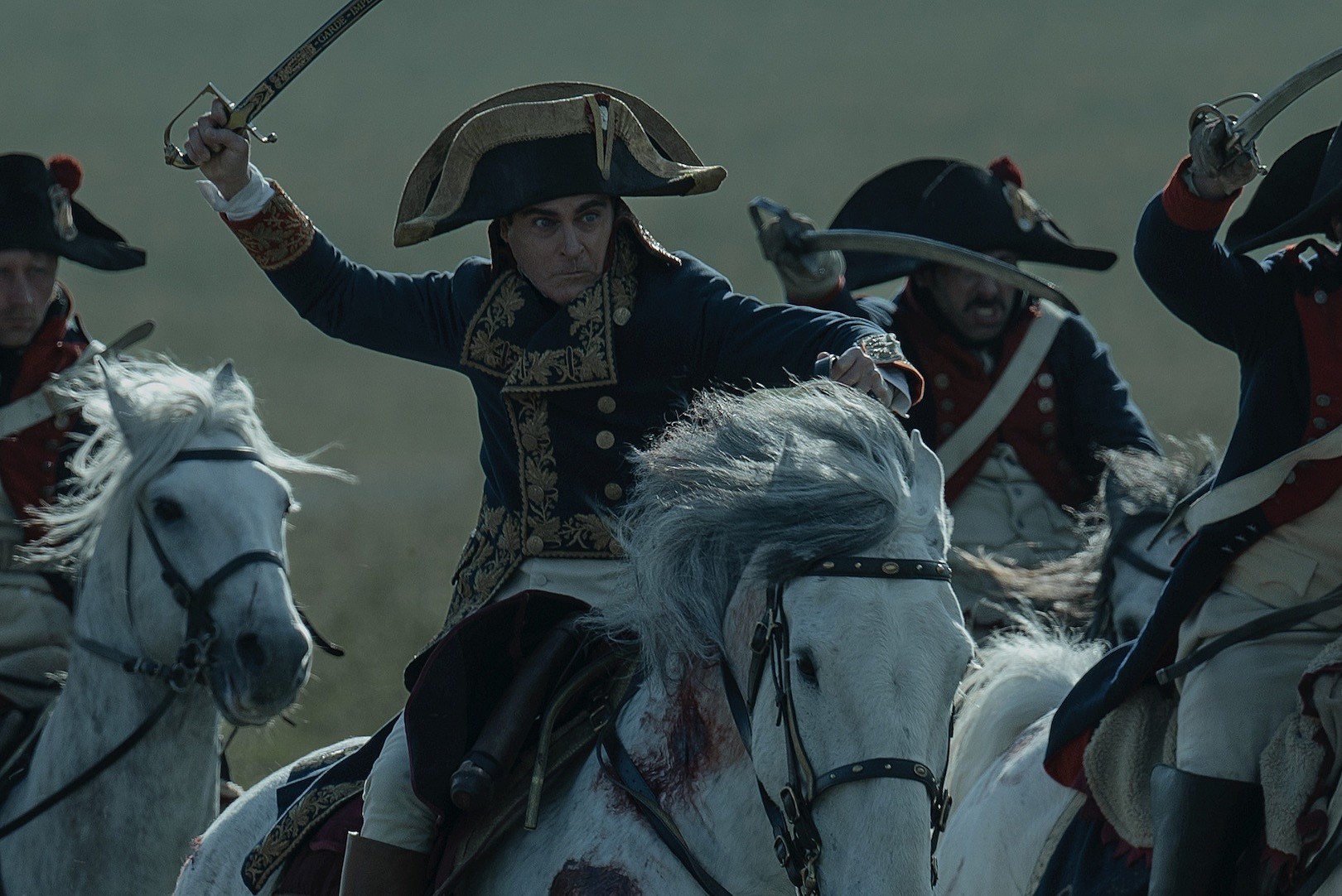
Napoleon (Ridley Scott, 2023)


Make love, not war

Ridley Scott at his best can be an immersive filmmaker and with the opening of his latest feature Napoleon he manages to locate you in the middle of the Place de Revolution, 1793, where a wood cart wheels one Marie Antoinette to the guillotine. Lovely little vignette with the queen (Catherine Walker) standing stoically while folks jeer and pelt her with rocks and rotting vegetables (a tomato stain marking her bosom like a scarlet letter). Some trouble fitting the stock onto her neck-- these are the little details that help you believe the reality of her oncoming death, and when the executioner picks up the head by its locks and shakes it at the roaring crowd you watch the expression closely wondering if you might catch it blink (you don't). Apocryphally Napoleon (Joaquin Phoenix) stands in the sidelines, watching.

Friday, October 20, 2017

Blade Runner vs. Blade Runner 2049


Does Deckard dream of synthetic sheep?

(Warning: narratives of Blade Runner, Blade Runner 2049 and Do Androids Dream of Electric Sheep? discussed in close detail)

Ridley Scott's science fiction epic Blade Runner opened back in 1982 to poor boxoffice and middling-to-hostile reviews (including a memorable slam by Pauline Kael).


And then--like a launching police spinner or Roy Batty's level of empathy--the film's reputation rose. From cult classic to cultural touchstone to a place in the Library of Congress' National Film Registry pantheon, Scott's possible masterpiece is now widely considered one of the greatest science fiction films ever made.

The film print went through its own odyssey from seven differently edited versions (including a Director's Cut that doesn't have the director's full participation or approval and a Final Cut that does) VHS releases laserdisc releases DVD releases Blu-Ray releases lord knows how many re-issues and retrospectives and finally--after thirty-five long years--a sequel.

How is the picture? Lemme put it this way:


Thursday, June 08, 2017

Alien: Covenant (Ridley Scott, 2017)

Alienated

Coming out of the multiplex

A: So what did you think?

N: It's confused. 

A: Confused?

N: The movie doesn't know if it wants to be horror or science fiction.


Monday, October 05, 2015

The Martian (Ridley Scott)


Barsoomed

I'd written about the source novel before, my basic verdict (if you don't like clicking on links or reading articles) being: fun and funny, excellent science and tech (grasp of human psychology not as good), rather unevocative, been done before only better.

Ridley Scott's movie gets this much right: jettisons Weir's clunky DOA prose in favor of photorealistic images of Mars (actually the Wadi Rum in Jordan, encarmined via filters), a series of vast landscapes surrounding a tiny lost spacesuited figure, John Ford-style.


Tuesday, November 05, 2013

Ender's Game (Gavin Hood); The Counselor (Ridley Scott)

(Warning: plot twists and story of both films discussed in close and explicit detail)

Game over
 
Gavin Hood's Ender's Game is a surprisingly supple, fairly faithful adaptation of the Orson Scott Card novel; if it fails as a film, I'd say the fault lies as much with the source novel as with the filmmakers. 

It begins well enough--the battle school scenes of both novel and movie are easily their best parts, with strategies and mind games clearly outlined, with the fighting given coherence and variety. The novel allows the training more time to develop: we see and feel the growing intensity, we appreciate the increasingly bewildering impossibilities thrown at Ender (Asa Butterfield). You miss that gradual progression in the movie. 


Saturday, January 26, 2008

American Gangster (Ridley Scott, 2007)

American gagster

Ridley Scott's American Gangster (2007) is, for all intents and purposes, Oscar bait. It's the kind of two-hour plus epic studios like to parade in the multiplexes just before the horse races (the New York Film Critics; the L.A. Film Critics; the Golden whatsis; the Oscars), in the hopes of garnering a statue or two (no such luck; the Academy Award nominees have just been announced, the picture save for a few minor categories largely ignored).

The movie was inspired by "The Return of Superfly," a New York Magazine article written by Mark Jacobson about Frank Lucas, a true-life heroin entrepreneur turned police informant. Lucas rose from the ranks of Ellsworth 'Bumpy' Johnson's Harlem gang (briefly but memorably played here by Clarence Williams III) as driver and enforcer; when Johnson dies of a heart attack, Lucas takes over.

Perhaps the most interesting portion of the movie's story takes place after Lucas inherits Johnson's gang. Studying the situation, Lucas realized that he would never get ahead if he relied on Mafia distributors for his heroin, so he went straight to the source--to Southeast Asia's 'Golden Triangle'--and bought directly from the suppliers. He devised an ingenious way of smuggling them in (to quote from Richard Maibaum and Tom Mankiewicz: "Alimentary, my dear Leiter…"), and sold them on the streets of Harlem as 'Blue Magic,' 98 percent pure heroin--so pure they sometimes caused dope addicts (used to inferior powder) to overdose.


It's a fascinating parody of American capitalism--cut out the middleman, be innovative, sell a quality product--or is it a parody? I can think of a few billionaires--Bill Gates comes to mind--who adhere to less lofty standards (Microsoft Windows, anyone?). Problem is, Scott wants it to be more than that, wants a big screen biopic that will include all the usual moments in a drug lord's life and still come out strong for the American war on drugs. What the material needs is a filmmaker with a sense of irony (a rare and precious commodity in Hollywood, when you stop to think about it); maybe the more mature Spike Lee we saw in Inside Man (2006) and 25th Hour (2002), or a less frenetic Martin Scorsese working on a sharply focused script, or even a still-breathing Robert Altman (go ahead, wish for the moon). Lucas' life is a--or should be--a black comedy about achieving success in the illegal drug industry, emphasis on the word 'industry;' instead we get The Godfather (1974) without the strong family dynamics or sense of rooted identity.

As Denzel Washington plays him, Lucas is basically an African-American Michael Corleone; he's suave and restrained, capable of the occasional (and unconvincing) burst of violence; about the deepest subtext one senses in his performance is a hunger to at least be nominated for yet another golden doorstop (as noted, no such luck). Jacobson's article (and Jacobson's October 2007 interview of the man talking with fellow gangster Nicky Barnes (played in the movie with lively gusto by Cuba Gooding, Jr.)) reveals a more expansive, forceful personality, one skillfully able to present himself as a hardworking businessman with a bent but nevertheless still working set of principles. Jacobson's Lucas is a bullshit artist extraordinaire, part candor ("It’s not something Frank (Barnes) or I would tell any of our children to get into"), part glamorizing spin ("A drug dealer gonna live to his word. I’m not talking about a junkie. I’m talking about a man like Frank Lucas or Nicky Barnes"). Lucas at the age of 77 and confined to a wheelchair shows more life, energy and outsized humor than Washington ever does in the entire picture; Gooding on the other hand captures enough of Barnes' style to make an impression onscreen, but throws the picture off-balance--generally not a good thing when the supporting performer out-acts the lead.

For this film director Scott eschews his trademark burnt-orange, dustmote-drenched lighting in favor of the kind of bright 'n gritty '70s-style cinematography pioneered by Vilmos Zsigmond and Laszlo Kovacs. But the expert reproduction of a long-ago look is disastrously employed, to photograph needles plunging into scarred arms, babies crying helplessly beside their dead, overdosed parents--images that would seem heavy-handed in an anti-drug TV commercial, much less this movie. When the picture goes into action, it's standard-issue handheld footage, cut chop-suey style for extra oomph; Scott's been making films for--what, thirty years?--and he still doesn't seem to know the first thing about shooting a coherent action sequence. He does best staging elaborate shots that last minutes at a time, allowing you to drink in all the period detail and atmosphere and production design, only this time the period is New York in the 70s, possibly the one era Scott hasn't a clue how to evoke properly.

The movie suffers even more when put against the near-miraculous achievement of James Gray's We Own the Night (2007) which came out around the same time, set in the same period (actually the '80s--but with many of the detritus and accoutrements of the previous decade). Gray has more than filmmaking talent, he has a distinct sensibility, one that likes to take a step back and apprehend its characters--usually standing against a door frame or striding down a hallway--while they introduce themselves to us with tiny gestures or brief but revealing expressions. His handheld footage needs no apologies--when during a surprise ambush he gives us Joaquin Phoenix's panicked appraisal of the dashboard and windshield of the car he's driving (plus glimpses of the pair of cars (one of them driven by his father, the other by hired assassins) racing beside him), he's showing us a world suddenly spun out of control, showing us chaos in full bloom, and Phoenix's utter helplessness in the face of it. It's amazing, really, how a great film like We Own the Night can be completely ignored in this year's horse races, while something like American Gangster is able to pick up a few Guild awards, some technical Oscars, even a few Golden Globes (nominations, all). Well, maybe not so amazing--it's Hollywood, after all, the land that's been refracted through the looking-glass so many times you're not sure what direction is what, or what constitutes reality, anymore.

(First published in Businessworld, 1/25/08)

Thursday, December 07, 2006

Hannibal (Ridley Scott, 2001)

Inspired by the Film Criticism Blogathon:

Days of swine and grossness

Noel Vera

(Fragment of a rejected draft for Ridley Scott's Hannibal)

BARN INTERIOR. NIGHT.

A fully grown BABE enters large wooden arena with his fellow boars. In the center of the arena is a forklift; tied to this forklift is a large man in a hockey mask.

BABE: Are you my mom?

MAN: No little pig. My name is Dr. Lecter. Why do you ask?

BABE: Never saw my mom so when I meet someone I ask. Otherwise I suppose I should go ahead and eat your toes.

LECT: You are welcome little pig but allow me to satisfy my curiosity: do you miss your mother?

BABE: O yes sir.

LECT: I too suffered loss when young, the death of my beloved sister. That story is told in the latest novel about me, not in this film version which seems to lack heart. Do you like heart little pig?

BABE: Yes sir! Especially when it's still beating.

LECT: So do I little pig so do I.

BABE: If you don't mind sir I'll start on your big toe now

LECT: But I do mind little pig. Not that I disapprove of your snacking; you are after all trained to eat human flesh, and as we are already shared childhood confidences I have no objection to sharing my toes with you. I am however disappointed in my current situation.

BABE: You mean being tied up? Why is that sir? Are you a bad man?

LECT: Very bad little pig. I am what you might call a man without hypocrisy; I treat the world exactly as it would treat me, kill or be killed, without regard for sentiments that might compel me otherwise. 


BABE: But isn't that what I do? If someone tries to hurt me I hurt him.

LECT: There's a difference. You do what you do in innocence, without guilt or remorse. Even feeding on my feet would be understandable, since you were no doubt starved beforehand and would like to rip my leg off at the knee.

BABE: Oh yes sir may I?

LECT: You speak so avidly because you speak with your whole heart. We do similar things, but certain sentiments are supposed to hold me back such as 'justice' or 'morality.' I don't heed these sentiments and so am considered insane.

But that was then; things have changed. There were three novels written about me by Mr. Thomas Harris, and in the first one, Red Dragon, he called me a monster.

BABE: Weren't you mad when he did that?

LECT: He did a fine job of portraying me, despite the insult; he amused me. In the second novel, The Silence of the Lambs--lovely title, don't you think?--even gave me a more interesting diversion, a young woman by the name of Clarice. You should meet her little pig; you would get along well.

BABE: Does she like heart too?

LECT: She won't admit it but I'm sure she can be persuaded. She has your innocence little pig, your idealism and freshness. She wanted to catch a killer, and I decided to help her. Mr. Harris in turn liked that about me; it touched something in him that I was capable of such kindness, and his attitude towards me softened considerably. Of course while everyone worried about Starling's killer I managed to escape--Mr. Harris probably felt pleased I showed such initiative, dismayed that I showed such independence.

BABE: But see you're caught again!

LECT: That's because we are near the climax of Mr. Harris' third novel Hannibal, named after yours truly thanks to the success of the second novel.

Hannibal was the end result of Harris' evolving attitude towards me. Where in the second he felt ambivalence in the third he shows definite sympathy. It helps that the morality of a serial killer doesn't seem so bad, compared to the corruption and stupidity of institutions Mr. Harris once respected--the police, the FBI, the U.S. Government as a whole. Hannibal's real story is Harris' growing disenchantment with society; it's both his declaration of independence from the rest of the human race and his oath of fealty towards m, ah sensibilities, for want of a better word. Quite a disturbing book in its implications when you think about it, at times cartoonishly written and not entirely persuasive. My nemesis for example, Mr. Mason Verger, is more grotesque than evocative, a horrorshow scarecrow rather than the greater evil to oppose my already great evil. Mr. Harris also hoped to make me more appealing to readers by 'explaining' me through the death of my sister. I had their sympathy all along of course--didn't need the help. But Mr. Harris didn't want me to just be the protagonist; he wanted me to be the romantic lead.

BABE: You mean with Clarice?

LECT: Yes little pig very good: with Clarice indeed. I hope I can introduce you to her, she'll be along any moment now to rescue me.

BABE: You still haven't said why you're so disappointed. Or should I ask? I'm really starving.

LECT: Appreciate your forbearance. In the first novel I was the inspiration for the killer named Dolarhyde; in the second I was the imprisoned monster who begins to show signs of compassion. The more known of me the more I shrink in stature, the more human I become to readers. It is a transaction of sorts, awe traded for affection. I suppose ambivalence would be the most natural reaction I can have towards this change. Still hungry little pig? You are drooling heavily now.

BABE: Yes sir very much. Couldn't I just nibble on a toenail?

LECT: Not much longer now. All three novels were made into motion pictures. Red Dragon was adapted by Mr. Michael Mann into Manhunter, a rather cold film with a nevertheless interesting visual texture. But Silence was the real success, commercially and critically winning a collection of what are known as "Oscar" statuettes.

BABE: Are Oscars good to eat?

LECT: You need a lot of ketchup.

Part of the success of Silence may be due to its director. Mr. Jonathan Demme is a fascinating man, full of empathy and compassion for the characters in his films.

BABE: He likes heart too?

LECT: Very much. Please step back little pig your sniffing tickles my toes. Thank you. At the same time, Mr. Demme told the more gruesome aspects of my story--my violent and bloody escape, for example--with real relish. You see, little pig, he tends to empathize with all his characters, good or bad; he must have been disturbed to find himself empathizing with me. 


More he has been accused of homophobia, which shocked him; he had carefully established what Harris also stated in his novel--that the killer Buffalo Bill was not a real transsexual. But the power of the word on the printed page is nothing compared to the power of the image on the silver screen: people saw a man trying to become a woman by killing other women; some equated transsexuals with serial killers. Demme was dismayed with the end result--the outcry and the audience reaction--that he presumably refused to direct the third film.

BABE: Who did it then?

LECT: Shan't tell you if you don't step back a little further. Thank you. Mr. Ridley Scott directed, with the help of producer Dino de Laurentiis.

BABE: Does Mr. Scott like heart?

LECT: Don't think he has one. Ridley Scott is a gifted hack, able to pour his considerable visual skills on both gold and garbage alike. He was the unfortunate choice to do Hannibal, unfortunate because he doesn't seem to have or seems to have lost the ability to tell a story with clarity and coherence. He begins the film for example with a fish-market shootout where you couldn't tell who was doing what to whom, what was happening or why--very confusing the way it was shot and put together. I dislike confusion little pig; I dislike it intensely.

More, you miss Mr. Demme's way with characters, his knack of using a telling detail or line of dialogue to reveal a person. Take my dear Barney, for example: in Silence, he has a brief scene in the hospital where he explains the rules when entering my cell to Starling, gives her a warm smile and tells her: "you'll do just fine." Later I thanked him for the services he's done for me, and Mr. Demme treats the quiet little moment as the culmination of years of acquaintance and respect--he is in those few seconds in Silence a richer, warmer human being than he is in the many minutes he enjoys in Hannibal. Then there are my face-to-face interviews with Starling, which have an intimacy missing in Hannibal--Demme photographed us full on, in giant close-up, to catch every nuance and shift of emotion; Scott has us talking through cellular phones with a merry-go-around whirling behind, as if he felt that what we were saying wasn't interesting enough. Demme’s focus in short is on the human face; Scott’s seems to be on the merry-go-round.

Scott likes to pose his characters against beautiful landscapes and setting suns, substituting visual drama for the missing narrative drama. He is careless about action sequences, unable to build much suspense (Mr. Demme does a better job creating tension with his flowing camerawork and elegant, unhurried editing). Scott ultimately is a shallow director who loves surfaces; any profundity in his work comes from the script, and the script of this film comes from a novel that does not represent Mr. Harris at his best.

That is it in a nutshell, little pig. I am perhaps not too unhappy with the my growing fame…but I am unhappy about Mr. Harris' inability to maintain the level of writing in his third novel, and extremely unhappy about this slipshod vulgar insulting little film they have made of the novel, all for the sake of money. Hence my distress.

BABE: But that's awful! Terrible! Those swine!

LECT: Aren't they, little pig? "Free-range rubes," I like to call them. Free for the picking--only I'm incapable of doing any picking at the moment.

BABE: Let me help you.

LECT: Certainly. But how little pig?

BABE: I don't know. I can bite their toes off.

LECT: If you go back into the pen from which you came you'll see to the left side the latch that keeps the door closed. Take a stick in your mouth and lift the latch. Go right, take the first stairs you see, and you'll be in the arena's upper seating. Ridley Scott should be the rube in the red shirt to the left of the camera, Dino de Laurentiis the rube in the yellow jacket behind Scott.


BABE: Gotcha.

LECT: Have you ever heard of Dante Alighieri? He wrote a long poem, part of which was called Inferno, where various sinners were punished, their punishments formulated according to the nature of their crimes.

BABE: Gosh, really?

LECT: Don't kill those two, little pig; it's important to me that they remain alive. De Laurentiis deserves to live for producing La Strada, Nights of Cabiria, Mandingo, Flash Gordon, and Danger: Diabolik. Scott deserves to live for the lovely images of Florence, and for the blackly amusing way he staged the climactic dinner--the single best scene in the picture. His life should also be spared in the hope, foolish perhaps, that he will someday gain the courage to do at least one more film of consequence. 
Will you do this for me, little pig?

BABE: It'll be my pleasure. Should I bring you back some toes?

LECT: Thank you, but I'm not that hungry at the moment. Bon appetit.


(With thanks to my evil twin brother  for the initial idea).

(First published in Businessworld, 3/2/01)