Best pig ever
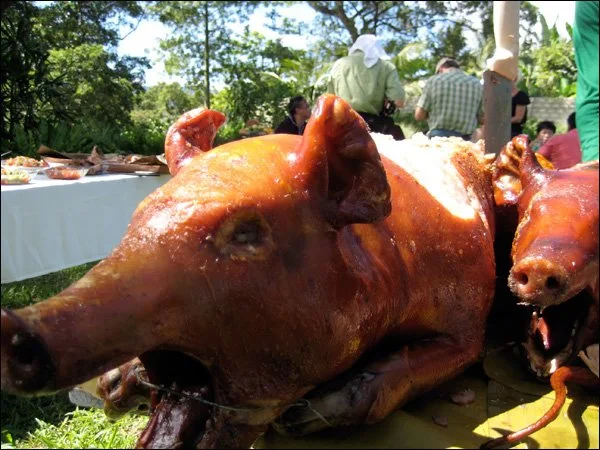
Well, it's official; Anthony Bourdain in his show and blog has said it: Filipino lechon is "the best pig ever.'
It's not as if we Filipinos need the affirmation--well, maybe we do. Travel shows don't usually showcase the Philippines (Bourdain and co-conspirator Andrew Zimmern excepted); Filipino chefs don't usually win Top Chef or become The Next Food Network Star, and I wonder if Samantha Brown will ever grace a Filipino beach with her bare suntanned foot. The Philippines is probably Southeast Asia's best-kept culinary secret, with travel bloggers and travel books pooh-poohing our food for being blander and less spicy than our Thai neighbors (Bourdain to his credit upon hearing this opinion in the show immediately dismissed it: "no, it isn't that," he says brusquely).
So if some gangly white man with a popular travel show and rep of straight-shooting no-nonsense street smarts flies in and declares our roast meat the best he's ever tasted, yes I can see where our reaction can be a little, uh, enthusiastic (see Bourdain's Hierarchy of Pork, and the almost four hundred (as of this writing) comments that follow, or see Marketman's (pseudonym of one of the show's purveyors) posting of the No Reservations Lechon Lunch (which includes an ingredients list of the various pigs roasted, both the classic Cebu lechon and the Marketman variation) with its hundred-plus reactions (including a dissenting one warning that Bourdain will never come back to the Philippines, ever).
I did offer my opinion that any disappointment Bourdain may have felt about his Philippine visit, or dampening of spirit felt due to Augusto's (his erstwhile host) lack of energy and initiative, is, while not exactly feigned, probably pointed up in the editing room during postproduction. I've watched enough episodes of the show to notice that Bourdain likes to have a through-story, a kind of premise on which to hang the show on, and the apparent premise he'd hit upon on this installment goes something like: "Bourdain takes naive Augusto, who apparently doesn't have a clue about his parents' culture and feels left out, and reintroduces him to said culture, through the medium of roast pork (hell, the previews practically spelled it out for us). Nicely different take for the show (Bourdain saves Filipino from himself!), nice way of turning apparent handicap into virtue (no bar scenes, which may mean the Filipinos failed to take the hint from past episodes and introduce Bourdain to the joys of lambanog, basi, or tapuy--meaning in a sense the Filipino hosts did screw up big time (or was Bourdain watching his alcohol? He quit smoking recently)), nice way to showcase Bourdain's softer, more paternal side (white man good guy).
All snarking (who said Bourdain had a monopoly?) aside, the man does know his pork. As he's said in practically every episode, he loves pig, and he's declared this or that variation of the meat good, better, great, or forgettable. And he seems impressed enough to say Filipino lechon is the best not once but twice, and follow it up with a clear ranking in his blog. Cynical as I may be, I'm not one to look down on another cynic's repeated praise; thank you sir, for the compliment.
(Can't help but go into a lengthy aside about my own experience with lechon Cebu--a friend Iris who worked for a Cebu resort invited the family over, and generously had us installed in one of the huts facing the sea. We just had to walk right out our door, and the ocean was about fifty paces away.
Beautiful place, with a shark pool in the front lobby (I remember standing at one end, marveling at some of the larger fish, only to turn and discover that one of my young 'uns had been standing at the other end, dipping his hand in the water). The seaside restaurant--literally, a grill place where you sat at the end of a jetty, over the water, as you ate--served a hot, briny and gingery Manila clam soup, and live lobster sashimi. Basically the chef plucked a large lobster out of his fishtank, bisected the tail with his sharp chef's knife, chopped the meat into large chunks and served it, still quivering, on a plate. It was unbelievably sweet.
The next day we went boating, and on one mid-ocean stop one of our guides dived for sea urchins. He surfaced with a bagful, which he banged against the boat's hull--to remove most of the spines--used a pair of scissors to snip the uni open, plopped the pale orange flesh onto our hands, and had us pop it in our mouths. The lobster was sweet, but this was rich, like briny butter, with a distinctly creamy texture. I felt this thrill emanate from the center of my forehead all the way down to my belly, it was so good.
We finally ate at Iris' home, and she topped the whole visit with an entire lechon Cebu, ordered and delivered to her home. Crisp crackling, with just the slightest hint of fat (like the world's richest sandwich spread, on a slice of porky toast), and the flesh around the ribs had the flavor of sea salt and lemongrass. We talked about that meal--about Cebu--for years afterward; still do nowadays. Actually, we talked about the lobster, uni and pig just a few nights ago, just after the Bourdain episode.)
A few complaints I had about the show (to be fair, Bourdain himself professed nervousness about trying to do justice to the cuisine of seven thousand islands). He didn't nibble on a balut, at least not in the show. He wasn't impressed by the pancit palabok (to be fair, maybe it wasn't a good sample).
He liked the pakbet, but if I were helping with the show (ha!), I'd have asked our manang, who comes from the Ilocos region to help prepare it. That was a Tagalog pakbet in the show, hardly the real thing at all, or hardly the most flavorsome version. An Ilocano pakbet would be cooked in a palayok (an earthenware pot), would feature the small Ilocano eggplant (about the size of a large egg), the small ampalaya (bitter gourd), sitaw (string beans), patani (a pale white Lima bean), small tomatoes, okra, ginger. The vegetables are not cut up, but tossed whole in the palayok to stew with fish bagoong (fermented fish paste) and--glorious of all glories--that decadent deep-fried pork product called bagnet, which is to chicharon (fried pork skin) what Bruce Banner is to The Incredible Hulk (bagnet is basically pork belly fried till it's crispy hard; for a detailed description of the meat and how to cook it, check this out). The result is an eye-rolling, sigh-inducing stew of pork-and-fish flavored vegetables, in a thick and incredibly flavorsome broth.
Then there's the bulalo, boiled beef soup and shank bones. Bourdain to his credit knows enough to suck out the bone marrow, but as I explained in this blog post, sipping the marrow without using patis (fermented fish sauce) is like enjoying the beef, the very essence of beef (as Zimmern likes to say, "fat is flavor") without adding the poetry, the briny sweetness that helps the beefiness take flight.
Finally, and this is possibly the saddest omission of all, Bourdain failed to partake of agus-us. I first heard of this possibly mythological delicacy years ago, from Ed Alegre's column in Businessworld. The article described various Filipino bar chow, including kaldereta (probably named after its cooking vessel, a Filipinized caldero, or large cooking pot), the best version of which features goat meat, the kaldaretang ulo ng kambing (stewed goat's head) being the best of the best with its tender, flavorful tongue, its pair of fatty eyeballs, its soft, cheesy brain tucked away like an oversized gold nugget within the skull. Plenty of crushed garlic as thickener ("which is why it's so expensive," I remember Ed writing), and whole sweet pickle, not relish ("so you can take it out and pop it in your mouth," Ed writes) as--well, I'm just not sure what it was for (flavoring or souring agent?), only that it tasted good.
Haven't found that article, may never will, but I did find an earlier version where he mentions all kinds of bizarre bar chow, and it makes for a fascinating read. Like his description of dinubok: "Take a big fish, preferably one that's fat....wrap as it is in plastic and let to hang for 4 days to a week. Unwrap. Remove its innards. Wash clean. Slice. Wrap in kolis leaf. Inun-un (paksiw (a kind of stewing)) in salt, garlic, ginger, palm vinegar, vetsin. Ampalaya is optional. Or cook linarang-style."
Agus-us is mentioned near the end of the piece. It's a conversation with Loyong, the brother of Raymond Fernandez, a professor in the College of Fine Arts University of the Philippines Cebu. Raymond come from Dumanjug, a coastal town in Cebu.
"'It's tuba (palm wine) country,' he says. 'All our sumsuman (bar chow) goes well with tuba.
"'Dalupapa is cuttlefish which has to be marinated in toyo (soy sauce) for one hour; otherwise it would be very tough. We cook it slowly, five minutes on each side. Fried or broiled. If it is overcooked it is too tough to bite. And we use only the body.
"'Then there's lumayagan, which is a small squid, or cuttlefish perhaps. Two inches to a foot long. This we fry with very little palm vinegar and salt. It cooks in its own black sauce. We do not take out the entrails. That is what makes it delicious, the taste of entrails. It is especially delicious if it has bihud (squid roe).
"'The rarest is agus-us. We mix boiled kamote (sweet potato tops) and raw pork. We let it hang for a few months. When worms start to appear that's the time to eat it. Very good as sumsuman. I remember the Camayos of Hinatuan, Surigao del Sur, who wrap the newly caught wild boar in anahaw leaves and keep it hanging until worms come out--that's the sign that its ready for eating.'
"'Masarap (delicious)?'
"'Nothing like it,' Loyong asserts with finality."
This was to be a celebration of Filipino cuisine in all its varied glory, which made it all the more startling when, googling around, I discovered that Edilberto Alegre, columnist and writer and champion of Philippine culture and its cuisine, died a little over a month ago. I read his column many times back when I was working at a bank, and copies of Businessworld were available outside of any vice president's office, or on the secretary's desk; even met him years back--once, maybe a few times. I don't dare profess to know him to any great extent, which makes it a bit of a mystery, why belated news of his passing should hit me so hard.
I do agree with his primary argument: Filipino culture is not damaged goods. It takes its influences, from Spain, from the United States, from China, and makes them its own. It's a thesis Alegre has been supporting for as long as I remember reading him, and it's one under which I operate (a common-sense attitude, really--"I'm basically okay, and what I do with what I'm exposed to (American TV, movies, books) is Filipino adaptability working at its inventive best").
I remember our last conversation. I'd asked him about agus-us. "How on Earth could you justify eating something full of maggots like that?"
"I asked Loyong about it. His reply was 'But it's exactly then that it's safe to eat.' When they disappear, then you know it's gone past rotten to being too poisonous, even for maggots."
"So what does it taste like?"
"Like soft, ripened cheese. Like nothing on earth."
Till we meet again, Ed.
2.19.09
Next on No Reservations: PhilippinesYes, my home country. I love the show, arguably the roughly three or four hours of non-film television I ever bother to watch on a weekly regular basis (I'm not the only one, apparently--Samantha Brown's manicured guided tours of Europe have been bumped out by Bourdain (and his co-conspirator Andrew Zimmern) to a Saturday time slot, practically a graveyard for ailing travel shows). I don't know what it is about the show, the mix of attitude and a philosophy, the restless hunger, the need to seek out new cultures and foods, to try keep an open mind to all cultures (or go down swinging) to contemptously urinate on the tried and touristy, except (as in the Singapore episode) when the food is that good. I mean--take his previous episode, on food porn. Basically blows away Zimmern's rival episode exploring the link on food and sex, and here's why---Zimmern's episode actually tries to explore said link, and at best the link's tenuous; upshot of the episode is that the best aphrodisiac is the one one believes is the best aphrodisiac (the placebo effect, in effect).Bourdain's episode is cruder, more straightforward: he just stitched together money shots of extravagantly rich and sensuous foods being prepared and eaten (there's some thesis connecting food television to the '70s porn industry being put forth, but the treatment is not too serious, nor no doubt was it meant to be). Eric Ripert prepares angel hair pasta with a buttery foie gras sauce and osetra caviar; Terrance Brennan slaps together a meat (braised ribs)-and-cheese grilled sandwich to die for; David Chang creates a Bo ssam--a 10-pound pork butt, slow-roasted in molasses, green chilies, and Korean soybean paste, served with a dozen oysters, and kimchi, and rice; Martin Picard's staff at Au Pied de Cochon prepares every part of the pig--from the head meat to the deboned and richly stuffed foot to the deep-fried tail--sautes them in pork broth and butter, tops the various parts with generous chunks of foie gras and cream, assembles the deliciously mutated monstrosity on a gigantic wooden board, sits down at the table, takes off their clothes (at least the upper garments) and eats. Now that's naughty.So what to expect from the Philippine episode? Lechon de leche, of course. Don't know if he'll prefer it to his current favorite, Indonesian pig (where the skin is basted with coconut water, to make it carmelized and crisp). Adobo; durian; fresh fish of all kinds; balut; pinapaitan. If he's really as hard-core as he likes to think he is, he'll try agus-us, a pork product I'd once read about from Edilberto Alegre that even Zimmern might hesitate to try. We'll see. I'll watch the episode, see what happens, hopefully write about it sometime this week.
Anthony Bourdain's death-row meal--in effect, what he would like to eat if he was going to be fried by two thousand volts the very next day--is roasted bone marrow with parsley salad.
I've tried cooking that meal myself, and it's very good, very rich. But I've just realized that I've eaten--have been eating, for years--something even better.
In other words, bulalo, or boiled beef shank with bone marrow. The recipe linked here is one I'm familiar with, only with a helluva lot more peppercorns. Not just the shank, which when boiled properly is full of tender meat and softened tendons and cartilage, but tail and neck bones as well.
The result--well, admittedly roasting the bones gives them a unique flavor, but boiling them to make a rich broth spooned over steamed rice (as opposed to spreading the marrow on toasted bread) is another thing entirely. Far more homey, I think, and comforting (and wonderful in the winter cold). True there's the former's contrast of textures--marrow on crisp toast--but that unctuous fat spread over pillowy rice (appreciated especially if your teeth aren't as firm as they used to be) flavored with simmering soup is, I submit, an equally complex (and arguably subtler--you get different shades of softness) symphony for tongue and teeth.
And while roasted bone marrow has been accursed with the patina of fine dining, bulalo is still pretty much a home-cooked meal, at most a lunch-counter meal. I remember going out on client calls to the province of Batangas, with officers from the Development Bank of the Philippines in tow. I particularly remember Vivian and Liza (poor Liza, who has since passed away, was always game to try something) asking to stop for lunch, the corporate van parked before an eatery with wraparound wire-netting windows and a creaking screen door (spring loaded, of course, to keep the door closed and horseflies out). We stepped out of the van into the broiling heat (being noon and the south of Luzon, it was easily ninety Fahrenheit in the shade), walked into a crowded lunchroom with concrete floor, picnic-table benches, wooshing ceiling fans overhead, picked up our orders at the long canteen-style counter (servers with great ladles splashing hot soups into bowls; tongs deftly picking out one's choice of vegetables, meats, bones; cups scooping out rice from huge pots to be emptied, upside-down, into plates).
I'd learned much later that Vivian and Liza had been horrified--such a common, low-class place for us to eat! But I loved it; I loved the cheap prices, the workingman atmosphere, the no-nonsense efficiency. And I like to think that, despite the ambience (or utter lack of), the two really enjoyed the food (I remember Vivian--or was it Liza?--wrinkling her nose and saying "it wasn't very hygienic--you can see the cooks' sweat dripping into the broth." To which I replied: "but that's part of the flavor!"). At the very least, they must have appreciated my company.
Memories like that and, further back, of myself as a child eating bulalo, can't help but rise up steaming (like the cliché of ghostly apparitions, only with a distinctly beefy aroma) from the bowl in front of me. I like to eat the pechay (Chinese cabbage) first, as a way to assuage my guilt at such a sinful indulgence (although pechay with rice and hot soup--the bitter leaves crunchy, the soft starch soaking up the meaty juices--is in itself a wondrous thing). I use a knife to worry out the marrow (sometimes I use a chopstick, though my favorite method bone structure allowing is to press one end to my lips and just blow the stuff--like snot--out the other end), which would lie like deep-gold butter (with flecks of brown meat) on top of the rice, trembling; my hands would tremble too, almost as if in sympathetic reaction.
And then--the secret, the glory of bulalo: the patis, or fish sauce. English roasted marrows are traditionally seasoned with salt--sea salt, if you like--but that is a poor substitute for this divine, dark-brown elixir dripped from unsteady spoon over rice, fat, everything. It's as if, having decided to excavate the heart, the very essence of beef flavor, you recklessly throw in the briny sweetness (oh so slightly corrupted by aging) of the sea. Surf and turf, fermented and fresh, raised to the level of countryside poetry.
Bourdain can keep his death-row meal and my earlier self can go stuff himself with parsley salad for all I care; a death row dish--a dish so beloved you would choose it for your last night on Earth--needn't be anything read from a book or seen on a TV show or downloaded from the internet; sometimes it can be as simple as what your grandmother cooked when you were a child, or ordered at a lunch counter, or ate at home, remembering, in the dead of winter.

Kiddie meal
Brad Bird's latest project for Pixar tells of a rat named Remy (Patton Oswalt) who upon reading the cookbook of famous chef Auguste Gusteau (Brad Garett) wants to be a chef; Gusteau has since died of a broken heart thanks to a nasty putdown by powerful food critic Anton Ego (Peter O'Toole, in an all-too-brief performance), and appears to Remy as a floating spirit, repeatedly consoling him with his favorite motto: "Anyone can cook!"
Remy makes his way to Gusteau's restaurant, where he meets Linguini (Lou Romano), an awkward youth applying there for a job--any job, presumably as janitor or better; Remy eventually finds his place in the restaurant under Linguini's toque, his paws tugging at the young man's scalp to control the hands marionette-style (Are we supposed to take the hair-pulling as mind control? Or dismiss the conceit as some kind of Gallic follicle?) as he creates the finest dishes in Paris.
Bird took over from an idea and characters first created by the Czech-born British animator Jan Pinkava (who ended up with a co-directing credit); the result is a fairly convincing rendition of the French culinary scene, thanks to advise by The French Laundry chef Thomas Keller (he designed the climactic version of the eponymous dish, which is lovingly rendered down to the slightly thickened juices dripping from precisely sliced vegetables). As celebrity chef Anthony Bourdain notes "The tiny details are astonishing: The faded burns on the cooks' wrists. The 'personal histories' of the cooks." Putting aside the fact that Bourdain gets an end credits "thanks" (for 'input early in the film') he's not for the most part exaggerating--the animated cooks handle their animated knives correctly, with that curious rocking motion that's so efficient (and on the fingers), toss their spices and condiments in that show-offy, cavalier way (it's for a more even sprinkle) professionals do.
Most impressive is Gusteau, who I suspect is an allusion to the rotund Fernand Point, master of la grande cuisine, and "Father of Nouvelle Cuisine" (Bourdain writes about how when he was ten his parents once locked him in their car so that they could dine at Point's fabled La Pyramide). Point never declared that "anyone can cook," but he did serve anyone he liked regardless of their ability to pay, from the richest nobility to the humblest laborer (though Point would rather close his place down than serve Nazi officers). La Pyramide was set in the countryside not the middle of Paris, but his spirit lives on in some of the dishes served in the movie (or rather his spirit possibly lives on in Keller, and of course Bourdain).
A few cooking bits seem off--the omelet Remy prepares for Linguini is way overdone in my opinion, and I don't think any self-respecting restaurant that once held three Michelin stars would ever erect a storefront sign that vulgar, bristling all over with that many light bulbs (they blink, too) on its rooftop (possibly villainous chef Skinner (Ian Holm) had the sign added--but this is never made clear). And Ego is far too rich to be a critic, at least one with some semblance of integrity (there are those able to amass money, sure, usually by having something going on on the side (a best-selling book, a TV show)--which we don't see in Ego, who's just a filmmaker's idea of a critic).
The picture also makes a few missteps storywise: can't believe Linguini would be stupid enough to dismiss Remy for any act short of his friend actually defecating in the food (spoiling the food, yes; stealing it--hell, no!); the boy should be smart enough to know which side of his bread is buttered, and I'd sooner believe he'd cage Remy and force him to cook forever than allow the rodent to leave. And cooks are pragmatic creatures; when presented with the claim that a rat is a culinary genius, I'd think it more believable that they'd at least demand a quick demonstration before walking away (you can tell Bird (or at least one of his four collaborators) was taking shortcuts with the script).
Overall, I'd say the picture's Pixar's recent best (their sterile Cars (2006)--a mechanical remake of the lugubrious Doc Hollywood (1991)--isn't even a serious contender), and Brad Bird easily the finest director of commercial animated features in the United States (though I'd consider his The Iron Giant--based on Ted Hughes' 1968 children's book "The Iron Man"--to be his masterpiece).
Which when you think about it isn't saying much. Ratatouille isn't bad, just far from great, and I'm mystified by all the hosannas. Scott in The New York Times considers it "one of the most persuasive portraits of an artist ever committed to film" (in the same league as Jacques Rivette's La Belle noiseuse (1991); Robert Altman's Vincent and Theo (1990); Stanley Kubrick's The Shining (1980); Bob Fosse's Cabaret (1972); Andrei Tarkovsky's Andrey Rublyev (1969); Jean Luc Godard's Les Mepris (1963); Yasujiro Ozu's Ukigusa (1959); Guru Dutt's Pyaasa (1957), Jean Cocteau's Orphee, Joseph L. Mankiewicz's All About Eve; Powell and Pressburger's The Red Shoes (1948)?). The movie's the latest example of a trend I've noticed since the '70s--where American animators sweat and strain to create something smart enough to perhaps appeal to adults, only to learn that the Japanese have already been there years before.
Bird and Pinkava, in choosing to depict the passion and artistry of French cooking, takes in my opinion a safe route; the French know and love food, but I believe the Japanese are nuttier in their enthusiasm, their willingness to try something--anything--different; combine this with Japan's gargantuan animation industry, and we're not talking chopped liver.
Animated chefs? Masami Anno's TV show Chuka Ichiban (Cooking Master Boy, 1997), about a thirteen-year-old master chef named Liu Mao Tsing who has wide-ranging adventures and competes in intense face-offs (the latter possibly inspired by the TV series Ryori no tetsujin (Iron Chef, 1993)), shows a wider, wilder range of cooking than anything you see in Bird's movie, with one foot in science fiction (a chef with a fantastically sharp knife slices a beluga sturgeon open, pulls out the roe, presses the edges of the wound together, and allows the fish to swim away whole and unharmed), another in fantasy (every time a dish is presented it glows with an unearthly light; every time a judge tastes a dish he's transported to another world). That said, there's a passion for food and cooking technique in this series that's rock-solid real no matter what special effect or cooking device is featured, the depiction of which sometimes approaches genuine complexity (despite the admittedly crude animation).
In one of the better episodes Mao confronts Shouan, a former star pupil of Mao's mother Pai (one of the greatest chefs in China); Shouan left Pai to travel the world and learn on his own, eventually joining the Underground Cooking Society, a feared gang of renegade chefs bent on domination and power. The competition involved tofu (some of the most memorable contests often involved simplest of ingredients), both its fermentation (which must happen overnight) and incorporation into a dish. Mao's tofu is sabotaged some time during the night, forcing him to improvise a way to ferment, cook, slice up the tofu and create his dish all in one box (you have to see it to believe it). Mao's solution is brilliant yet simple, his resulting dish a delight; Shouan's dish is genius--tofu pasta topped with a meat-like fried tofu and a tofu-based sauce. "Stereosonic tofu," Shouan called it, because the tofu is presented three ways in one dish, approaching the diner from all sides.
When the dishes are voted on, it's Mao who wins out; one reason and the strongest being that one of the judges had tasted Shouan's dish before, from Pai's restaurant, no less. The loss is a blow to Shouan--he's wandered the world for years in search of techniques that would go beyond that of his former master, only to find that he's at most run (in one breathtakingly animated shot) the length and breadth of Pai's outstretched palm. The episode poignantly comments on the absolute hierarchy of creativity and talent (there's good talent, great talent, talent so immense it's inescapable), the need for roots and identity (you must know who you are and what you're capable of before you attempt something truly original), the love-hate relationship between a master and her prodigal pupil. Anton Ego's sudden zooming back to the supper table of his childhood is nicely done (I could have done without the zoom), but compared to Shouan's bitter epiphany, Ego's flashback is child's play.
Then there's Mamoru Oshii's Tachiguishi retsuden (Amazing Life of the Fast Food Grifters, 2006), a jawdroppingly dense and at times excruciatingly funny meditation on Japanese fast-food lore, post-war history, and largely existential philosophy. A group of con men (Moongaze Ginji; Foxy Croquette O-Gin; Beefbowl Ushigoro; Hamburger Tetsu; Frankfurter Tatsu; Medium Hot Sabu (Tarantino can only dream of inventing aliases half as colorful)) visit various food stalls and noodle shops and pull elaborate scams to get out of paying for the meal; the characters are rendered as flattened, two-dimensional figures, as if they were paper cut-outs (Japan-based film critic Mark Schilling calls it kamashibai, or a story told in a series of picture cards) suddenly brought to life.
At one point the noodle shop owner declares "it's only a bowl of noodles!" Moonshine Ginji transfixes him with a glare and observes that it's not only 'a bowl of noodles,' but a bowl of noodles made from bogus (read: inferior) ingredients--despite which Ginji, thanks to his powers of perception and imagination, is able to devour the noodles at the peak of flavor, a moment before they disappear forever. The narrator (who speaks at an relentless pace, presumably because there's so much information to convey) declares that only words can bring back that experience, and in such a way as to surpass the intensity of the original.
Now, if Bird (or any other American talent) can come even close to expressing that kind of transcendental culinary moment in an animated work, I'd be a happy (and hungry) camper.
First published in Businessworld, 7/27/07)
So we finally got down to it, the ultimate act of gastronomy, the most outlandish, esoteric, downright repulsive dish ever served--a dish that in fact recalls a film in 1972 (the title will become clear, I think, when you read on).
But let me backtrack: I've been a fan of Anthony Bourdain's No Reservations, a sort of badass travel show where this cook (executive chef at Les Halles, in New York) goes to some foreign country--sometimes even Miami, or the Pacific Northwest--and makes snarky remarks, tastes the food, tries a few things, and if we're lucky, generally makes an ass of himself.
It's fun; I'm not going to defend it as prime TV or an example of the broadcasting arts, but I love it for his attitude, and for the quite real possibility that he'll break his fool neck (which he almost did once, when he was riding some kind of dune buggy and it turned turtle, hundreds of pounds of metal rolling on top of him--showed the footage, too).
But I like his pretensions too. He's often snarky when in rich European countries--Iceland comes to mind, and he took a few potshots at Sweden ("so Sweden--big blondes, meatballs, ABBA--that's it, right?"). Relatively underdeveloped countries are treated with more kindness--I remember him seriously thinking of settling in Indonesia, of positively loving Ghana, of enjoying a meal of slaughtered seal with a family of Inuit in Quebec, which included frozen blackberries rolled in the inside of the seal carcass (picking up blood and fat) for a dessert, and the piece de resistance--the seal's eyeball, presented to the honored guest. Bourdain downed the jellied orb and declared it tasty.
When fighting in Lebanon broke out and Bourdain's crew was in the middle of it, they did the smart thing and stayed in the sidelines. Bourdain was respectful and full of angst--almost an hour's worth of angst. But I'd rather hear his uninformed angst (which, to his credit, he's the first to admit is uninformed) to any attempt by him and his crew to actually go out and try make sense of the madness there, probably blow their fool heads off. I appreciated that episode.
Anyway--so he goes to Namibia, is choppered to the Bushmen near the Kalahari Desert, and they come upon a nest of ostrich eggs ("he found it earlier, but was afraid to pick them up alone for fear that the mother would come back." "are ostriches dangerous?" "they have powerful legs with huge claws that can rip your belly open"). A Bushman broke a hole in the egg, scrambled the contents with a long stick, then after building a fire with a cleared flat space in the middle, poured the contents of the egg in the middle. The egg cooked; when it formed a skin, they pushed coals and hot ash on top of it. After half an hour, the Bushman tapped the omelet with a stick to shake off extra ash (not that he managed to remove all of it, not by a long shot), and handed the 'dirt frittata" to Bourdain, who chewed it with a wide grin.
Later they hunted for warthog. The Bushman bow and arrow is a tiny affair, more like a dart shot by a bit of elastic; the Bushman has to sneak up to the prey close enough to prick him with the dart, then track it for hours until it's overcome by the poison in the dart (Bushmen are renowned for their tracking skills).
Hours later, they come home with the carcass--which, in the desert heat, was already rotting. They cut off the head, bury it in hot coals, dig it out afterwards. Bourdain reports that the tongue--and most of the head--tasted of the soured grassy effluvium the pig had been chewing on before he died. But the best, of course, was to come: the fattest, juiciest, downright tastiest part of the warthog: the rectum. The Bushmen pull it out the long, bloody tube, squeezed out the contents (a green ball the size of a (what else?) hockey puck dropped out), and without the benefit of a cursory wash (this was the edge of the desert, remember), plopped it in the fire. Where Bourdain gazed at it with a sickly, nervous grin ("this is one time where 'well done' is definitely good"). They cut off a slice, hand it to him; he pops it in his mouth, smiles. "It's chewy," he says. "Great food."Later he's walking, presumably out of earshot, with the camera following, and he declares it "the worst meal in my life," noting how every word he had preached about how one must eat the native food, how one must suppress squeamishness have come back to haunt him. "I have my limits," he admits. He doesn't think it's hypocrisy to smile and thank his hosts, though; it might be an unwashed rectum to him, but it was still a feast for the Bushmen, and he had been treated with great generosity. Later they walk through the Bushmen's market--which turned out to be a field of grass, through which they passed, picking out berries and things. One of the things they plucked (from a thorny bush that pricked Bourdain's fingers badly) was a beetle the size of one's thumb; the Bushmen quickly pulled the beetle's legs and wings to keep it from escaping. When they got home, the beetle was roasted in a fire, dipped in salt, and popped in the mouth. Bourdain's eyes widened--this wasn't good, this was delicious--a little chili to go with it, and it could be served in any restaurant. It was the best thing he ate that day, he said.


