Race to the bottom
Saturday, February 01, 2025
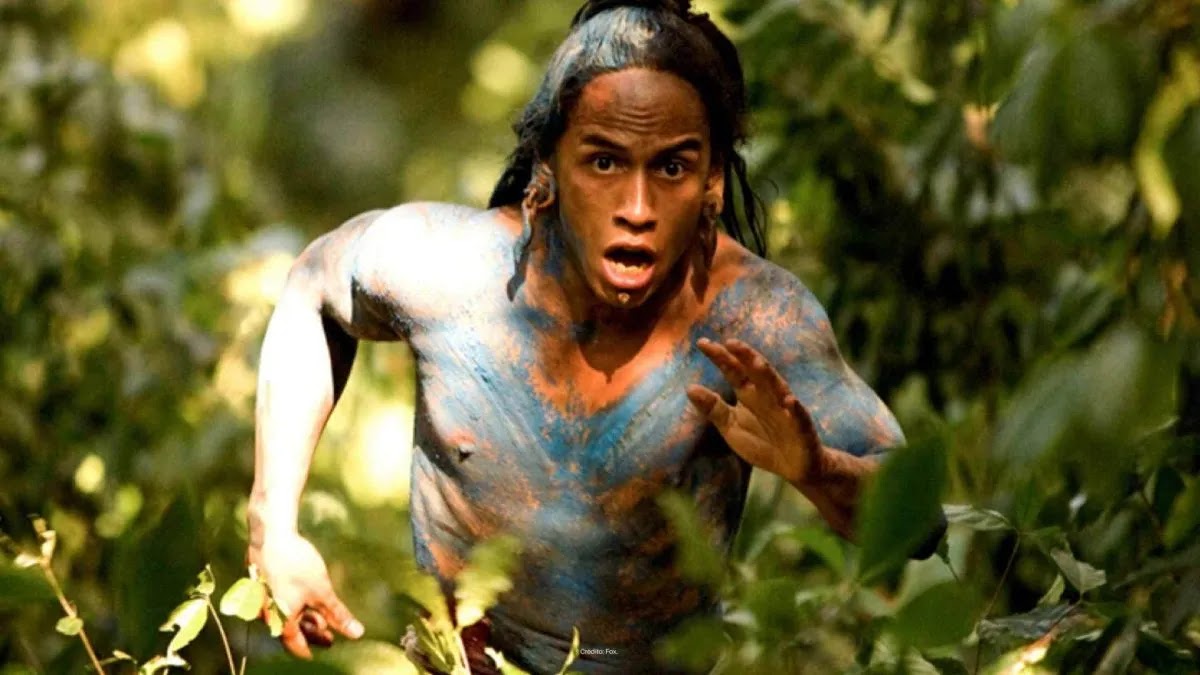
Apocalypto's racism
Race to the bottom
Tuesday, December 14, 2021
West Side Story (Steven Spielberg, 2021)
Batang West Side
Not sure why people are surprised Spielberg has done a dance musical--arguably he's been making them throughout his career, from the deadly pas de deux between the colossal Peterbilt and little red Valiant in Duel to the lines of police cars snaking behind Goldie Hawn in The Sugarland Express to the Ferris Wheel strolling down a seaside dock in 1941 to the alien ships playing tag across the clear Wyoming skies in Close Encounters of the Third Kind. Spielberg isn't just a master at shooting people dancing (see the USO dance hall sequence in 1941), he's a master at shooting anything dancing, from cars to saucers to Ferris wheels; the first time we manage to view the entire Great White in Jaws (after teasing us for about an hour) Spielberg cuts to a high overhead shot of the creature gliding smoothly past the fishing vessel (accompanied by John Williams' eerie harpstrings) and we see with an electric tingle shooting up our spine that it's about the size of the vessel. That's why the quip "You're gonna need a bigger boat" lingers so in memory--turns out Police Chief Brody was right.
Thursday, March 23, 2017
Get Out (Jordan Peele)
Get who's coming to dinner
(WARNING: plot twists and ending to be discussed in detail!)
Call Jordan Peele's sneaky-clever directorial debut Get Out his take on Stanley Kramer's insufferably benign racial warmedy Guess Who's Coming To Dinner with knives drawn out midway between the fish course and dessert. The politeness and civility are still there only like a pair of lips drawn taut to conceal fangs.
Monday, August 19, 2013
The Butler (Lee Daniels); Fruitvale Station (Ryan Coogler); Much Ado About Nothing (Joss Whedon)
Lee Daniel's The Butler (director's name included reportedly for copyright reasons) really should read: Lee Daniel's Forrest Gump. We get a similarly hapless, helpless hero bouncing his passive way through recent American history, though Daniels does refrain from digitally inserting his protagonist in every famous archival footage in recent memory--at least we're spared that travesty.
I'm guessing though what Daniel's really striving for with this story of Cecil Gaines (Forrest Whitaker), the White House butler who served seven presidents (based loosely--very loosely--on the story of Eugene Allen), would be popular audience response to Gump's feel-good version of history (we experience in swift succeeding order institutional oppression; physical, mental suffering; decades of bad prosthetic age makeup; and ultimately and eventually vindication, triumph) combined with the kind of respectful accolade granted to filmmaker James Ivory and novelist Kazuo Ishiguro for their film Remains of the Day, about yet another butler (Anthony Hopkins) serving in the cusp of history. Not an easy task, though--Ivory directs with an aesthetic severity that sucks all the pathos out of the material; you actually find yourself gasping for air in the film's hermetically sealed screen space (my favorite of Ivory's works, possibly) while Hopkin's unceasingly smiling butler stand invisible and invincible in one corner.
Daniels doesn't suffer any severity, except perhaps the ADHD kind: his movie makes Robert Zemeckis' picaresque romp through the decades look positively Japanese with subtlety and restraint. There isn't a dramatic confrontation or emotional breakdown or historic occasion he can't shove in your face and up your nose with his ten-ton touch; this is coercive emotional porn of the worst sort, shameless propaganda shrieked out from the rooftops on the remote chance that perhaps you didn't get the message. I found myself hiding behind the seat before me, trying to avoid the sheer obviousness of it all (case in point: the picture's final death is telegraphed at least minutes before it actually occurs, causing me to exclaim: "Can't believe he's going to do it--oh, he did it!").
A shame, because there are some honestly powerful moments to be found here. Daniels builds some surprisingly potent comic-horrific contrapuntal rhythms from the sequence where Gaines' rebellious son (David Oyelowo) insists on keeping his chair at a whites-only lunch counter while Gaines seats honored guests at the White House dining room; later Daniels intercuts between Gaines listening to Nixon talking about undermining the Black Panthers and Gaines' son listening to the Panthers speak similarly brutal language. In moments like these Daniels makes a cogent point: that estranged father and son aren't so far apart in their struggles and aspirations as they would like to think they are.
Whitaker does plenty with an indrawn breath or a slightly lifted brow--but he isn't working with a screenplay from an Ishiguro novel, nor does he enjoy the deft guidance of a James Ivory (at one point Gaines actually quotes a line, not from the Ivory film but from an interview about the film, where Hopkins summarized his character with the observation that ideally a room should feel emptier when the butler is present; Hopkins actually makes you feel that vacuum while Whitaker with no small help from Daniels fails--possible because the feat requires subtlety). Whitaker's role (heroic restraint in the face of dramatic circumstances) also bears striking resemblance to Cherry Pie Picache's emotionally wounded-up surrogate mother in Brillante Mendoza's Foster Child--only Mendoza doesn't provide dramatic catharsis and spiritual uplift at the end of his film.
What Daniels has done (or failed to do) can't help but make me better appreciate Eddie Romero's achievement in his Ganito Kami Noon, Paano Kayo Ngayon (The Way We Were Then, The Way We Are Now, 1976)--yet another hapless Gump figure traipsing his way through history, only with tongue pressed firmly in cheek. Comedy solves a lot of problems in historical chronicles--you are forgiven the unlikeliest coincidences, you're excused from maintaining a wearying fidelity to realism, the same time comedy is constantly analytical; it tends to take an issue apart and hold it up for close examination, and properly used it can still develop an emotional wallop. The Butler could have used a bit more analysis, a lot less catharsis; at the very least Daniels could have used more comedy to cut through all the cheese he poured over his huge steaming pile of nachos.
Coming home
The impact of Ryan Coogler's intensely felt Fruitvale Station is belied by the relative innocuousness of the title: unless you know about or heard of what happened you'd be thinking the film is some kind of documentary on San Francisco's mass transit system.
It's some kind of document all right: the final twenty-four hours of Oscar Grant III, a young black man arrested and shot to death (accidentally, not-so-accidentally) by transit police on New Years' Day, 2009.
I've no large issues with the film's ending--far as I can see it's a powerful piece of filmmaking, apparently well researched and for the most part accurate. I like it that the more overtly brutish and possibly racist of the transit officers (Kevin Durand) isn't the one who fires the fatal shot; that it isn't quite made clear--or at least Coogler manages to recreate the confusion at the time--whether or not Grant's hands were handcuffed at the time, or if (as the officers claimed) he was really reaching for his waistband in an apparent attempt to draw a gun (he was unarmed). I think Coogler with the less-than-coherent imagery and editing is trying to make a larger, more powerful point: that a black man's existence is in such a state of ferment and turmoil his life can be cut short at any time, just like that.
Coogler makes a similar point earlier, in a subtler manner: Grant and his friends board the fateful train which pulls away; the camera stays put and as the train blurs into motion the passengers inside become shimmery and ghostlike, almost as if they threaten to flicker completely out of existence. Lovely, memorable effect.
More troubling I suppose is his recreation of the earlier part of Grant's day. Coogler doesn't hide the fact that Grant is a repeat criminal offender, that he has used drugs in the past and is still using, and that he's less than faithful to his girlfriend. On the other hand he plants little hints here and there that tend to mitigate these character flaws--to cite three: he loves dogs, he's seriously thinking of quitting drugs, and if he flirts with a pretty girl it's mainly to help her out at work.
The first hint is the most problematic; the entire incident did happen--but to Coogler's brother, not Grant; Coogler admits to trying to establish a metaphor, that Grant is like that pit bull, a basically goodhearted creature with an unhappy reputation. The second (giving up drugs) was apparently discussed by Grant with his mother and girlfriend--though no one actually saw him go so far as to throw away an expensive bag of grass.
Can't help but liking the third little detail--for a while there you're not sure if Grant is being helpful or trying to pick up the girl, and the actor Michael B. Jordan plays up this ambiguity beautifully; also, this is one of the few details that seems to have some basis in fact, as the grandmother did say he called her asking for her fish recipe.
Think Coogler weakens his film when he tries to mitigate his protagonist's many flaws, when he tries to both present the flaws and defend his protagonist however indirectly from the uglier implications of those flaws. Coogler misses the more difficult but possibly more rewarding argument: that no matter what faults Grant may have (and even if every accusation leveled at him were true he'd hardly be the worst person aboard that train) he didn't deserve to be shot in the back, lying on his belly on the floor of that station.
Still it's a harrowing experience, and call Coogler irresponsible for picking the aftermath of the Treyvon Martin case to release his picture, I'm willing to admit the film articulates something, a frustration we feel on the issue of race in America: we may have come a long way, but have an even longer way to go.
Much to-do
Joss Whedon's adaptation of Shakespeare's Much Ado About Nothing is pretty much what you'd expect--sexy fun--but I didn't expect it to be so much of a piece with the rest of Whedon's work. Smart and attractive people dealing out wit in intricately woven, kilometric lines? That's so--Buffy. Or Firefly.
Not saying Whedon's managed to pull Shakespeare down to the level of television (well-made television); time and time again he's borrowed characters, situations, ideas from The Bard--he's just taken a major source of inspiration and brought it to the big screen. Plus he goes on to demonstrate how unintimidating Shakespearean English can be, if you've got a cast of actors confident enough and deft enough to wrap their lips around all that archaic (yet still playable after all these centuries, still of-the-moment pertinent) dialogue such that the meaning is not only clear, but the actors clearly had fun speaking them.
Helps that much of the film is casually--even carelessly--shot and cut together, giving the very opposite impression of a formal Shakespeare drama; Whedon has things hopping and we're put on alert trying to keep up with his lively sense of pace.
If Much Ado feels so Whedonesque, the grounds on which the play is performed--Whedon's own house--feel so, well, Italian, or at least Santa Monica California doing its level best to be Italian (the play is officially set in Messina, Sicily). This along with (as Whedon himself notes) the film's extensive use of window panes, glass, reflections, candlelight, sunlight and shadow play on classically Shakespearean themes like deception and truth, of something or someone or someplace pretending to be what she, he or it is not, from that pretense forging a new truth--or at least a more persuasive lie.
There's a bright side (Benedick (Alexis Denisof) and Beatrice's (Amy Akers) belligerence hiding a budding affection for each other) and dark side (Claudio's (Fran Kranz) festering distrust of Hero (Jillian Morgese, in her debut role), fanned by the machinations of Don John (Sean Maher)). Matters come out right in the end (this is a comedy after all), but Whedon doesn't stint on the more pessimistic implications of the play, as mistrust and misogyny wrap their tentacles around Hero's helpless form to the point that even her own father Leonato (Clark Gregg, in arguably the finest, most understated performance here) accepts the calumny directed against his daughter with heartchilling speed, and the only ally she can reach out to is her friend and confidante (and fellow woman) Beatrice. People in distress act instinctively, and Hero's instincts have her choose along gender lines--that's how it is, the play seems to say, though it also makes you wonder: why should this be so? Why do women more easily trust women, why do men put much more faith in men, and should Hero continue loving a man who has demonstrated so little of both?
Hero and Claudio's relationship produces much of the play's drama; Benedick and Beatrice's churns up much of the comedy--but also much of the warmth, as theirs is the older story with more than a bit of history, and not just in the play. Whedon fans recognize the actors playing Benedick and Beatrice as the famously star-crossed lovers in his series Angel and call it cheap fan service, but watching them consummate that tragically brief romance in this modestly scaled, sloppily shaped Shakespearean comedy is like having a little ribboned gift presented for our delight. Ackers and Denisof aren't just a pair of pretty faces: you can tell they're totally comfortable with each other, and the developing fondness on their faces isn't just skilled emoting, it's genuinely felt. Wonderful fun.
8.19.13
Sunday, February 03, 2013
Zero Illuminated, Django Unzipped
After writing extensively on Zero Dark Thirty and the literature surrounding it, I'm struck by one other article that ingeniously and even brilliantly squares away its lack of context or characterization, pointing an accusing finger at the film's true antagonist--not UBL or Osama Bin Laden, not the American industrial-military complex and its complementary intelligence organizations, but something much bigger, the forces of history itself.
If we take this essay to have finally solved the riddle of Bigelow's film and its ambivalent (some would say confused) stance towards torture, then Bigelow's persistent apolitical posture turns out to have been a prescient aesthetic choice, one consistent with her film work since she met Susan Sontag back in the '70s. As the article puts it, the film is not postmodern, but post-postmodern, where it puts out a view, a sensibility, a story that competes for legitimacy in the public mind.
The article even puts to rest the suspicion that the film endorses torture--not really according to Rombes; it merely suggests that history itself demands the torture of suspects, with all the attendant consequences to be paid for and endured (the delays, the subsequent fall from moral grace). The film in effect notes that history itself is responsible, not us--I suppose as big a cop-out as any I can think of ("The Devil (history) made me do it!"), unless the film makes this statement in a state of dismay, not mere resignation or relief, and here (again) the film remains stubbornly silent. At this point Bigelow's narrowly focused POV starts to look less willfully ignorant and more heroically honest--when one character in the film profanely demands targets to eliminate, Rombes writes: "his words ring with a hot, burning truth about power rarely spoken in American mainstream films."
Like I said, brilliantly put; it actually made me pause to try rethink my thoughts about the film.
Maybe the biggest problem I have with Rombes' thesis is that looking at Bigelow's other work I don't quite see consistent aesthetic choices: just a lot of stylistic ones that help prop up a usually muddled script, Hurt Locker included (as I pointed out in my earlier article it's excellently made, but the central character doesn't make much sense). Strange Days begins with a fantastic single-shot action setpiece that runs for around ten minutes and says--I don't know what, exactly; the rest of the picture is far less coherent. Blue Steel is full of dread and cool metallic blue imagery that in retrospect feels ridiculous; Near Dark--arguably my favorite of her early work--is compellingly violent vampiric poetry that sometimes contradicts its own rules. Give me a more consciously nihilistic pessimist like late Bresson (Lancelot du Lac and L'Argent comes to mind)--he's every bit as deadpan and ambivalent, but you at least get from him the sense that he knows what he's doing; this stumbling along in the murky waters of political controversy clouds the waters more than clears them, and really doesn't help anyone much, least of all Bigelow.
Django Unzipped
(Warning: plot of several Tarantino movies discussed in explicit detail)
I'd already talked about how I think Tarantino's Django Unchained was sexist; now I've been asked to explain why I think the movie's racist.
I thought just linking a few perceptive articles would be enough; but just to humor those in question, I'll point out the highlights, and add a few thoughts of my own:
Keli Goff's Huffington Post article questions the violence--why, comparing this to his previous pictures, did he feel the need to amp up the overall suffering of African Americans in his picture? Why, for example, does he show Jews killed in Inglourious Basterds and Uma Thurman suffering in the Kill Bill movies but not in such voyeuristic length and with so much creative detail? Why single out black slaves, hm? As a kind of stinger finale, Goff also points out the telling detail that in his most famous film, Pulp Fiction, the black man is raped, and saved by a white man.
Don't totally agree with Ms. Goff in everything; she professes to be a Tarantino fan, and thinks the violence in Kill Bill "on par with watching ballet"--so speaketh an otherwise thoughtful writer unfamiliar I'm guessing with the works of Liu Chia-Liang and Johnnie To (In my book the first Kill Bill is Tarantino's amateur stab at the martial arts epic, its sequel only marginally better).
More damning I would say is Jelani Cobb's article, which begins by showing the injustice inflicted on the Russians by Tarantino's previous picture (I personally thought it oververbose and less than inventive myself). Cobb goes on to discuss both the use of the "N" word and the depiction of a black hero in the movie, noting that while the word in question was used during the time, here it's used so excessively, unconvincingly often it has practically been raised to "the level of a pronoun;" he goes on to talk about how the slaves offered continued resistance against their white masters to the point that the "slaveholding class existed in a state of constant paranoia about slave rebellions, escapes, and a litany of more subtle attempts to undermine the institution"--a reality that Tarantino not only ignores, but overturns with the notion that Django is the only non-passive slave out there. In effect, Tarantino reinforces the myth, the stereotype--and, Cobb insists, it is a myth and stereotype--that the slaves never fought back; they mostly shuffled along clad in their leg irons and esoteric metal neckware.
I'd go further on this: with all the suffering endured onscreen and in reality, with the wide variety of experiences and stories to tell, with all the strength and intelligence the enslaved can muster--is bloody payback the only response Tarantino can have them take? I'd like to ask African-American filmmaker Charles Burnett his reaction to the Tarantino flick, only I suspect it isn't necessary; he's already done his take, and a subtler, finer, more nuanced response I doubt can be found.
I'd especially point to a key dialogue that takes place between two slaves, concerning the power and importance of reading and writing and, beyond that, knowledge (a discussion I'd have with my students, many of whom seem unaware of this aspect of history and their ancestors' role in that history). At its lowest level, that of reading words, an educated slave can help his flight by reading maps and street signs. When a slave learns to write words he can forge a day pass (a note authorizing his passage through public roads)--allowing the runaway, oh, at least a day's head start. If said slave could read, write, and compose, why he could actually begin to strike at the heart of the institution itself, which is basically a set of laws printed on paper. So when I say "is that all Tarantino can think for them to do?" I'm serious--the fight against slavery took many forms, and that of blowing a white man's head away with a shotgun is the least imaginative I can think of.
2.3.13
Monday, December 28, 2009
Is Avatar racist?
Listened on NPR and they talked about how people see racist themes in Avatar.
Wesley Morris of the Boston Globe harumphed and said it was very 'limiting' to think of the movie in those terms (how so? Wouldn't it be more accurate to say we've uncovered yet another subtext to the picture's script, one Cameron possibly didn't even know about?). He added that the characters are 'so rich'--I had to laugh at that remark. I've sounded just like that when I'm trying to defend a film I like that had serious problems.
I don't know about racist, but the picture's not exactly what you'd call culturally sensitive. Why DOES it take some white guy to switch sides, be black (in this case blue), and fight for the helpless blacks--sorry, Native Americans--sorry, Na'vi?
This is where Cameron's use of classic storylines runs into problems--he's channeling old movies but he's channeling old attitudes too, and the old, old whiff of racial condescension seeps through the channels he's using.
(Might as well point out here that the idea of human minds being implanted into alien brains is nothing new--Poul Anderson wrote about it in a short story "Call Me Joe." And that Joss Whedon has a darker and more sophisticated take on mind imprinting in his new Dollhouse TV series)
To be fair, it's no Apocalypto; it's not the product of a raging Anti-Semite and homophobe. But still...
Could he have done a better job? Sure. He could have given the Na'vi their due, could have fully honored their culture by writing a better script, one with a more plausible psychology for both the Na'vi and the human military, and managed a more consistent integration of the cultures he borrowed from to make his aliens (as is, it's a grab-bag of Native American, South American, African and, yes, Iraqi ethnic traits--the overall impression is more of opportunism than of any real affection for his creations).
Frankly, if you're going to watch a white man go native and fight for their freedom, I'd rather see Richard Harris drive hooks into his chest in Irvin Kershner's The Return of the Man Called Horse (1976). Does not transcend its pulpy origins, but it's so well and simply done, so lyrical and passionate in its filmmaking, I can give it a pass. That could be my creed: anything lyrical and passionately done, it's easy to give a pass--or at least appreciate, despite the flaws.
Friday, June 19, 2009
Year One (Harold Ramis, 2009); Frozen River (Courtney Hunt, 2008); Mandingo (Richard Fleischer, 1975)
One year
I didn't mean to watch Year One (2009)--it seemed to be the least repugnant choice available at the local multiplex--and was surprised to learn that it was directed by Harold Ramis.
One has expectations of Ramis; one can't help having them. He is, after all, the director of Groundhog Day (1993), one of the finest films of the '90s, one of the finest metaphysical films ever made, and about as near-perfect a comedy as anything I can think of in the past sixteen years. Daunting standards to hold a man up to, but Ramis, while never quite reaching so high again, has made a few decent attempts: Stuart Saves His Family (1996), for example, takes an unpromising Saturday Night Live sketch and turns it into a quietly desperate, ultimately moving film about the pleasures and perils of self-affirmation; Multiplicity, made the year after that, posits multiple copies of Michael Keaton scurrying everywhere (a hilarious or horrifying idea, depending on how you take to Keaton). Analyze This (1999) seems like the ultimate idea of the psychiatric patient from hell--it's only halfway realized, but at least the idea had something of the absolute about it.
Judging from the cries of blood surrounding Ramis' latest (Roger Ebert gives the picture one star, spends a whole paragraph discussing the movie's poster, and sums it all up as a "dreary experience"--one gets the impression the man could barely bring himself to engage with the movie, much less like it), Ramis has failed yet again to touch the comic heights of Groundhog (But what else does?). He has failed but surprisingly, despite the unpromising trailer and the generally negative outcry, he does leave an indelible mark.
It's a cross between Mel Brooks' History of the World, Part I (1981) and Monty Python's The Life of Brian ((1979)--Brooks for the formless, across-the centuries format, Python for the subject matter (religious hypocrisy and faith). It's not laugh-out-loud funny, even if it does have more than its share of flinch-worthy gross-out moments; fact is, it's remarkably thoughtful in its treatment of and attitude towards religion and faith. It has a handsome look for a comedy, mostly burnished desert sun and torchlight interiors (checked out cinematographer Alar Kivilo, and the only work of his that stuck out were Sam Raimi's A Simple Plan (1998) and some Sandra Bullock vehicle called The Lake House (2006)), and is competently edited (one expects no less from the director of Groundhog, which is all about editing).
The climax, strangely enough, bears some passing resemblance to that of Ishmael Bernal's Himala (Miracle, 1982)--I'm sure we needn't accuse Ramis of stealing from Bernal, though.
So. Find myself in the strange position of recommending a solidly Hollywood summer movie, and a comedy to boot. Goes to show how accurate 'common consensus' can be, in gauging a picture's quality--sometimes you just have to go and see for yourself.
Icewater
Courtney Hunt's Frozen River (2008) is despite its bleak setting a lovely film. Hunt captures the essence of lower-class living in the colder Northern states--the prefab houses, the junked cars, the temp jobs, the pinched-face people struggling with one scam or another (as either victim or perpetrator) and earning a meager wage, all under the gray skies and endless snowdrifts of upstate New York (some of the scenes look exceptionally difficult to shoot--not only are you dealing with a whitened ground that often radiates more light than the sky, you're dealing with the shifting, often treacherous conditions of the eponymous river itself).
The two protagonists, Ray Eddy (an amazing Melissa Leo) and Lila Littlewolf (Misty Upham) make a good odd couple--they embody their respective social classes (poor white trash, Native-American destitute), they have a genuinely spiky chemistry that makes any possibility of collaboration or friendship seem less than certain, more the result of life's strange vicissitudes than of opportunistic plotting.
The river itself becomes a visual metaphor (a nicely unforced one) for the women's lives--for the kind of fragile, uncertain ice they skate on, struggling to keep their balance, hoping to God the surface of things holds and doesn't drop them into the cold water.
One of Ebert's worst films ever
I remember Roger Ebert granting Richard Fleischer's Mandingo (1975) not one but zero stars--apparently the eminent critic, harumphing about "taste," was shocked at all the decadence and exploitation going on, not to mention the sultry, sensual ambiance.
Recommendation enough. It's a startlingly beautiful to look at and despite--or precisely because of--its trashy, melodramatic roots, full of unwholesome energy. It's also declared to be (by film critic Robin Wood, among others) "the greatest film about race ever made in Hollywood." There's always Roots, of course, which aired on broadcast television two years later, but that well-made production doesn't have the inimitable image of James Mason as Southern plantation owner Warren Maxwell, planting his feet on a black boy's belly in the hopes of drawing the rheumatism out of his aging body into the healthy child.
The film is more than the sum of its grotesqueries; Fleischer has taken a Kyle Onstott's pulp potboiler, pruned some (but not all) of the more extreme sadism, given (with the help of writer Norman Wexler) the blacks in the film a social and historical consciousness, overall fashioned a distinctly gothic tragedy. With the help of cinematographer Richard H. Kline (they've collaborated on films like The Boston Strangler (1968) and Soylent Green (1973)) Fleischer has conceived of a doomed, decadent South: the Maxwell mansion is a brooding presence full of huge, shadowy rooms and, despite their wealth, dirt-stained walls (mansions of other families, particularly those with womenfolk, are noticeably better kept); the surrounding forests are lit by dustmote-thickened sunbeams and teem with tropical plants that thrive in the Southern heat.
I can't help but think that the film's violent setpiece, a no-holds-barred bareknuckled fight between two black men with bets placed, may have been the inspiration for the duel to the death in Mario O'Hara's Bagong Hari (The New King, 1986). Other than the common premise, the two sequences couldn't be more different--Fleischer stages his fight as a claustrophobic battle, with teeming crowds on the sidelines and a handheld camera lunging in for closeup shots; O'Hara's is more of an arena event, with tiers rising above and away from the circular floor, torches bordering the battle area, and the camera confining itself to more aloof medium and long shots. Preference for one over another may be a matter of taste--I love O'Hara's cool appreciation of the desperation far below, same time as I like Fleischer's sense of immediacy; I was startled by Fleischer's bloody conclusion, same time I appreciate O'Hara's one wince-inducing moment, involving a meat hook. Both worked with small budgets (O'Hara's being the far smaller), both show a distinct flair for and understanding of violence.
At the film's center is Warren's son Hammond (Perry King), an angel-faced, ostensibly kindhearted plantation owner who at the same time feels more comfortable bedding and deflowering his black 'wenches' than he does bedding Blanche (Susan George), his upper class white wife. Yet he's not above stringing up an old black slave upside-down, and having another slave beat the man's naked bottom bloody with a paddle drilled with holes (to reduce air resistance and speed up the swing). The old slave's crime? Learning to read.
Hammond is in the classic mold of the tragic hero--like, say, Macbeth he is basically a good man, a promising catch for Southern women what with his money and his progressive attitude towards slaves; like Macbeth he never fully realizes the precariousness of his position, never learns that unlimited access to power can lead to its unlimited abuse, and eventual payback. Robert Keser in The Film Journal argues that when matters come to head, when "the crisis peels away Hammond’s velvet glove, revealing his essence as he reverts to violence," he precipitates "the final wave of tragedy." Keser goes on to conclude that "A benign despot with an attractive smile and surface compassion is a despot nonetheless."
I don't quite see it that way. Hammond's moments with his favorite 'wench' Ellen are about as touching as anything I've seen on film, his vow to her that "No one, black or white, gonna take your place" a far more real declaration of matrimony than anything he says to poor Blanche, who is in turn as much a victim as any of the wenches in the Maxwell plantation (she just has more bite, is all). I see Hammond as being an essentially tenderhearted, loving man, who unthinkingly embraces the violence inherent in the institution of slavery; any punishment he instigates is out of obligation, as in the bloodying of that old man's behind (when a cousin walks in and takes over the beating with greater relish, Hammond immediately objects). The real tragedy I think is that a loving heart is not enough; the institution victimizes blacks and their masters alike, robbing both of their humanity as Hammond is gradually robbed of his.
When push finally comes to shove, I don't see the event as Hammond reverting to a violence that was always there so much as it is a matter of a soft heart pierced to the quick, striking out in unaccustomed fury. It's a truism, I suppose, that the gentlest people when provoked express the most extreme reactions, but that's the truism I believe Fleischer had in mind for the film's climax. Hammond has the numbed face of one trying to hide his inner revulsion at what he intends to do, and he carries out his mission with the briskness of one who knows he has to do things quickly, unthinkingly--if he paused to consider, he would fail to go through with it.
In a kind of reverse trajectory, Hammond's favorite buck slave Mede (boxer Ken Norton) gradually gains his humanity. He doesn't have it at film's beginning; in one of his earliest scenes, he's examined and prodded and looked over like a prized racehorse. His preferential treatment is thrown at his face time and again; fellow blacks keep pointing out that on issues that matter, his benign white masters will turn on him. When a runaway slave is about to be hanged, the condemned man looks at Mede and declares "at least I die a free man." As push again comes to shove and Mede finds himself facing the unfortunate end of a rifle barrel, his eventual recovery of the dignity he had lost makes for a stirring counterpoint, a hopeful (if faint) note to contrast against Hammond's own despairing, downward spiral. A great film, absolutely.
Sunday, November 23, 2008
Griffith's ghosts, and Cahier's 100 most beautiful films
Take the case of his recent article on Kino's release of the second volume of the films of D.W. Griffith, and read the commentary page, which runs to over 160 posts as of this time.
Griffith almost a hundred years later is still the provocateur, still able to raise a good if not always civil or intelligently reasoned (or worse, unoriginal) fracas. All to the good despite the negativity, I say; better by far than if no one cared at all.
Didn't want to add fuel to the fire (or static to the already considerable noise), so I'll just comment on the whole debate here. Been an Asian living in America for five years, and for the past half decade, has not been entirely unaware of the problem of racism in this country. Been called everything from 'spic' to 'nigger' (apparently Filipinos are not a very common sight), and accused of being racist myself (among other less savory things). I get that sidelong glance when walking into a store, or public institution; I've felt that closemouthed tension whenever entering a room full of white people. Racism--or at least its simmering, tightly-plated-over-with-a-thick-layer-of-courtesy equivalent--is something I have to live with all the time.
I can see what an appalling tract Griffith's The Birth of a Nation is; I know something of its history, and the role it played in reviving the Ku Klux Klan. Watching the film, I cringe at the blackfaced stereotypes depicted onscreen, running apelike after Flora Cameron (the ever-sunny Mae Marsh), or wreaking havoc in Congress.
And it's not just the racism; if the racism were hamhanded and obvious (as I have to admit it often is here), it wouldn't be such a thorny issue. It's in how persuasive the film at its best can be. If a black man (or an actor in blackface) running after a woman hoping to have sex with her is too grotesque to take seriously, the subplot about the mulatto Silas Lynch (George Siegmann) trying to force marriage with Elsie Stoneman (Lillian Gish) is sufficiently and subtly developed to actually make one bristle at the thought of a subhuman brute laying his hands on Gish's lily-white limbs (not to mention make one feel the satisfaction of seeing a do-gooding liberal (Austin Stoneman, played by Ralph Lewis) being confronted with the consequences of his own 'wrongheadedness'). The climax is easily the film's most powerful moment, a thrilling rescue sequence to rival anything done by Kurosawa or Spielberg, and not the least of Griffith's accomplishments is in having you cheer a band of Klansmen riding to the rescue.
All that said and considering what I am, I take what I think's the middle view on Griffith: the man was a social naïf, but he could direct like an angel (or devil, if you like). For every scene with a slouched and gibbering white man in blackface, he's got a scene of exuberant gallantry, like a wounded Confederate, defiantly stuffing a Union cannon with its own flag, or of surpassing tenderness, like a soldier's halting, hesitant homecoming. Griffith in film took sides and dug in like a soldier, and people cheered or condemned him for that--still do to this day. I do think you're probably something of a naïf if you can dismiss his racism as "a product of his times;" if you can manage to totally ignore his filmmaking, though, you're probably also blind (or maybe just not paying attention).
Also found in the commentary pages is a link to Cahiers du Cinema's 100 films pour une cinematheque ideale. It's not a bad effort, for an attempt at something definitive (personally, I prefer a whole score of lists, and refusing to tally them up in any shape or size whatsoever), and probably the most credible outside of Sight and Sound's and Senses of Cinema's.
I've heard minor cavils--no Borzage, no Naruse. To which I'd like to throw in "What, no Guru Dutt, or Raj Kapoor, or Bimal Roy (what, are Donen and Minnelli the only masters of the musical?); no Anthony Mann; no Hou Hsiao Hsien; no animation (unless you consider King Kong, which is arguably stop-motion)? Nicholas Ray represented by a kitschy work (I'd love to see him recognized for In a Lonely Place)?Welles present, but represented by the usual suspect (Citizen Kane--though it's nice to see Touch of Evil included)?"
To be fair, I do appreciate the high ranking of Laughton's Night of the Hunter, which critic David Ehrenstein considers the greatest American film ever made (I don't know if I'd go so far, but I understand where he's coming from, and I do love the picture myself), of M (my favorite Lang), and of City Lights, which I do love to death but have failed to keep in my own top ten , due to overfamiliarity. Maybe I should look at it again.
(But waitaminute--only one Keaton, while Chaplin has five? What's going on here? (Only, I suppose, the rubbing off of strange protuberances and projections in the lists--one reason I dislike tallies is that they usually end up giving us what the mainstream considers top quality; give me heterogeneous lists anytime, where a man's quirks and eccentricities are clearly on display))
But yeah--maybe the most painful omission is any word or mention of a Filipino filmmaker, Brocka or Bernal or Ad. Castillo or either of the two De Leons or Diaz or Red or even O'Hara. Still have a long way to go with the French critics, I suppose. To work, then.
Saturday, July 05, 2008
Angst essen Seele auf (Ali: Fear Eats the Soul, Rainer Werner Fassbinder, 1974)
Miss agitated
Rainer Werner Fassbinder's Angst essen Seele auf (Ali: Fear Eats the Soul, 1974) is as direct as a white man's contemptuous glare, as mysterious as a black man's serene gaze.
Fassbinder uses color, stylized theater acting and camera movement to point up the extreme isolation felt (and developing bond shared) by two lovers--Emmi (Brigitte Mira), an elderly cleaning lady, and 'Ali' (El Hedi ben Salem), a young Moroccan immigrant worker who came to his name by mistake (his real full name is El Hedi ben Salem M'Barek Mohammed Mustapha).
Their first meeting at a bar, for instance: we first see Emmi entering the establishment's front door, the row of small tables (topped with a rich red tablecloth) emphasizing her distance from the camera. Fassbinder cuts to a reverse shot where Ali, bar owner Barbara (Barbara Valentin) and friends stare at Emmi as if at a personal affront. Cut back to Emmi, who at this wordless assault gropes for a chair to pull back and sit down.
Ali is asked to dance with Emmi; he goes forth to comply. Cut to the seated Emmi as Ali asks; their shared posture--Emmi at her chair looking to the left, Ali standing behind her bent slightly in the same direction--already has the look of a casual pas de deux. Emmi seems flustered at the question, somehow finds the perfect answer ("why not?") then stands up; like a butterfly shedding her cocoon she drops her black overcoat to reveal a bright white-and-yellow dress; not spectacular, but a bit startling to see on such a humble mouse of an old lady. She and Ali walk to the back, Fassbinder not cutting (as he did when Ali went to Emmi's table) but following them, underlining the drama of their gesture (handsome young man asking, shy senior citizen accepting), the fact that both ends of the bar has suddenly been united.
A red spot is turned on; the couple dances slowly under its heavy glow. We listen to their conversation and it's easy, casual; the two feel totally at home with each other, chatty Emmi curious at her dance partner, Ali easygoing and open despite the stumbling block of his faltering German. If there's any electricity to the moment, any tension, it's coming from Barbara and friends, who stare at the shuffling couple as if at a personal affront doubly insulting (now there's two of them).
Emmi returns to her table, Ali following; behind them Barbara walks up to set Ali's beer (which he had left at the bar's other end) on the table. Barbara walks away, and the camera which had held the table in a medium shot glides sideways to catch Barbara stopping midway down the bar to turn and look at the couple; Emmi's table up close, Barbara in mid-distance, the figures at the far end--all three sets of figures plus the bar's considerable length help emphasize the distance between elderly stranger, Moroccan, and disapproving watchers.
Emmi decides to go; Ali decides to escort her home. As they stand up to leave the camera suddenly pulls back from them, Fassbinder's way of underlining the significance of the moment. But the shot has yet another function: when Fassbinder cuts to a reverse shot it's to Barbara, looking at the departing couple; we realize that the camera has leaped from table bystander to Barbara's point of view--from sympathetic viewers, in effect, to silent onlookers, silently judging the two.
At the hallway of Emmi's apartment building we see Fassbinder building their intimacy through dialogue, staging and, again, camera movement. The scene begins with a long shot as the two enter the front door; Fassbinder breaks this into two separate shots, cutting from Ali asking questions to Emmi answering. Then Fassbinder brings them together again by having Emmi walk from one side of the room to the other while Ali is standing but behind her, out-of-focus. Emmi is talking about her job; suddenly she turns to look at Ali (who snaps into focus) and notes that he would look better in lighter-colored suits (turning her focus to Ali transfers our attention from her and her past to him). When she talks of children, Ali moves forward to finally stand beside her; mention of family, of being with them and being without, has brought the two closer together. From polite strangers trying to maintain an interested conversation Fassbinder swiftly and persuasively shows them becoming real friends, sharing secrets, sharing vulnerabilities.
When the two finally become lovers Fassbinder makes this such a natural, uncomplicated development it takes one's breath away: Fassbinder, master of melodrama, baroque storytelling, extremes of suffering and emotion, is also capable of creating scenes of simple tenderness and transcendent joy--in some ways the more difficult achievement.
As their intimacy grows, so does resistance to their union. Fassbinder uses a variety of means, but the gossipy women chatting in scandalized voices is such an old and familiar device I had to laugh--Lino Brocka, whose sensibility comes closest to Fassbinder's than any other significant Filipino filmmaker I know, has used small-town gossip-mongers at least one other time, in his early masterwork Tinimbang Ka Ngunit Kulang (You Were Judged and Found Wanting, 1974) (and in fact there Brocka also had his version of the aliented couple, in the form of a leper and a madwoman (Mario O'Hara and Lolita Rodriguez, in arguably their finest onscreen roles)).
In interracial dramas the character whose race is the issue is often a paragon of virtue, and for at least the picture's first half that's what Ali is: patient understanding, charming, somewhere this side of lifeless. In the film's second half Fassbinder adds flesh to this walking cliché: he grants Ali the right to be willful, self-destructive, even cruel--to be fully human, in effect, free to experience and inflict every form of suffering such a state of existence implies. At this point Fear Eats the Soul transcends its racial issues and becomes a meditation on the mysteries of human nature; the relationship, unhappy because of stresses without, starts to crack from stresses within. The strange and somehow beautiful finale brings the film full circle, and we can see Emmi and Ali continuing on, but on a sadder, not necessarily wiser level (or if wiser, not necessarily capable or willing to act on that expensive bit of wisdom). A great film, one of Fassbinder's finest.
The Goethe-Institut’s Rainer Werner Fassbinder film festival kicks off on July 5 with a screening of a documentary on the director, I Don’t Just Want You to Love Me (3 p.m.), followed by a discussion on Fassbinder by Teddy Co at 5 p.m. and a screening of Fear Eats the Soul (Angst essen Seele auf) at 6 p.m. The film festival, which will run until July 26, will be held at the Goethe-Institut Manila, 5F Adamson Center, 121 L.P. Leviste St., Salcedo Village, Makati City. The movies will be screened on Fridays, 7 p.m., and Saturdays at 3 and 6 p.m. There is also an exhibit of posters of his films which will run during the duration of the festival. For more information, call 817-0978. The screening schedule is available at www.goethe.de/manila. Admission is free.
Wednesday, March 28, 2007
Freddie Francis: 1917-2007; Mel 'Foot in Mouth Disease' Gibson strikes again!
David Hudson's Greencine tribute to Freddie Francis (1917-2007) is about as varied and comprehensive a site on all matters concerning the life and passing of a great cinematographer.
Difficult to add much more--except to note that arguably two of the most memorable moments in his incredible oeuvre stay foremost in my mind: first, the blurry, indistinct ghosts in The Innocents (1961), which Francis lensed, proving definitively that it's not what you see but what you think you saw but can't be absolutely sure you did that unsettles us; uncertainty unsettles us.
Second are the spinning shapes that prance onstage in The Elephant Man (1980)--for a stronger expression of exuberance, I can't think of a better example; the fuzziness through which they're seen helps convey a feeling of dreaminess, of dim traces of a happy childhood memory, bubbling up from the subconscious. A cinematographer is often honored and remembered for giving us crisp, vivid imagery; Francis did, much of the time, but on at least these two occasions, he did more by blurring the images, evoking two diametrical extremes of emotion--absolute fear, and absolute joy.
And the latest from Melvinland--Gibson tells Central American Studies professor to fuck off.
And again, don't feel I've much to add to that, except the following points:
1) Hooray for Ms. Estrada--the woman has guts, and she follows in a long tradition of dramatic protests. A few headlines should serve to call more notice to the movie's racism, and the Mayans' rejection of it.
2) As for Gibson--not surprised. At all.
3) Why would CSUN screen Apocalypto and more, invite Gibson to speak? Did they think he had something to teach them? If I were a film professor, I'd keep my young ones very, very far away from Gibson.
4) "Make your own movie!" Nice parting shot. It's their culture he appropriated and slandered; didn't he think they would try a little payback?
Monday, March 12, 2007
Racism in the arts
Beefy McManflesh:
Last night I discovered something about H.P. Lovecraft that makes me profoundly sad; he wrote the following poem:
On the Creation of Niggers
When, long ago, the gods created Earth.
In Iove's fair image Man was shaped at birth.
The beasts for lesser parts were next designed;
Yet were they too remote from humankind.
To fill the gap, and join the rest to Man,
Th'Olympian host conceiv'd a clever plan.
A beast they wrought, in semi-human figure,
Filled it with vice, and called the thing a NIGGER.
H.P. Lovecraft, 1913
I know this has been a topic of discussion in the past, but how can I now relate to the art of a person capable of spewing such vitriol? It sickens me to reread the words of the author whose stories have given me such enjoyment in the past. I feel as if a part of my childhood has been lost.
Is it possible to separate art from the artist, or must they be taken as a whole? Is it reasonable for a humane person to suggest that Albert Speer designed some rather beautiful buildings? What is the morality of this dilemma?
Nerdy suggests that my disappointment shows a certain racial "naivety"; I disagree. I have been surprised by the beauty of the human heart, but never by its attendant ugliness. We invent monsters because we cannot accept the fact that the monstrous lies within us.
In this case, I am saddened because I have begun to receive "viscerally" what I have always understood "intellectually" to be true. Love has bound me to a woman of colour and through that love I am slowly beginning to "feel", piecemeal, what she has put up with for all of her life. I may never fully understand it, but I am continually heartened
The Great Beast:
Beefster, being married to a woman of colour (and into her family) for 23 years I have a bit of perspective I can share.
The past is a different country: they did things different there. Lovecraft was a product of his time, and no worse than any other man who wrote for a living.
It's a mistake to assume that everyone in the past was unsophisticated, naive or ignorant--people are pretty much as sharp as they've always been in our recorded history. However, modes of thought have changed over time. Leonardo thought women were only useful for reproduction, and we don't discard his ideas.
Jefferson was a slave-owner. Greek civilisation was founded on slavery, and we distill our philosophy from them for the most part.
True evil happens when someone is presented a choice, clearly understood, between good and evil, and chooses evil. Someone soaking in their own milieu, who merely failed to overcome prejudice or ill-thinking, and has been dead a hundred years? It's tough for me to get a serious hate on for them--I'll save that for where it can do some good.
Randy Wylde:
It's problematic, I'll give you that. I don't have a good answer, but I do try to allow that people are a product of environment and time, and while it would be great if more would rise above the petty hatreds and misconceptions of their time, many do not. I think that's why I'm more forgiving of the dead than the living.
Wagner's what brought it up for me this past week - he was a bit of an asshole, and also a virulent anti-Semite. But living without the overture to Tannheuser would be very hard for me; it fills me with joy, and I don't hear his antisemitism in it. On its own, it's a work of joy, majesty and great beauty. It also drowns out obnoxious people on the bus very successfully.
I'm trying to love the good works while despising the bad works he did, and to speak out against antisemitism and other hate/bias where it exists today. At this point, my listening to Tannheuser doesn't benefit him or his estate in any way.
I have a much harder time with, say, Mel Gibson. Supporting his work at this time does realize a financial benefit to him; it also adds to the "data" that says he's popular, and while it's specious to say that popularity=support for his ideas, I'm not willing to help build that fallacy.
I'm not sure by any means that my position is defensable, and I don't intend to defend it. But it does bear thinking about and discussion, and I appreciate your raising the issue.
Beefy McManflesh:
You make a good point, Beast. As a student of history, I understand that we need to filter the ideas of the past through the lens of historical "context"; and I am certainly NOT one who holds to a great deal of moral absolutes. I too believe that "people are pretty much as sharp as they've always been"; I guess that's why I'm a little disappointed that Lovecraft was unable to rise above the predominately held beliefs of his day. It was about this time that Franz Boas was developing his theory of cultural relativism.
Randy says, "But living without the overture to Tannheuser would be very hard for me; it fills me with joy, and I don't hear his antisemitism in it."
I hear you, buddy.
It is true that Lovecraft's racism comes through directly in his fantasy fiction in only a few instances that I know of...
Not that I'm trying to be his apologist.
Tim o-Bedlam:
Beefy: It is true that Lovecraft's racism comes through directly in his fantasy fiction in only a few instances that I know of...
it's evident in quite a few of his stories; witness all his talk about "degenerate folk" in many of his stories, like Call of Cthulhu or the Dunwich Horror. ALso, his cat in the story "Rats in the Walls" is named "N****rman".
I suspect Lovecraft was guilty of the upper-crust WASP racism common in his social group.
rufus christ:
You know something? Mores and manners and all of that might have been different back in the bad old days, but it never excuses cruelty. I have it straight from my own maternal ancestors, in their own hand(s), that what was going on in Tennessee in the early to mid 19th century was wrong. So, giving somebody an out based on when and where they lived seems kind of...nope. Can't do it.
It's one thing when you're very young and people are telling you lies and you believe them because it's family and there's a degree of safety and trust. Once you become capable of independent critical thought, then your responsibility should become more personal and less a product of following whatever patterns your culture has taken you.
Maybe this isn't fair, but I hold writers even more responsible than other folks for the simple reason that a lot of what they/we/I/ohputwhoeverthehellyouwanthere do/does in order create often entails wearing someone else's skin for a while.
You can't tell me Lovecraft didn't know he was writing about people and not chattel to be ridiculed. Same goes for Baum's Coulteresque essays about Aboriginal Americans. The thing that gives me hope is that maybe somewhere down the line they had a revelation that their thinking was wrong.
aclipscomb:
I have to bisociate when I read/listen to/view art produced by people I find repugnant. So many artists are just shitty people (but not all of them) that I have to keep two images in my head. Lovcraft(bigot) and Lovecraft(writer) have to be separated or I can't appreciate the art.
And I don't know what that says about me - I don't know if I'm a moral coward for being unwilling to set aside art I like/love over deep moral principles or if I'm being corageous for the sake of timeless art, but I suspect I'm just being human.
It helps that many of the artists I have to bisociate like that over are comfortably dead, so even if I purchase an anthology of Lovecraft's work, I'm not giving him money.
But maybe that's weaseling about it, too.
The Great Beast:
As much as I'm a moral absolutist in my day to day, I'm with Adam here: yes, the baby may be bad, but that's no reason to chuck out perfectly good bathwater.
Tim o-Bedlam:
I think it's death and distance, at least for me. Lovecraft was clearly not the most emotionally healthy person overall (to say the least) so it's not surprising he had some ill-thought-out ideas about race.
Racism among white people was the social norm in 1920 in a way that it absolutely is not (at least, not openly) in 2007.
I do admire people who were able to at least partially overcome the racism of their time: both Lincoln and Darwin were able to do this.
e fulton:
Hearing that someone was a bigot or a misogynist or whatever sours me on them generally and dims the light of any admiration I might have for his or her body of work, but it does not snuff out such light. For people in the past, buying or enjoying their work does nothing to encourage their bad ideas, as (a) they are no longer alive to perpetuate such ideas beyond their existing body of work and (b) I can judge any portion of their work as racist or sexist or what have you, with my judgment being the last word. The ugliness continues beyond their grave, but it stops with me.
Sure, there are those who will draw encouragement in their current racism and sexism and such from old writers who manifest those evils, but as long as I have the ability to transmit my ideas, I hold out hope that over time there will be more people who think like I do and fewer people who think like they do.
So, I think of it like so -- assholes do great work, but great work shouldn't excuse someone for being an asshole. Inasmuch as we know someone is an asshole, we should think such asshole an asshole, but we can still appreciate the great work of such asshole, so long as we don't perpetuate that which makes the asshole an asshole, either by funding the assholicity or by mimicking it in ourselves.
Beefy McManflesh:
Rufus Christ says, "The thing that gives me hope is that maybe somewhere down the line they had a revelation that their thinking was wrong."
True enough. When a writer puts pen to paper, their thoughts, for good or ill, are frozen for all time. What is true for a person one minute may be different the next.
Imagine if we lived in a society where all communications were conducted sans internal filters; what sorts of insane, psychotic ramblings would we be subjected to - racist or otherwise. Does that mean we're all scum? No. Though a confirmed cynic, I still believe "most" people are good "most" of the time.
Me:
As a person of color (brown, dark), racism isn't very far from my consciousness. Apocalypto, for example feels like a personal affront.
You get plenty of that in films, actually--one of the greatest ever made, in my opine, was Birth of a Nation, which singlehandedly revived the Ku Klux Klan; one of the greatest documentary/sports films ever made was by a woman, who did it for Adolf Hitler.
One way I can make some kind of peace with these contradictions is by trying to keep both aspects in focus--I can dwell or write about the greatness I find in a Birth of a Nation or Olympia, but I always append it with the warning that Birth is outrageously racist, and Olympia played into Hitler's notions of a superman (though to Riefenstahl's credit, she did allow for the beauty of a Jesse Owens).
(There's a case-to-case element to all this, too--Intolerance I think was Griffith's masterpiece, and considerably less racist, while Triumph of the Will is more clearly Nazi propaganda, and I think a good deal less interesting than Olympia (though there's a moment in the documentary The Wonderful, Horrible Life of Leni Riefenstahl where she looks at footage of Triumph and--in the way I read her expression--is enjoying the sheer beauty of vast amounts of men marching in precisely orchestrated motion (men depicted as cogs in a machine aren't exactly unique to the Nazis--Busby Berkeley? Fritz Lang in Metropolis?)).
As for Mel Gibson--well, he's an egotist, anti-Semite, and talentless to boot. There's no excuse for the likes of him.
(postscript: a New York Times review of two Riefenstahl bios argues that it's a fine line between accepting her talent and excusing her opportunism--something I hope I'm still on the right side of...)