Showing posts with label Blogathon. Show all posts

Thursday, April 28, 2016

Popeye (Robert Altman, 1980)


Comic poetry 

Robert Altman's Popeye opens with the tinny monophonic sound of The Sailor's Hornpipe segueing into Sammy Lerner's theme song (I'm Popeye the Sailor Man). We see the cartoon image of a ship's rear cabin, doors sliding open, the classic opening of many a Max Fleischer cartoon short; Popeye pops up, chuckles, exclaims (in stereo and in the voice of Jack Mercer, who played the sailor from 1935 to 1978):

"Hey what's this, one of Bluto's tricks?"

"I'm in the wrong movie!"

Wednesday, December 09, 2015

Kakabakaba Ka Ba? (Does Your Heart Beat Faster? Mike de Leon, 1980)

On the occasion of its restoration and screening, an old blog post slightly tweaked.

Come on get happy

Filipinos love to dance; even convicted Filipinos love to dance, and dance well--you only have to see the occasional
video clip CNN plays, of orange-clad convicts from the Cebu Detention and Rehabilitation Center dancing to pop tunes (the choreographer is an accused mass murderer) but strangely enough there aren't a lot of noted Filipino films that feature dance, or at least notable filmmakers making musicals that include dance.

There are early musicals, like Carlos Vander Tolosa's Giliw Ko (1939); problem is the surviving print is in wretched condition (even after restoration by The Philippine Information Agency and the National Film and Sound Archive in Canberra), and what little song and dance I do see in it is, well, of interest, but not quite inspiring. Comedy team Tito, Vic and Joey have done dance numbers; so has comedian Dolphy, among many others. Lino Brocka did Stardoom (1971), a showbiz melodrama full of singing (only the melodrama--a Jacobean struggle between two brothers (Mario O'Hara and Dante Rivero) is more interesting than the music); O'Hara's own Kastilyong Buhangin (Sand Castle, 1980) features singing (you can sense that O'Hara actually gets into his song numbers--gives them genuine emotional heft), and fight sequence so gracefully done I'd argue they are dance numbers (and for a while was tempted to write about them as such).

But an honest to goodness dance number, in an honest to goodness musical, one that I actually like? None off the top of my head, except, of all people, from the forbidding dark genius of Philippine cinema, Mike de Leon. The filmmaker responsible for such grim masterpieces as Itim (Rites of May, 1975), Batch '81 (1982) and Kisapmata (Blink of an Eye, 1981) directed Kakabakaba Ka Ba? (1981), a bizarre caper comedy involving Yakuza gangsters smuggling an audiocassette tape full of opium into the city of Manila and eventually to the northern city of Baguio, for processing and eventual distribution throughout the Philippines.


Wednesday, November 25, 2015

Hakuchi (The Idiot, Akira Kurosawa, 1951)

In tribute to Setsuko Hara 1920 - 2015

Forgotten masterpiece

Akira Kurosawa's 1951 film Hakuchi (The Idiot), his adaptation of Dostoevsky's novel, is pretty much forgotten now, or is rarely mentioned when talking about the filmmaker or his masterworks. The work is seriously flawed--about a hundred minutes were chopped off before the film was released, and you can see Kurosawa trying to make up for this with lengthy expository titles and voiceover narrations, trying to explain the characters' complex relationships in a few minutes of screen time. Critics who do get past the rushed, awkward beginning note the film's literalness, its director's apparent need to get as much of the novel as possible up on the big screen.

Friday, October 30, 2015

Gerardo de Leon: Two vampire films

For Halloween, two classic Filipino horrors:

Pair of Living Dead

On Gerardo De Leon's Kulay Dugo ang Gabi (aka The Blood Drinkers) and Ibulong Mo sa Hangin (aka Blood of the Vampires)

As noted by Mark Holcomb in his Senses of Cinema article; the Gerardo De Leon known to us today had two faces: as director of some of Philippine cinema's greatest films (El Filibusterismo (The Heretic, 1962), The Moises Padilla Story (1961), Daigdig ng Mga Api (The World of the Oppressed, 1965)) and as director of a handful of fine B-pictures (Terror is a Man (1959), Mad Doctor of Blood Island (1968)). In 1964 and 1966 respectively, De Leon made two films: Kulay Dugo ang Gabi (Blood is the Color of Night) and Ibulong Mo sa Hangin (Whisper to the Wind).*

Thursday, May 14, 2015

Chimes at Midnight (Campanadas a medianoche, Orson Welles, 1965)


(Note: plot discussed in close detail--but at 450 years old and counting, is anyone still unfamiliar with the story?)

Bigger than life

What to say about this film? I first saw it on a pirated VHS tape I'd rented in New York back in 1991 (the tape startled me; I had no idea pirated tapes still existed in the USA), and despite the video snow, unstable vertical, wretched sound (not that the actual soundtrack was a model of clarity), thought it the most amazing thing I'd ever seen. Haunted Theater 80 at St. Marks for the longest time, because I'd been told they screened it before and might again, but it never showed up. Finally had a chance in Detroit of all places, an arthouse theater which served coffee and sandwiches while you watched. There were two screenings, and I went to both; had no reason to change my opinion.

Sunday, June 15, 2014

The Many Faces of Jose Rizal


The Many Faces of Jose Rizal

The Philippines has long been obsessed with Jose Rizal-- writer, poet, artist, intellectual, doctor, educator, martyr. Two of the earliest silent feature films made in the Philippines dealt with Rizal-- La vida de Jose Rizal (The Life of Jose Rizal) and El fusiliamento de Dr. Jose Rizal (The Execution of Dr. Jose Rizal)-- and Ramon Estella made a three-hour version in 1956: Buhay at Pag-ibig ni Dr. Jose Rizal (Life and Loves of Dr. Jose Rizal). Rizal's two novels, Noli Me Tangere and El Filibusterismo were adapted twice: the first time in 1915 and 1916 respectively by Edward Gross, the second time in 1961 and 1962 respectively by Gerardo De Leon, arguably Philippine cinema's greatest filmmaker. De Leon also directed Sisa (1951) a variation on Noli Me Tangere, which takes the story of one minor character in the novel and expands it to feature-film length (at the time it must have seemed like a dress rehearsal for De Leon's full-on adaptations; nowadays it seems to anticipate Stoppard's play Rosencrantz and Guildenstern are Dead by seven years). Lino Brocka did his modern-day version of Noli with Tinimbang Ka Ngunit Kulang (You Were Judged and Found Wanting) in 1974.

Rizal seems to inspire both audiences (the two silents and Tinimbang were boxoffice hits), and filmmakers (El Fili has been described as De Leon's gothic masterpiece, while I consider Tinimbang to be one of Brocka's best-ever films). Now, with 1996 being the centennial of Rizal's death, and 1998 being the centennial of the country's independence from Spanish rule-- an independence to which Rizal contributed no small part-- the local film industry has made not one, not two, but three Rizal films, with one more in post-production at the time of this writing.

The first-- Tikoy Aguiluz's Rizal Sa Dapitan (Rizal in Dapitan)-- has already been discussed in this magazine. The second-- Marilou Diaz Abaya's Jose Rizal-- opened December last year, to widespread acclaim and huge commercial success. Why not? It's about Rizal, and at P120 million (US$3,000,000) the most expensive Filipino film ever made.

Jose Rizal is a vast exercise in logistics-- hundreds of extras, dozens of locations, Steadicam rental for over six months. Diaz-Abaya's most impressive achievement is in marshaling all the elements together into a comprehensive view of Rizal's life-- his university days; his exile in Europe; his writing the two novels; his arrest, trial, and ultimate execution by firing squad.

If there's a flaw in Rizal, it's not in the technicals-- photography, costume, and production design are as perfect as three million dollars can make them-- but the utter conventionality. There are speculations that events in Rizal's life inspired his novels (not exactly fresh insight), and one scene has a character from his novels urging him to support the revolt against the Spaniards-- Hollywood epic filmmaking at its most tasteful, in the grandly thudding tradition of Richard Attenborough's Gandhi, or David Lean's Doctor Zhivago.

Doesn't help matters that Cesar Montano is miscast as Jose Rizal. Diaz-Abaya must have had Montano's action-star persona in mind when she chose him, as a way of emphasizing Rizal's vanity; but after a few witty and regrettably short scenes, nothing much is made of Rizal's egotism-- all we're left with is an action star trying to act the intellectual. Better is Jaime Fabregas as defense lawyer Luis Taviel; in his soft-spoken way Fabregas gives a subtler performance than Montano. His defense summation-- understated yet intense, spoken in fluent, effortless Spanish-- upstages Montano's own climactic trial speech.


Mario O'Hara's remake of Gerry De Leon's Sisa couldn't be more: where Diaz-Abaya took six months and three million dollars to shoot, O'Hara did his in ten days, for about sixty thousand dollars.

There's much to dislike about Sisa: the sets are basically of the plywood-and-Styrofoam school of production design; the acting-- sex star Gardo Verzosa plays Rizal, sex starlet Aya Medel the title role-- is crude, if not a bit embarrassing. The story is difficult to follow, shifting from past to present to fantasy to supernatural reality, with little preamble and no apologies whatsoever.

Yet there's something about Sisa. As all Filipinos know, she's is the madwoman who haunts the margins of Rizal's Noli; dressed in filthy rags, calling out the names of her two lost children, she's easily the single most memorable character in the novel. O'Hara believes that memorable characters aren't created so much as they are based on people the writer knew in real life (Rizal once spoke of a "Miss L., who has the most enchanting eyes"). It's O'Hara conceit (and the crucial difference between his film and Gerry De Leon's) that this "Miss L." was the basis for Rizal's Sisa, and that she was the great love of his life.

In a sense O'Hara has been telling Sisa's story all his life. He not only wrote the screenplay for Tinimbang Ka Ngunit Kulang (Brocka's version of Noli) he also played Berto the Leper, lover of the Sisa figure in the film. O'Hara may have revealed more of his feelings than he intended in Tinimbang, both in the screenplay and in his acting; his Berto (like his screenplay) is compassionate, infinitely loving, infinitely tender towards the helpless Kuala. From writing a great screenplay for Brocka (and giving, incidentally, a great performance) to writing a great screenplay for his own film must have been an inevitable, all-too-tempting step.

I've never really liked Rizal as a dramatic character; he's always been too passive, too intellectual a hero for me to believe in. Except for his execution he lived a meandering, uneventful life-- hardly ideal stuff for film biographies. I've never really understood what drove him to write his novels, or believe what he believed. His family was maltreated, yes, and he saw Spanish injustice firsthand...but that was years ago, when he was a child. Could there have been someone closer to him-- some woman, perhaps-- whose tragedy drove him to what he did?

This is Sisa's greatest audacity-- to explain Rizal in such a way that he comes to vivid life before us; everything O'Hara does complements and reinforces this ambition. He knew he couldn't create the world of 1896 on a two-and-a-half million budget so he deliberately creates an unrealistic one out of painted plywood. He knew he couldn't get topnotch actors to play his Rizal and Sisa, so he reconceived them as a pair of crudely intense, emotionally passionate lovers (Verzosa and Medel for all their 'crudity' are ultimately affecting). O'Hara has reimagined Rizal's life the way Marc Norman and Tom Stoppard reimagined Shakespeare's in John Madden's Shakespeare in Love-- as a grand, once-in-a-lifetime love affair. If you don't buy it, you find yourself hooting helplessly in laughter; if you do buy it, you find yourself believing in Rizal for the first time, as a fully human being.

Rizal sa Dapitan was the first, Jose Rizal the biggest; coming soon is Mike De Leon's Bayaning Third World (Third World Hero), invited to this year's Cannes. Sisa will probably fall between the cracks opened up by these three works; it's too ambitious for its own good, a project that fails (though fails magnificently) to live up to the promise of its wildly innovative screenplay. It may end up forgotten in the flood of Rizal films, relegated to the more obscure dustbins of film history...except by those who can respond to its magic, or thrill to its unfettered imagination.

Cinemaya magazine, Issue #44, Summer 1999

Friday, November 01, 2013

Day of the Dead (George Romero, 1985)


(George Romero 1940 - 2017)
 
My contribution to the 31 Days of Zombie at The Projection Booth:


My favorite Dead

The Dead movies aren't so much examples of sophisticated filmmaking as they are powerful metaphors given free rein by a cunning imaginative filmmaker. Night of the Living Dead (1968) was about how a handful of people under siege (Middle-class America faced with the horrors of Vietnam) are able to uphold their standards of decency (not too well unfortunately); Dawn of the Dead (1978) was the same formula set against a large-scale parody of American consumerism (this just a few years before the onset of the materialistic '80s)--even the blandly overbright quality of the film's lights perfectly mimicked mall lighting.

Dawn is of course the critics' favorite for its comic-book flavor relative lightheartedness commentary on consumerism; when the critics went to see Day they expected more of the same. But Romero had moved beyond the satire of Dawn; he was making metaphysical and philosophical statements on the human condition rendered in extremis--soldiers vs. scientists, men vs. women (or woman), pacifists vs. idealists, all cooped up in the hellhole of a pressure-cooker with dial set to 'apocalyptic.' Unpleasant characters and nasty tense dialogue? It's the end of the world; things are falling apart. They haven't sealed themselves off in this series of linked corridors and windowless rooms just to sit down for tea.


Friday, June 15, 2012

Mystic Hitchcock


Posted as part of the For the Love of Film: Film Preservation Blogathon. 

Please donate here.


Mystic Hitchcock

(Warning: stories, twists, and surprises of various films to follow will be discussed in close detail)

Despite his Roman Catholic background, you find a dearth of mysticism in Hitchcock. He seems more concerned with the mystery residing in the human mind, than with any unknown supernatural power residing in the world at large.

That's fine, I suppose--the mind is as complex a puzzle as any, and a lifetime's study probably won't offer any immediate solution. Hitchcock, one might say, has confined himself to specific territory, though a territory particularly rich in drama and conflict.

Original Sin

Possibly the most consistent influence Catholicism had on Hitchcock was on the idea of "transference of guilt"--of an innocent man who comes to bear the burden and suffering of one who is guilty. That idea bears more than passing resemblance to the Catholic concept of Original Sin--where all of  humanity is guilty by reason of Man's fallen state, and the only hope of redemption is through an innocent Son of God.

Hence the common thread going through films like The Wrong Man, The 39 Steps, The Lodger, I Confess, and Strangers on a Train, where a man is accused of a crime he did not commit. A scapegoat if you like, in the Old Testament sense, a creature arbitrarily chosen to be blamed for others' sins.

Which isn't the same as saying the man is a total innocent--in The Lodger one reason why the man is so suspicious, why he's always at the right place and time, why he carries so much circumstantial evidence around with him is because he does have a relationship with the killer; in I Confess the priest is suspected because he stands to profit from the murder; in Strangers on a Train the thought of murder is so tempting the hero actually blurts the thought out loud--in effect, he is guilty in all except the actual deed.

That's as far as Hitchcock went, mostly: a kind of subtle filigree of fear and paranoia, overlaid on his otherwise secular filmography.

Life after death

And then there's the idea of life after death, which Hitchcock didn't deal with often, but when he did it was with unnerving intensity.

In Vertigo Madeleine Elster dies halfway through the story--but death in one form or another was always implied in this picture. Through  color, through camera angles, through sound effects and above all Bernard Herrmann's haunting music we are made aware again and again that this is a film steeped in death and memories, that everyone is haunted by everyone else. Madeleine is haunted by Carlotta Valdez, the city is haunted by Madeleine's desolate figure, Scottie Ferguson is haunted by details and echoes of Madeleine scattered throughout the city long after she's gone. 

There's something otherworldly about Madeleine herself: Hitchcock often shoots her from a distance, in profile, constantly on the verge of turning round a street corner or stepping behind a redwood trunk or dropping off a stone pier into San Francisco Bay. Finally she evades him, slipping like a prestidigitator's assistant up the bell tower's trapdoor; Scotty catches a glimpse of her hurtling past a tower window. 

As for the body itself, crushed and broken on the Mission's rooftop, he could hardly be less interested: it's the woman's elusive ghost--her soul if you please--he's after, not its mere fleshy remains. He leaves that behind, slipping surreptitiously out a side entrance, for others to discover.

What makes the second half of Vertigo so unsettling, I submit, is Scottie's full-on attempt at resurrecting Madeleine through Judy Barton. We get a rough inventory of half the filmmaker's arsenal in realizing his ideal woman: clothes ("I want to look at an evening dress, a dinner dress, black, short, long sleeves...with a neck cut this..."), makeup and hair ("You're sure about the color of the hair?") even lighting (standing before the windows in such a way that when Judy steps out of her bathroom she's wrapped in the unnatural green glow of the hotel's street neon). "She's alive!" Scottie might have cried, the way Dr. Frankenstein did in James Whale's horror classic; she is for a while anyway before she steps off the bell tower ledge one last time, simultaneously stepping  into Scottie's despairing, devastated memories for all time. 

There is, sadly, a rational explanation behind the film's supernatural claptrap, Gavin Ellster's over-elaborate plan to kill his wife. But in mood and tone, in spirit and intent if not strictly in actual deed (and isn't that an accusation leveled at nearly all of Hitchcock's heroes?), Hitchcock manages to create one of the greatest ghost stories in all of cinema.

Then there's Psycho, where for the first thirty or so minutes Hitchcock seems to be setting up Norman Bates as one of his Wrongfully Accused. We know, of course, that his mother did it. 

Turns out we're right and wrong: Norman did it, but not as Norman. The whole case is written off as an example of split personality, presented in what has often been argued as Hitchcock's worst-directed scene--an endless expositional monologue by Dr. Fred Richman.

Simon Oakland's performance as Richman should have clued us in to what Hitchcock was really after. Oakland has the manner of a carnival barker, speaking hurriedly and energetically as if to keep his audience from leaving; a police officer enters, blanket draped over one arm: "He feels a little chill," the officer asks. "Can I bring him this blanket?" The camera follows the officer out the hallway towards a door, which he enters. The camera sits outside waiting; suddenly we hear a woman's soft husky voice call out: "Thank you!"

Cut to inside the room, the camera slowly approaching a seated Norman Bates as he wraps the blanket around him. We hear a woman--the same woman, we realize--talk: "It's sad when a mother has to speak the words that condemn her own son..." We recognize the gravelly voice of Mrs. Bates in voice-over.

Basically Hitchcock through Dr. Richman first gives us the official explanation, a tale full of cross-dressing and poison and enough guilt to kill an entire platoon of mama's boys. It's not a convincing performance; you wonder if Oakland was rushing through the text, if his heart was really into making the most of the short and specific period of time allotted to his character. It comes off like a makeshift reply, something cooked up last-minute to satisfy a deadline.

Then we have Mrs. Bates, taking slowly and deliberately while the camera brings us close and closer to Norman's glittering eyes, and we come to a realization: this is the film's true explanation, this is the film's (and Hitchcock's) true response--that Mrs. Bates is alive and well, living inside Norman's totally insane head. 

Fade to the film's final image, of a chain pulling a car out of the swamp. During the transition we catch a glimpse of an image superimposed over Bates' glittering eyes and wide grin: a human skull. We can't help but note that the shape and width of Bates' grin and eyes match those of the skull's almost perfectly. 

A final image meant to send the audience out of the theaters on an appropriately macabre note? A way of suggesting what's really going on inside Norman's head--basically cunning and implacable Death, grinning at our ludicrous need for a crumb of comfort, a word of reassurance? Or did Hitchcock in a moment of weakness betray his true attitude towards death--that certainly there's the possibility of an afterlife, but we're entirely too optimistic in thinking this a good thing?

A greater power

The Birds stands alone among all of Hitchcock's films, I think, in leaving us with no explanation, however demented, for the violence. Bruno wanted his father dead because he couldn't stand the man; Gavin Ellster wants his wife dead presumably because he wanted control of her money; Mrs. Bates wants any girl interested in her son dead because she's jealous of him (or rather, as Dr. Richman puts it, he's so intensely jealous of her he assumes she's the same way about him). The birds never tell us why they want everyone dead, they just keep at it--presumably will keep doing so until the desired end is achieved. 

There's a funny scene in a diner where different people gather together and offer explanations: changing weather, occult malevolence, biblical vengeance, none of which ultimately stick. With the film's final image--of the little sports car about to lose itself in a vast herd of fowl, inching towards a baleful sky--there's an ambivalent rise of volume and intensity in the birds' constant murmur: are they about to attack again? We can't know beyond the end credits; we can only speculate.

But the supreme moment for me isn't the film's appropriately bleak final image (not as bleak perhaps as in Daphne du Maurier's original short story, but in its way more cruel--as hope, represented by the few sun rays that manage to penetrate the gray cloud cover, is always more cruel than absolute despair); rather, it's the pause right after the gas station explosion--the breathless moment before the birds launch into their most massive attack yet.

To review: gulls attack a gas station attendant, knocking him down. Gas flows downhill, towards a parked car; the driver has stepped out to light a cigarette. The gasoline ignites, the car explodes; the flames follow the stream up the road to the station, which explodes.

Suddenly Hitchcock cuts to a high overhead shot, looking down on the town of Bodega Bay. Far below we see the flames from the burning car and gas station.

A startlingly peaceful moment, this. The panic and mayhem are all far below, out of earshot; the town itself looks like a toy diorama, where some willful boy has poured whiskey over one corner and set it alight.

Then you hear it: the sound of breathing. Barely registering on the ear but labored, as if someone were sucking air from a scuba tank. Then you see a pair of wings--here, there, gathering in increasing numbers. The birds are like skiers on a summit, looking down on the slope they plan to plunder; or like fighter planes perched above clouds waiting for the signal to attack--and suddenly you realize the burning station looks like a signal, like something they've been waiting for all this time.

Hitchcock is almost always about the point-of-view, about gliding, eye-level shots that increase our identification with the protagonist's helplessness and fear. Once in a blue moon (I'm thinking of the opening shot to the cropduster sequence in North by Northwest, or the camera swooping upwards to look down on Norman carrying his mother to the fruit cellar in Psycho) he resorts to a high overhead angle--less a point-of-view shot than a pitiless gaze assessing man's all-too-apparent vulnerability.

This was, well, different. This felt like both point-of-view and pitiless, sentient yet not quite human. The breathing (or rather the faintest suggestion of breathing) makes the moment all the more unnerving--who is this? Why is he doing all this? What does he intend to do next?

It's the closest, I submit, that Hitchcock ever comes to entertaining the possible existence of God, albeit here--and more clearly in du Maurier's story--a God in the guise of implacable nature. You do form specific impressions from this all-too-brief assumption of his  point of view, this fleeting glimpse of the world through his eyes: he seems less like the loving God of the New Testament, more like the vengeful God of old; and he seems to look down on the town and its inhabitants like so many ants--like a pestilence that must be dealt with, if a house is to be considered clean and fit to live in by more respectable inhabitants.

It's about as mysterious and terrifying an image as anything Hitchcock has ever produced--and as such, arguably one of the most mysterious, indescribably terrifying images ever created in the history of cinema. 

6.15.12

Sunday, December 02, 2007

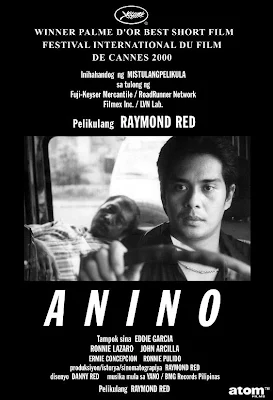
Raymond Red

This article posted as part of the Short Films blogathon:

(First published in Businessworld, 5/26/00)

The Man with the Golden Palm

Earlier this week all the newspaper articles came out about a Filipino winning an award at the Cannes International Film Festival. And not just any award; he had bagged the Golden Palm, the highest honor the festival can bestow.


Friday, November 16, 2007

Yojimbo (Akira Kurosawa, 1961); Ikiru (Akira Kurosawa, 1952)

(Yet another contribution to filmsquish's Kurosawathon)

Yojimbo (1961)—about a wandering super-samurai (the late Toshiro Mifune) who cleans up a lawless town—is supposed to be Kurosawa’s comic masterpiece, but it’s easy to overlook that fact. The film is overwhelmingly grim, dealing as it does with violence, murder, and wholesale genocide. In the opening sequences, Kurosawa swiftly establishes a mood of threat and sudden danger—a dog walks by with a human hand in its jaws; minutes later someone’s entire forearm is chopped off, and presumably the same dog will carry away the even bigger trophy. The only clues Kurosawa allows in the picture suggesting that the whole thing is really a comedy are the bouncy, sardonic music and the editing, the kind of precisely timed cutting you find in slapstick, or in great silent comedy.

Friday, November 09, 2007

Oh God! (Carl Reiner, 1977)

(This is part of the Comedy Blogathon)

In this age of high-concept comedies (sometimes yoked to an action-oriented plotline for more value per ticket-dollar spent) and semaphoring, elastic-faced comedians, going back to a modest, semi-forgotten little comedy like Carl Reiner's Oh God! can literally be, well, a godsend.

Made back in 1977 from a novel by Avery Corman (who also wrote Kramer vs. Kramer, the movie adaptation of which became a rallying point for middle-class single fathers) and adapted for the big screen by Larry Gelbart (Tootsie, the MASH TV series), the movie was an agreeable little entertainment that presented God (who was much more Jewish in the novel) as an agreeable little old man trying to get a message across--and maybe earning a laugh on the side.

The picture keeps a firm foot on the ground, always suggesting more than it shows, always creating its comic effects with a minimum of effort (you should see the reactions Reiner gets from an elevator door opening and closing, opening and closing). It's a resolutely middlebrow comedy--basically God as a 70's poster writer, doing sunny one-liners that don't really offend anyone--but Reiner's direction is such a model of simplicity and restraint and grace one can't help thinking "we can use more of that." You only have to endure, oh, Bruce Almighty and its even less funny sequel, or Apatow and his overaged virgins and geeky impregnators to realize just how different Reiner's film really is.

And it's not as if Reiner doesn't show any visual inventiveness. He opens the movie with an intriguing white glow--you spend most of the opening credits wondering just how he achieves that pearly glow. His camera pulls back to reveal an egg, and that's the picture's theme in a nutshell--look at the world no matter how humdrum and dull from a slightly different angle and it becomes an object of wonder. Later, when Jerry is intimidated into attending an interview with the Lord he enters a room with the same pearly glow--Heaven, Reiner suggests, has a limitless supply of white vinyl paint and industrial-strength Mr. Clean. Oh, Warren Beatty will adopt a similar featurelessness for his hereafter in Heaven Can Wait, released the following year, but I like to think Beatty's bigger-budgeted, more terminally tasteful and ultimately less funny metacomedy took its cue from this smaller picture.

But Reiner's funniest moments are based less on some mildly radical take on the afterlife and more on Burns delivering Avery Corman's (via Larry Gelbart) jokes with a soft-spoken approach. "Did you know that Voltaire probably got me right?" God (George Burns) informs Jerry Landers (John Denver), his would-be prophet; "He says 'God is a comedian playing to an audience too afraid to laugh.'"

For a veteran like Burns, who at that time had been performing in showbiz--radio, TV, stage, film--for something like 74 years, such an uptight audience would be anathema; he works on them patiently, prying a chuckle out of them, maybe even a giggle, building on scant material for a decent laugh, maybe even a guffaw. The movie would be unthinkable without Burns--Mel Brooks, an early choice for the role, would have probably played Him like a Borscht Belt professional out for scalps. Burns has a far lighter, quieter and in his way more effective touch--you can imagine him shuffling into the room holding an empty satchel bag, greeting everyone, complimenting all the pretty girls, puffing on his trademark cigar, and before anyone has even noticed, shuffling right back out with everyone's wallets in his satchel.


Burns' late life persona always depended on this scrawny little old man outsmarting everyone in the room; lift that joke to a cosmic level--at the same time keeping everything to visibly human, even everyday, proportions--and you gain something, not quite sure what. But no, I do know--a divinely empowered Burns, shuffling out of the room with a bag full of wallets.

Burns is surrounded with a royal flush of comic performances--David Ogden Stiers as an exasperated produce manager; William Daniels as an even more exasperated district manager; Paul Sorvino, near-unrecognizable as a bullying Bible-Belt reverend (I remember how Anthony Hopkins on the set of Nixon (1995) admitted that Sorvino (who did a spot-on impersonation of Henry Kissinger) played Nixon better than he ever could), and Ralph Bellamy, the very picture of pompous, self-righteous villainy, as the reverend's high-powered lawyer. Not to mention Reiner himself, appearing on the Dinah Shore show and giving a fifteen-second impression of The Picture of Dorian Gray.

Can't write about the film and not mention John Denver--he's not an actor and it shows, and that's not meant as a snide comment. Denver is such a relaxed and easygoing presence you feel for him no matter what he does, even when he's yelling in exasperation at his sexy, skeptical wife Bobbi (Teri Garr, the only actress I know who can give marital domesticity considerable erotic appeal). His soft eyes and wide nose and even wider mouth denote pure sincerity (what is it with wide noses and mouths? Charles Bronson had a similar quality); compare him to more recent recipients of Divine Intervention (Jim Carrey, anyone?), and, well, who would you be more willing to believe, when he claims to have met the Almighty Himself?

More than the relentless optimism, the corny jokes (which are only funny because they're delivered by either veterans or amateurs), perhaps what speaks the most to me is the picture's sanity. It doesn't claim much for its God--He can't tell the future, and He can't affect our lives any more than to give us some poor schmuck with the message "We can do it! And He's rooting for us." It's that very helplessness and candor that's refreshing; we pray to Him day and night, only to find out that He's been seated right next to us all along, every bit as unsure what will happen next, or why. If the film were made today, the Religious Right might have a fit--probably surround the theaters with picket lines as long as those protesting Scorsese's The Last Temptation of Christ (1989--my favorite Christ film, incidentally). Well, maybe not, but I'll bet there'd at least be a dozen picketers at the boxoffice.

It isn't just God Himself, even His miracles are wonderfully mundane--a calling card that refuses to be discarded, an elevator to a floor that doesn't exist, an impossibility predicated on the steady sound of squeaky shoes--nothing that would upset anyone's composure too much, much less (as He puts it) "the balance of things." And when He does stretch--causing it to rain, for example, while He and Jerry are out on a drive--He limits the downpour to the inside of the car. "Why ruin everybody's day?" God reasons out to Jerry; if only the real article was half as tactful.

Thursday, October 18, 2007

Close-ups in Philippine Cinema


Photo Sharing and Video Hosting at Photobucket

Bembol Roco in Maynila sa Mga Kuko ng Liwanag
*************
My contribution to The House Next Door's Close-up Blogathon:
(Note and warning: plots of both Tatlong Taong Walang Diyos (Three Years Without God, 1976) and Maynila sa Mga Kuko ng Liwanag (Manila in the Claws of Neon) discussed in close detail)

An article on the use of close-ups in Philippine cinema probably wouldn't be very long--Filipino filmmakers are mostly narrative storytellers that rarely use the medium in formally experimental ways. The close-up for a Filipino filmmaker--at least the classic Filipino filmmaker, the digital young turks may have been doing interesting work on it since--is mainly a punctuation mark, a means of pointing up the climactic end of a scene or film. Filipino films are a stew of intense emotions; close-ups are the filmmaker's way of shoving said stew into your face.

That said, my earliest memory of a close-up would have to be the ending of Lino Brocka's classic Maynila sa Mga Kuko ng Liwanag (Manila in the Claws of Neon, 1975), where Julio (Bembol Roco), having killed a man, is cornered in an alley by an angry mob; Brocka cuts to extreme close-ups of Julio's face as the men point at him, point out his icepick, and pick up various pipes and rocks and clubs. Brocka had been using long shots before this, of Julio running desperately away from his pursuers; now he's switched to a strategy of identification, as we see Julio's face register the significance of the rocks, and pipes and clubs, the determined expressions on the men's faces. The men approach; the camera zooms in past them to a gigantic shot of Julio's face, tear-streaked and trickling snot, as his mouth opens in a wet scream--a scream we never hear, because Brocka freezes the shot at the penultimate moment. Slow fade to the cause of all this violence--a silhouette of Ligaya (Hilda Koronel, one of the loveliest faces in all of cinema), the setting sun behind her filling the screen with a light that the film from title onwards has all along been promising, all along been threatening, to flood our eyes with. The end.

When I was a child my grandfather had been screening movies in his basement. Not mere 16 mm prints--he had two monster 35 mm projectors down there, and a man who came every Saturday night with cans of film to screen for us (and whoever else we invited). Jaws, The Godfather 1 & 2, even 1941 we saw before their commercial screening (which was if I remember right mere weeks after the American premiere (this was before the proliferation of video piracy, and the practice of pre-emptive commercial runs in Manila theaters days before pirates can copy them off of American screens)). One of the more memorable films he screened was Brocka's Tatlo, Dalawa, Isa (Three, Two, One, 1975), and it shocked me no end, the shame and despair I saw in the figure of a man, head bowed, having all his hair shaved clean off (he was entering drug rehab).

Another was Maynila. There I was, ten years old and staring at Julio's wet, dripping face; for the first time in my extremely spoiled and sheltered life I knew violence, I knew hate, I knew terror, I knew suffering, I knew death. I knew, for the very first time, the power of cinema.

A similar though arguably subtler use of the close-up can be found in Mario O'Hara's Tatlong Taong Walang Diyos (Three Years Without God, 1976). Rosario (Nora Aunor) is about to hurl her baby, the result of rape by a Japanese officer, down a high bridge; O'Hara's camera slowly draws close till her face fills our view and we see, larger than life, feelings of hate, anger, horror--at the baby, at the man who created it, at what she's about to do--flit across the screen. Fade to a sunset (you can see the pattern: after dramatic intensity the filmmakers shift to a different, usually more serene emotional key). But the outcome is hardly settled; O'Hara cuts to scenes of mounting panic as the family searches for Rosario and her baby. Where has she gone, they wonder? Why has she gone? And what, exactly, has she done? 

O'Hara had honed his skills in radio, and with the sure touch of a veteran radio dramatist, he knew when to present a narrative hook then withhold information, withhold it, withhold it, withhold it till the maximum possible tension has been achieved. And then, simply and without fuss, allows release.

My story regarding this film is much less primal: I had met art critic Jolicco Cuadra back in 1995 in the offices of The Manila Chronicle. A man of eclectic tastes and outrageous opinions (the greatest American writer, he declared, was Philip K. Dick, and I found myself, well, not disagreeing with him (at least not vehemently)); he regaled me with stories of his bohemian life in Paris, where he met Orson Welles and Pier Paolo Pasolini ("he was so dirty--a dirty man!") and in Manila, where he met, among others, Gerardo de Leon. "Everyone is a thief and a fake," he informed me. "Celso (Ad. Castillo), Mike (de Leon), Ishmael (Bernal), Lino (Brocka), Gerry (de Leon)--all thieves and fakes."

"I don't know," I told him, "They're not bad."

Jolicco shook his head. "The only one who's any good is Mario O'Hara. I can't remember the title of the movie I saw of his--what's the matter?"

The matter was, I had just seen Tatlong Taong Walang Diyos and I was more or less thinking the same thing--not that O'Hara's the only one who's any good (he isn't, and I disagree--vehemently--with Jolicco's list of thieves and fakes), but that he's the best filmmaker we have.

The realization took a long time coming. I had been blown away by O'Hara's Bagong Hari (The New King, 1986) when I saw it on the big screen; I had thought it arguably the greatest Filipino action film I've ever seen (a huge flop, it disappeared from theaters the very next day). I sought out other O'Hara films, but couldn't find any.

I did see some of his collaborations with Brocka, which were easier to find--Insiang (1976), arguably Brocka's masterpiece, about an Othello-like drama set in an urban slum (O'Hara had written a near-perfect screenplay, and--blowing my mind a second time when I learned about it--had based his characters on his backyard neighbors of long ago in Pasay City); and Tinimbang Ka Ngunit Kulang (You Were Judged and Found Wanting, 1974), which blew my mind a third time: not only had O'Hara written the screenplay but also gave a great performance as Berto, the leper. The man, I thought, was a triple threat: he could direct (Bagong Hari), write (Tinimbang Ka Ngunit Kulang, Insiang), and act (Tinimbang)--what, exactly, could he not do?

Then I saw Tatlong Taong Walang Diyos, and was blown away for a fourth time.

Unsophisticated stratagems, perhaps; not for Brocka or O'Hara the almost exclusive focus on Falconetti's face in Dreyer's La Passion de Jeanne d'Arc (The Passion of Joan of Arc, 1928), or the melding of faces (and by implication, of souls) of two faces as in Ingmar Bergman's Persona (1966), which Brocka may have seen (O'Hara--probably not). The close-up in Philippine cinema is often just a punctuation mark--but the very force of that mark, as I can readily attest, can at times be a formidable thing.

Tuesday, October 02, 2007

Wyler reloaded

Wyler reloaded

(Note: This post was part of the William Wyler Blogathon)

It's not as if Wyler intended it I suppose, but for what seemed like the longest period--from the thirties (Wuthering Heights, Jezebel) through the war years (Mrs. Miniver, The Best Years of Our Lives) right up to the threshold of the socially turbulent sixties (Ben-Hur) and late into it (Funny Girl) he was a force to be reckoned with. He was Hollywood, or at least that part of Hollywood that wanted prestige pictures (preferably the kind that also made money). He wasn't half as prolific as Ford--around 70 films in 46 years, compared to Ford's 140 plus in 49 years--and his reputation today isn't as formidable, but to misquote yet another Hollywood icon "what's there is cherce." 


Monday, June 25, 2007

Sisa (Mario O'Hara, 1998)


For the ambitious failure blogathon (and the perfect companion piece to oggsmoggs' article on Jose Rizal (Marilou Diaz Abaya, 1998):

If I had to define 'ambitious failure,' it would have to be Sisa (Mario O'Hara, 1998). A tiny film (roughly seventy thousand dollars) shot in ten days, it didn't have much expense to recoup, yet it bombed at the tills, closing on its opening day. I saw copies of the VCD for a while, and (I still have nightmares about this moment) actually held the print in my hands (oh why oh why didn't I run with it-- it was even in good condition), before I returned it to Regal Films, where it disappeared into their warehouse (where hundreds of other prints sat in the Manila heat, slowly turning into vinegar) forever.

Anyway-- here's my contribution, an early assessment of the film:

Friday, June 08, 2007

Omohide poro poro (Only Yesterday, Isao Takahata, 1991)


(In memory of the late Isao Takahata 1935 - 2018)

The way we were

Takahata is less well-known than his Oscar-winning colleague Hayao Miyazaki but for those familiar with both, his work is arguably equal if not superior. His best-known, Hotaru no haka (Grave of the Fireflies, 1988), is considered by Roger Ebert one of the world's greatest war films, comparable to Spielberg's Schindler's List (Ebert frankly is talking out of his colonoscope: Hotaru is far superior to Schindler's). I've discussed Hotaru several times, though never dared write a full-length article--its DVD release, on several occasions defending the film's tragic nature, even replying to the question of why it was animated in the first place.

I've written about Takahata's Pom Poko (The Raccoon War, 1994), which depicts warfare on a far wider and more complex scale than Hotaru and is almost as unbearable to watch, and think his Hôhokekyo tonari no Yamada-kun (My Neighbor the Yamadas, 1999) a better 'family film' than say Edward Yang's Yi-Yi (A One and a Two, 2000).

Omohide poro poro (Only Yesterday, 1991) is (compared to Hotaru) considerably more lighthearted and (compared to Pom Poko) smaller in scale, but you find the same subtle handling of character nuance with perhaps a more complex appreciation of time memory nostalgia. Arguably this is Takahata's time-travel film, and I would argue a major work--not only by Takahata, but by Studio Ghibli.


Monday, April 09, 2007

Eye of Welles, brain of Wood


Eye of Welles, brain of Wood

There are films that inspire passionate admiration thanks to their sublime beauty, or skilled construction, or honesty, courage, audaciousness at tackling difficult or taboo subjects; then there are films that are great not because they're beautiful or skillful or honest, but because they have this great something--not so much courage or audaciousness, but sheer cluelessness--that has led them to where, well, no filmmaker has ever trod before.

People misunderstand my intense regard for Carlos Siguion-Reyna's films. I don't think they're just bad (even if they are), and my articles aren't merely attacks on their artistic merits per se (even if they do). To be honest, I've actually grown to enjoy every new Siguion-Reyna film that came up, and am disappointed that he hasn't done anything (at least as far as I know) in the past seven years.

Filmmakers like Pedro Almodovar or John Waters earn critical praise for their shocking bad taste and outrageous comedy, but Almodovar and Waters are fully aware of what they're doing; they revel in bad taste and outrage. Siguion-Reyna belongs to a purer breed altogether: think Edward Wood, Jr., the legendary director of films like Bride of the Monster and Plan 9 From Outer Space. Wood's films are enjoyable because they're obviously labors of love, the same time they're excruciatingly bad; he thought he was destined for artistic immortality, and he was half right.

Siguion-Reyna is a Wood with real talent--he has huge resources at his disposal, he wields them with the confidence of a master, he's film literate and knows how to tell his story in visual terms. I remember a shot in Hihintayin kita sa langit (I'll Wait For You In Heaven, 1991), his version of Wuthering Heights, where Richard Gomez held the dying Dawn Zulueta in his arms, and a panoramic landscape unfolded below them--a deep-focus shot straight out of Welles' Lady From Shanghai. In Misis mo, misis ko (Your Wife, My Wife 1988) Edu Manzano attempts to seduce Dina Bonnevie in the background while Ricky Davao tries to do the same to Jackie Lou Blanco in the foreground--a scene that could have come out of Renoir's La regle du jeu. In Ikaw pa lang ang minahal, Siguion-Reyna's adaptation of William Wyler's The Heiress, Maricel Soriano is told by her father that she's an unattractive spinster; Soriano goes into her bedroom and in a single unbroken take trashes it, and you can't help but think of Welles trashing his wife's bedroom in Citizen Kane.

Ikaw pa lang ang minahal is his finest, most honest work in the conventional sense, possibly because Siguion-Reyna connects with Henry James' story of the insulated rich more than to anything else he's ever done, but for my money his outré masterpiece has to be Abot kamay ang pangarap (Elena's Redemption, 1996).

The film is based on the true story of a maid who was either seduced or raped and made pregnant by her Chinese employer; the baby was either killed by the employer's wife or by her own hand, depending on who you talk to.

The film begins with Michael de Mesa as the lawyer of the employer (now an upper class Filipino mestizo), urging the maid (again, Ms. Soriano) to sign a document releasing his client from all liability. Soriano signs; De Mesa grabs her round the waist, spins her about, rapes her on the coffee table she signed on, and spits on her face. Soriano goes back to her hometown, where her father (Pen Medina) slaps her face for bringing shame to the family; she starts bleeding between her legs and collapses. When she wakes, she's lost her memory; her mother (Daria Ramirez) begins reading all the letters she wrote from Manila, in an attempt to make her remember.


All this happens during the first ten minutes of the film.

The rest of the story takes its cue from the opening. We see Soriano (during the lengthy flashback that makes up the bulk of the picture) apply for the position; we see her throwing sidelong glances at her handsome employer (Tonton Guiterrez). When Gutierrez has a quiet dinner of shrimp and rice with his wife (Dina Bonnevie), Soriano suddenly picks up Gutierrez's shrimp and starts peeling it. Instead of staring at the maid with an expression of "Excuse me--why are you touching my food?" Gutierrez seems grateful; Bonnevie looks jealous. "That's enough," she snaps at Soriano, waving the maid away.

Soriano and Gutierrez have their affair; Soriano learns that she's pregnant by him. She goes to see an abortionist. She's sitting in the doctor's illegitimate home clinic when the doctor walks in and stumbles, dropping all his instruments on what looks like the world's stickiest floor. The doctor apologetically peels the tools off the floor, and asks Soriano if she will go through with the procedure; Soriano shakes her head in horror. The doctor snorts, calls in the next patient--a girl, head downcast, accompanied by her boyfriend. The girl looks up, exclaims: "Father?" The doctor exclaims: "Daughter?" and starts beating on the boyfriend "What have you done to my child? What have you done to her?" Soriano quietly lets herself out the door.

Heavy irony: Bonnevie learns she can't have a baby (Bonnevie is a fertility specialist). She starts stripping down her proposed baby room of its fixtures--mobiles, stuffed dolls--and Gutierrez is trying to talk her out of it when Soriano suddenly appears in the doorway, says "I'm pregnant. You can have my child if you want it," turns and walks away. Bonnevie, instead of asking the inevitable question ("Who's the father?") starts after her, is held back by Guiterrez, and shakes off his arm. "Don't you realize this is our only chance to have a child?" she tells him.

Soriano has the baby; since this is a Filipino melodrama, she delivers it on the living room floor. Bonnevie arrives, listens to Soriano and her husband talking, realizes just who the father really is, and does this (the action isn't as clear as I'd like; the image is drastically cropped).

I'd learned that there was an earlier edit of that scene which the producer had invited friends to watch: Guiterrez and Bonnevie struggled, the baby flew out of Bonnevie's arms, and bounced. The audience gasped--in laughter or horror, no one could tell. On subsequent edits, the bounce disappeared; when asked about it, the producer said, "Oh, I think it's understood what happened."

All this, of course, is faultlessly photographed, with lush production values and live sound recording (a luxury in Filipino productions). At one point Soriano tells Guiterrez "We have nothing else to discuss; the child is yours. But I fervently hope that every time you look at that child, your conscience pricks you; that is, if you still have a conscience left to prick!" I remember a filmmaker sitting next to me, listening, and whispering in my ear "The sound is so clear and crisp!" and me replying: "Apparently they want you to hear every word."

How to explain a film like this? I've often maintained that Siguion-Reyna's pictures look as if a band of aliens suddenly landed on Earth outside a film studio and started making films by applying their advanced techonological knowledge on available equipment and watching maybe three hours' worth of television soaps on the side. The film betrays no feel or understanding of common human interaction (the shrimp dinner), much less human psychology*, but that, for me, is the very source of their fascination--Siguion Reyna makes films like no one else on Earth; he is sui generis, and this, I submit is not a bad thing. Even the unusual to the point of grotesque has its value, I think, though I would probably feel differently if he had actually inspired a movement of like-minded filmmakers (which he hasn't to date--thank God--though filmmakers like Erik Matti and Yam Laranas, when writing their own scripts, seem to suffer from a similar cluelessness and disconnect from reality, albeit while wielding a lesser, MTV-derived style). I'm grateful we have him, the same time I'm equally grateful there's no one else who follows--or can follow, apparently--in his lead. Perhaps one of my dearest dreams--and greatest frustration--is to one day host a retrospective of his work that would tour the festivals, with me introducing each and every film, explaining why I think they're so special. Alas, it may never be...


*Take the ending of Ang lalaki sa buhay ni Selya (The Man in Her Life, 1997). Rosanna Roces is persuaded by her lover (Gardo Verzosa) to try blackmail her gay husband (Ricky Davao) into giving up the son she and Verzosa conceived under Davao's nose and that Davao is raising. They show up for tea at Davao's house one afternoon (Davao daintily pouring from a pot), demanding that Davao give up the boy; Davao refuses. Verzosa pulls out a gun, waves it in Davao's face; Davao again refuses. Verzosa mutters "we'll think of something else," gets up to leave; Davao suddenly stops them, declares "A boy must have his mother," and tells them they can have the child.

Davao goes upstairs to pack the boy's things. Verzosa, impatient, grabs the luggage and boy (now weeping), and heads out the door; Roces stops Verzosa: "You love my body, not my self," she accuses Verzosa, taking the boy away from him and shutting the door on his face. Verzosa is left glaring impotently, gun still in hand (everyone seems to treat the weapon like the movie prop it really is).

Motivations and convictions spinning three-hundred-and-sixty degrees at the least provocation, for maximum melodramatic effect, all breathlessly shot and edited, with magnificent sound design, a beautiful score, and a sumptuous large house of a setting--the very hallmarks of the Siguion-Reyna style of filmmaking.

(Parts of this post derived from articles first published Businessworld and reprinted in my book Critic After Dark: A Review of Philippine Cinema)

(This post written for the Trashy Movie blogathon at The Bleeding Tree)

Monday, February 19, 2007

The Exorcist (William Friedkin, 1973)


Scary movie?

 
(Warning: plot of this and Rosemary's Baby discussed in explicit detail).

When The Exorcist-- that sensational horror flick about a girl possessed by a demon-- first screened in the early '70s it was touted as the most frightening film ever made; for almost thirty years that reputation has held-- has, if anything, grown.

Wednesday, February 14, 2007

Tatlong Taong Walang Diyos (Three Years Without God, Mario O'Hara, 1976)


A Love Story

Tatlong Taong Walang Diyos (Three Years Without God) starts on an ominous note: artillery and fire; corpses swept up by waves onto a beach; war and destruction. A narrator tells us that the three years during the Second World War when the Japanese occupied the country were "three years when there was no God."


Thursday, February 01, 2007

Todo Todo Teros (John Torres, 2006)


The spy who loved me

John Torres' Todo, Todo, Teros is, simply put, a lovely film. Part video collage of found footage, glued together with bits of poetry (by Joel Toledo, who co-wrote the screenplay with Torres); part espionage drama; part documentary look on the Manila of today (the sights, sounds, feel of it, the excitement, energy, jacked-up paranoia); part meditation on relationships and the impact one has on others, the film is by turns funny, disturbing, tender, erotic.

Thursday, December 07, 2006

Hannibal (Ridley Scott, 2001)

Inspired by the Film Criticism Blogathon:

Days of swine and grossness

Noel Vera

(Fragment of a rejected draft for Ridley Scott's Hannibal)

BARN INTERIOR. NIGHT.

A fully grown BABE enters large wooden arena with his fellow boars. In the center of the arena is a forklift; tied to this forklift is a large man in a hockey mask.

BABE: Are you my mom?

MAN: No little pig. My name is Dr. Lecter. Why do you ask?

BABE: Never saw my mom so when I meet someone I ask. Otherwise I suppose I should go ahead and eat your toes.

LECT: You are welcome little pig but allow me to satisfy my curiosity: do you miss your mother?

BABE: O yes sir.

LECT: I too suffered loss when young, the death of my beloved sister. That story is told in the latest novel about me, not in this film version which seems to lack heart. Do you like heart little pig?

BABE: Yes sir! Especially when it's still beating.

LECT: So do I little pig so do I.

BABE: If you don't mind sir I'll start on your big toe now

LECT: But I do mind little pig. Not that I disapprove of your snacking; you are after all trained to eat human flesh, and as we are already shared childhood confidences I have no objection to sharing my toes with you. I am however disappointed in my current situation.

BABE: You mean being tied up? Why is that sir? Are you a bad man?

LECT: Very bad little pig. I am what you might call a man without hypocrisy; I treat the world exactly as it would treat me, kill or be killed, without regard for sentiments that might compel me otherwise. 


BABE: But isn't that what I do? If someone tries to hurt me I hurt him.

LECT: There's a difference. You do what you do in innocence, without guilt or remorse. Even feeding on my feet would be understandable, since you were no doubt starved beforehand and would like to rip my leg off at the knee.

BABE: Oh yes sir may I?

LECT: You speak so avidly because you speak with your whole heart. We do similar things, but certain sentiments are supposed to hold me back such as 'justice' or 'morality.' I don't heed these sentiments and so am considered insane.

But that was then; things have changed. There were three novels written about me by Mr. Thomas Harris, and in the first one, Red Dragon, he called me a monster.

BABE: Weren't you mad when he did that?

LECT: He did a fine job of portraying me, despite the insult; he amused me. In the second novel, The Silence of the Lambs--lovely title, don't you think?--even gave me a more interesting diversion, a young woman by the name of Clarice. You should meet her little pig; you would get along well.

BABE: Does she like heart too?

LECT: She won't admit it but I'm sure she can be persuaded. She has your innocence little pig, your idealism and freshness. She wanted to catch a killer, and I decided to help her. Mr. Harris in turn liked that about me; it touched something in him that I was capable of such kindness, and his attitude towards me softened considerably. Of course while everyone worried about Starling's killer I managed to escape--Mr. Harris probably felt pleased I showed such initiative, dismayed that I showed such independence.

BABE: But see you're caught again!

LECT: That's because we are near the climax of Mr. Harris' third novel Hannibal, named after yours truly thanks to the success of the second novel.

Hannibal was the end result of Harris' evolving attitude towards me. Where in the second he felt ambivalence in the third he shows definite sympathy. It helps that the morality of a serial killer doesn't seem so bad, compared to the corruption and stupidity of institutions Mr. Harris once respected--the police, the FBI, the U.S. Government as a whole. Hannibal's real story is Harris' growing disenchantment with society; it's both his declaration of independence from the rest of the human race and his oath of fealty towards m, ah sensibilities, for want of a better word. Quite a disturbing book in its implications when you think about it, at times cartoonishly written and not entirely persuasive. My nemesis for example, Mr. Mason Verger, is more grotesque than evocative, a horrorshow scarecrow rather than the greater evil to oppose my already great evil. Mr. Harris also hoped to make me more appealing to readers by 'explaining' me through the death of my sister. I had their sympathy all along of course--didn't need the help. But Mr. Harris didn't want me to just be the protagonist; he wanted me to be the romantic lead.

BABE: You mean with Clarice?

LECT: Yes little pig very good: with Clarice indeed. I hope I can introduce you to her, she'll be along any moment now to rescue me.

BABE: You still haven't said why you're so disappointed. Or should I ask? I'm really starving.

LECT: Appreciate your forbearance. In the first novel I was the inspiration for the killer named Dolarhyde; in the second I was the imprisoned monster who begins to show signs of compassion. The more known of me the more I shrink in stature, the more human I become to readers. It is a transaction of sorts, awe traded for affection. I suppose ambivalence would be the most natural reaction I can have towards this change. Still hungry little pig? You are drooling heavily now.

BABE: Yes sir very much. Couldn't I just nibble on a toenail?

LECT: Not much longer now. All three novels were made into motion pictures. Red Dragon was adapted by Mr. Michael Mann into Manhunter, a rather cold film with a nevertheless interesting visual texture. But Silence was the real success, commercially and critically winning a collection of what are known as "Oscar" statuettes.

BABE: Are Oscars good to eat?

LECT: You need a lot of ketchup.

Part of the success of Silence may be due to its director. Mr. Jonathan Demme is a fascinating man, full of empathy and compassion for the characters in his films.

BABE: He likes heart too?

LECT: Very much. Please step back little pig your sniffing tickles my toes. Thank you. At the same time, Mr. Demme told the more gruesome aspects of my story--my violent and bloody escape, for example--with real relish. You see, little pig, he tends to empathize with all his characters, good or bad; he must have been disturbed to find himself empathizing with me. 


More he has been accused of homophobia, which shocked him; he had carefully established what Harris also stated in his novel--that the killer Buffalo Bill was not a real transsexual. But the power of the word on the printed page is nothing compared to the power of the image on the silver screen: people saw a man trying to become a woman by killing other women; some equated transsexuals with serial killers. Demme was dismayed with the end result--the outcry and the audience reaction--that he presumably refused to direct the third film.

BABE: Who did it then?

LECT: Shan't tell you if you don't step back a little further. Thank you. Mr. Ridley Scott directed, with the help of producer Dino de Laurentiis.

BABE: Does Mr. Scott like heart?

LECT: Don't think he has one. Ridley Scott is a gifted hack, able to pour his considerable visual skills on both gold and garbage alike. He was the unfortunate choice to do Hannibal, unfortunate because he doesn't seem to have or seems to have lost the ability to tell a story with clarity and coherence. He begins the film for example with a fish-market shootout where you couldn't tell who was doing what to whom, what was happening or why--very confusing the way it was shot and put together. I dislike confusion little pig; I dislike it intensely.

More, you miss Mr. Demme's way with characters, his knack of using a telling detail or line of dialogue to reveal a person. Take my dear Barney, for example: in Silence, he has a brief scene in the hospital where he explains the rules when entering my cell to Starling, gives her a warm smile and tells her: "you'll do just fine." Later I thanked him for the services he's done for me, and Mr. Demme treats the quiet little moment as the culmination of years of acquaintance and respect--he is in those few seconds in Silence a richer, warmer human being than he is in the many minutes he enjoys in Hannibal. Then there are my face-to-face interviews with Starling, which have an intimacy missing in Hannibal--Demme photographed us full on, in giant close-up, to catch every nuance and shift of emotion; Scott has us talking through cellular phones with a merry-go-around whirling behind, as if he felt that what we were saying wasn't interesting enough. Demme’s focus in short is on the human face; Scott’s seems to be on the merry-go-round.

Scott likes to pose his characters against beautiful landscapes and setting suns, substituting visual drama for the missing narrative drama. He is careless about action sequences, unable to build much suspense (Mr. Demme does a better job creating tension with his flowing camerawork and elegant, unhurried editing). Scott ultimately is a shallow director who loves surfaces; any profundity in his work comes from the script, and the script of this film comes from a novel that does not represent Mr. Harris at his best.

That is it in a nutshell, little pig. I am perhaps not too unhappy with the my growing fame…but I am unhappy about Mr. Harris' inability to maintain the level of writing in his third novel, and extremely unhappy about this slipshod vulgar insulting little film they have made of the novel, all for the sake of money. Hence my distress.

BABE: But that's awful! Terrible! Those swine!

LECT: Aren't they, little pig? "Free-range rubes," I like to call them. Free for the picking--only I'm incapable of doing any picking at the moment.

BABE: Let me help you.

LECT: Certainly. But how little pig?

BABE: I don't know. I can bite their toes off.

LECT: If you go back into the pen from which you came you'll see to the left side the latch that keeps the door closed. Take a stick in your mouth and lift the latch. Go right, take the first stairs you see, and you'll be in the arena's upper seating. Ridley Scott should be the rube in the red shirt to the left of the camera, Dino de Laurentiis the rube in the yellow jacket behind Scott.


BABE: Gotcha.

LECT: Have you ever heard of Dante Alighieri? He wrote a long poem, part of which was called Inferno, where various sinners were punished, their punishments formulated according to the nature of their crimes.

BABE: Gosh, really?

LECT: Don't kill those two, little pig; it's important to me that they remain alive. De Laurentiis deserves to live for producing La Strada, Nights of Cabiria, Mandingo, Flash Gordon, and Danger: Diabolik. Scott deserves to live for the lovely images of Florence, and for the blackly amusing way he staged the climactic dinner--the single best scene in the picture. His life should also be spared in the hope, foolish perhaps, that he will someday gain the courage to do at least one more film of consequence. 
Will you do this for me, little pig?

BABE: It'll be my pleasure. Should I bring you back some toes?

LECT: Thank you, but I'm not that hungry at the moment. Bon appetit.


(With thanks to my evil twin brother  for the initial idea).

(First published in Businessworld, 3/2/01)