Showing posts with label Philippines. Show all posts

Friday, November 07, 2025

Quezon (Jerrold Tarog, 2025)

Quezon!

Start right off with a caveat: not a historian, merely a student of film. I can talk of storytelling and visual style, but of historical facts about the period and details of the man himself? At most I can repeat what I've found through online research, perhaps hazard a few inexpert opinions based on what I've read. 

Jerrold Tarrog's Quezon (2025) begins in quietly spectacular fashion, taking its cue from the film that inspired many an aspiring director, Welles' Citizen Kane: a silent short depicting the younger Quezon (Benjamin Alves) during the Philippine-American War; for the rest of the running time fictional journalist Joven Hernando (Cris Villanueva) dogs Quezon's heels, digging into and commenting on the man's life the way Jerry Thompson dug into and commented on Charles Foster Kane. Tarog with cinematographer Pong Ignacio (who lensed the previous two installments of the director's period epic) employs the kind of sweeping camera movements Welles used in his second feature The Magnificent Ambersons, or Bertolucci in 1900 or-- to name a model closer to home-- Peque Gallaga in his wartime drama Oro Plata Mata (mind you, I'm not ranking Mr. Tarog as equal to Welles or even Bertolucci, just citing influences).   

Thursday, July 06, 2023

Pangarap ng Puso (Demons, Mario O'Hara, 2000)


Demon lover

Mario O'Hara's Pangarap ng Puso (Demons, 2000) is about a pair of children who grow up at the edge of the Negros' enchanted rain forests, fall in love, are pulled into the tumultuous currents of history. Their growth can be seen in the evolving ways the two lovers view the creatures that dance about them-- as a child's metaphor for the wide, unknown world; as a pubescent's metaphor for emerging sexuality; as a young adult's metaphor for the daibolic impulses that drive terrorists and fascists alike, locked in a never ending cycle of violence and revenge.

Monday, January 27, 2020

The Kingmaker (Lauren Greenfield)


The iron butterfly

Lauren Greenfield's The Kingmaker is a welcome addition to the too-meager genre of documentaries and dramas attesting to the abuses of the Marcos' regime.

Thursday, May 30, 2013

Busong (Palawan Fate, Auraeus Solito, 2011)


Chrysalis


First published in Businessworld, 5.23.13

Auraeus Solito's Busong (Palawan Fate)--which is enjoying its international release--is arguably a failure--but what a failure! At first glance it's incomprehensible, slow, apparently confused; it's also ballsy, impassioned, impossibly beautiful.

The film's first half is the most difficult to sit through. We are introduced to Punay (Alessandra de Rossi), whose skin is speckled with mysterious boils and open lacerations (it's not clear whether they are some form of disease or inflicted wounds), and whose feet are so raw they literally cannot touch the ground--she's borne aloft on an intricately woven hammock (with a delicate mosquito-netting canopy, no less) by her brother Angkarang (Rodrigo Santikan), and she seeks a cure.

We eventually meet a woman (Bonivie Budao) who helps carry Punay for a while, telling her story; at one point the woman is warned that the sacred Amugis tree growing nearby--an impressive evergreen that grows to the height of around seventy-five feet--should not be harmed (besides the spiritual significance its bark and sap have medicinal properties). Of course her husband is a logger, and his chainsaw roars hungrily for hardwood to chew on...

The pacing is leisurely--perhaps too leisurely; Solito's attempts at a mysterious air (Who is she? Why is she so afflicted? What does she intend to do about it?) are rigorous to the point of asphyxiation--you hunger for even the tiniest crumb of exposition, maybe a relaxed moment between the two siblings, even a vulgar joke or two.

What sustains the viewer and keeps his eye drinking in the film (in heavy, gasp-inducing draughts) is Solito's unblinking camera lens, capturing the unbelievable beauty of Palawan. It's not just photographing the surrounding greenery--any Travel Channel cameraman can do that--but Solito (with the invaluable help of cinematographer-filmmaker Louie Quirino, who also lensed Rico Ilarde's Beneath the Cogon and Altar) captures the infinite variety and expressiveness of the landscape, a mystery and majesty that gives this film (would give any film I imagine) more magic than it can handle, almost. At one point a character crossing the screen stops, presumably startled by the richness of the verdant growth and deep blue sky, and you can't help but nod silently in agreement. Shakespare once described Cleopatra thusly: “age cannot wither her, nor custom stale her infinite variety;” one can imagine the Bard confronted with Palawan, and struck speechless.

The film comes into its own with the third story, told by the fisherman Lulong, whose boat was confiscated because he fished in private waters--he and his son must cross from sandbar to shore on foot, and the waters are filled with poisonous stonefish. Lulong of course knows the fish's true name, which protects him from its venom; he's left unprotected however from abuse by the bodyguards of the rich man who now owns the area...

Solito stages the moment with surprising speed, and one appreciates the venom with which he expresses his anger at the landowner; in one of his previous works, Basal Banar, he documents the abuse wealthy landowners in Palawan often inflict on both the environment and the indigenous tribespeople. If anything the venom is perhaps too intense--what this and the previous story lacks is some kind of empathic imagination for all the characters of the story, including the villains (the landowner here is painted in effective if broad strokes; we do feel sympathy for the logger's wife, but barely understand the logger himself).

If, say, Solito were to fill out the landowner's character--give us the man's point of view, not necessarily endorse it but give it the same intense sympathy he gives the fisherman--it would give the ironic resolution to that storyline more bite. Likewise if the logger and his wife were more thoroughly fleshed out (when you think about it, they have the most complex predicament: they make their livelihood from destroying the surrounding forest that is their home) it would give their storyline more resonance, more relevance.

One doesn't really need to outline what one means--full empathy is amply demonstrated in Solito's fourth story, that of Aris, a shaman's apprentice who left to live in Manila and has come back to his native land. Aris (a thin disguise for Auraeus Solito himself) is easily the most richly realized figure in the film, with his ambivalent straddling of the modern and the traditional, the urban and the rural, the rational and the mystical. He's abandoned his culture at one point, has come back with happiness and at the same time regret, having lost loved ones in his absence.

He meets Punay and in the single loveliest moment in the picture attempts to cure her: her boils and lesions bloom with hatching chrysalis, actual dormant creatures swelling out of their hardened shells to bloom into butterflies. It's an amazing moment--if Solito's many loving shots of nature evoke Terence Malick (with Malick's sense of reverential awe), this is Solito's Malick-crossed-with-Cronenberg moment, a monstrous miraculous mutation of both prosthetic art and actual biology...no you can't fake that delicate pulsing, the insistent pushing out and spreading of fragile, not-quite-dried wings.

This, finally, is the Solito we've been waiting for; the Solito of miracles and wonders, effortlessly produced; this is the Solito of his animated short Suring at ang Kuk-ok, arguably his most extraordinary work to date, a low-budget yet effective cross between the enchantment of nature, and the enchantment of imagination. One draws in one's breath (the way one doesn't in Hollywood superproductions and their ridiculous digital effects nowadays) and wonders: how did he do that? And can he do it again?

Busong is as noted before not a complete success; it is flawed, it is difficult to follow; it is, on the other hand, the genuine expression of a genuine artist, bounding forward in his art and not looking back; it is a stumble and step, more courageous and thrilling than any number of less flawed, less ambitious films I've seen in the past few years. I look forward to the full blooming of this chrysalis, and await his next work. 
 

5.30.13

Friday, May 17, 2013

Jolico Cuadra (1939 - 2013)

Never really thought I'd be writing this, but:
Jolico Cuadra, 1939 - 2013 
Best known for his poetry, particularly this poem--
"Wing hard, white-stallioned time:
The whirlwind sun upride
Where no sheerer
The crude bird dies.
Hanged in the mind’s eye, hold
Fast—shake out
The canines of God
The manbird locked in God’s bones
Him dogstar till the phoenix hour
The manbird locked
Till the phoenix hour. "
Dogstar
--but I'd known him for almost everything else.
I'd first met Jolico in the offices of the Manila Chronicle back in the '90s, when I practically lived in their editorial office, tapping away on one of their computers long after everyone else had gone home. He had an art column where he alternately terrorized and championed local artists, praising those he thought deserving, holding none sacred, raising a ruckus in his distinctly poetic prose.
We talked for hours. He told me of encountering artists and filmmakers (I remember a few of the names--Picasso, Jean Cocteau, Orson Welles, Pier Paolo Pasolini, Gerardo de Leon). He had wild stories (a friend once regaled him with a blow-to-blow sexual encounter with Pauline Kael ("they made love standing up")) and even wilder opinions (Pasolini was "filthy--a filthy man!" Gerardo de Leon was "an idiot!" which he later qualified: "you don't need to be an intelligent man to be a gifted artist"). 
Are any of the stories true? I don't know. But I had a grand time listening to them.
Even more interesting was what he loved. He thought Philip K. Dick was the greatest writer America ever produced--borrowed my copy of Dick's The Valis Trilogy and never returned it ("I'm rereading it for its ideas" he told me when I asked him about the book some years later). He loved Chiqui Gomez (also known as 'Auggusta de Almeida'), poet and stunningly beautiful woman: they met in '74 and started living together in '75, and she was at his side till the end. 
He didn't think much of our best Filipino filmmakers--Brocka, Bernal, Mike De Leon (for the record, I begged to disagree), but: "there is one I like--Mario O'Hara." 
This was in 1996, when the filmmaker's career was in a bit of a lull (two films made in a period of eight years), and his best known work Tatlong Taong Walang Diyos (Three Years Without God, 1976) largely forgotten (both his and the film's reputation would be revived by a screening at the "Pelikula at Lipunan" festival around that time). Cuadra had never seen Tatlong Taong, but did see Insiang, and when he had the chance to talk to O'Hara criticized the film for being set in Tondo.
 O'Hara wasn't offended; he nodded in agreement. He had originally set the teleplay in Pasay (why Pasay is better than Tondo is explained in the article). 
On Bagong Hari (The New King) he had this to say: "(Dan Alvaro) was perfect. So quiet! Real killers are like that. The loud man walking down the street, threatening death, I don't notice. I'm afraid of the quiet man." 
When he finally saw Tatlong Taong--I'd arranged to have him attend a screening--he said it was "a great film." He pointed out that Peque Gallaga's Francis and Christopher De Leon's Masugi were probably lovers ("they don't look at each other's dicks when pissing") and loved how the women circling Nora's Rosario at the end of the film mirrored the children circling in the playground at the beginning of the film.
Cuadra, I had to admit, was more perceptive about and responsive to O'Hara's films than I was.
He was a wonderful man, an incredible asthete, a for the brief time we'd spent together good friend. I'd finally gotten hold of Auggusta only last year after a long time spent out of touch, and asked for news of him; she replied that he's been struggling with Parkinson's the past three years, and was wondering if I could send money.
I tried; I couldn't. I sent her a message apologizing, said I'll send something as soon as I can afford it. I planned to send something this end of May.
Too late.
Death happens all the time; it happens to friends, to family, to people we care for and admire and (even if we're only fooling ourselves) we believe are going to outlast us, be around forever or at least long enough for us to meet again, to help in some small way. 
I know, I know; I should've known better. Doesn't mean I have to like it.      
May 17, 2013 

Monday, December 31, 2012

Fr. James Bertram Reuter, SJ (1916 - 2012) -- a remembrance


(An old post, revised)

Remembering Fr. James Bertram Reuter, SJ

I first met Father during a production of The Bridge (a play Father had written and directed, about Matteo Ricci), and through rehearsals and tours of the Philippine countryside performing the play for various schools and colleges, learned the virtues of teamwork, friendship, loyalty, discipline, patience, hard work--everything I should have learned from the classroom or from my family but for one reason or another did not (either no one bothered to teach them--my school's main emphasis was math and science--or I just didn't listen).

Saturday, September 24, 2011

Mammoth (Lukas Moodysson, 2009), Never Let Me Go (Mark Romanek, 2010), Intacto (Juan Carlos Fresnadillo, 2001)


A scene from Lukas Moodysson's Mammoth

Is this the real life? Is this just fantasy?

Cine Europa is on its second weekend at the Shang Cinema, Shangri La Mall in Mandaluyong, and for this year non-realist genres seem well represented.

Case in point: the United Kingdom's Never Let Me Go (Mark Romanek, 2010), an adaptation of the Kazuo Ishiguro novel (using a screenplay by Alex Garland), postulates an alternate-history England very much likenow--dreary buildings, lovely countryside, rustic farmhouses--with only one difference: a caption at film's start explaining that a medical breakthrough in 1952 allows the human lifespan to extend beyond a hundred years. What this breakthrough is, and what the consequences involved, are left unexplained.

Romanek (whose career mostly consists of music videos) takes his cue from Ishiguro and crafts a quiet, leisurely little film about three friends: Ruth, Kathy, and Tommy growing up together in a boarding school, and then a small farm, together. Kathy and Tommy love each other; jealous Ruth steals Tommy away from Kathy. All very bucolic and pleasant except for the occasional odd details that suggests there is more to the film than just Romanek's willfully placid surface: every time the children enter a building they flash badges at a blinking scanner; later a teacher tells them some startling truths about themselves--apparently against protocol, because she's never seen again.

As with Ishiguro, the drama is internal--these children eventually learn of and accept their fate. But what if there's a way out? Through art, perhaps, or love? Like dumb farm animals (is it a coincidence that much of the story takes place in the countryside?) they resignedly fulfill their functions unaware of any alternatives, but faced with even the possibility of a different life they appear upset, even unhappy--more so, one suspects, than if they had been explicitly abused.

How you react to the film pretty much falls into two categories: either you turn off the DVD player and fall asleep, walk out of the theater demanding your money back (unlikely in the latter case, since you spent time and effort to buy the ticket and attend the screening), or you stay till the end, possibly clutching the edge of your armrests in a death grip. The final monologue is perhaps too explicit (it firmly outlines what the film has been quietly suggesting all along), but if--and this is a huge if--the film works for you, the experience is not much different from a frozen icepick sliding silently into your chest.

Spain's entry into the festival, Juan Carlos Fresnadillo's Intacto (Intact, 2001) is cruder, lewder, but a hell of a lot easier to enjoy. Its alternate-universe proposition is that there is an underground economy of psionic talents specializing in probability games--in effect, people who are abnormally lucky. More, some of these people are capable of feeding on the luck of others--are in effect psionic vampires, who can draw your good fortune out of you with a hug and long kiss, or even just a photograph. Fresnadillo directs with shadows and plenty of style--when one man draws another to him you feel dread creeping over you the way it does in some of the better films about the undead (and I don't mean the twinkly kind). The film (written by Fresnadillo with the help of Andres Koppel) focuses too much on the mechanics of lucksucking (I doubt if this neologism will catch on) to fully draw out the various metaphorical and philosophical implications of his premise, but there's enough here to make this a memorable, if not superior, suspense flick. What in no small way helps make the film watchable is Max Von Sydow--at the age of eighty-two (seventy-two when this picture was released) he seems to be enjoying himself as much as he ever did in Ingmar Bergman's films (more, since Bergman is seldom funny, and almost never camp). Here he plays the ultimate lucky gambler, a Holocaust survivor (who else could be so fortunate?), and he does so with quiet humor and humanity (look out for a gem of a little speech he gives late in the movie, about a girl's faded photograph that he keeps in his pocket--he's a monster, but such a sad, charmingly agreeable one!).

I'd seen Lukas Moodysson's Lilya 4-ever (2002) and aside from a few implausibilities was impressed with the filmmaking overall, a kind of casual hand-held lyricism that helped stylize (without softening much) the relentless poverty depicted onscreen.

Representing Sweden, his Mammut (Mammoth, 2010) follows the story of four people: an American couple Leo and Ellen Vidales (Gael Garcia Bernal and Michelle Williams), their Filipino nursemaid Gloria (Marife Necesito), and Cookie (Natthamonkarn Srinikornchot), a prostitute. Their lives interact, separate, come together, so on and so forth.

In many ways the film resembles Alejandro Gonzalez Inarritu's Babel (2006) without the muscular, overexerting cinematography and ADHD editing--Moodysson is as good as his name, his camera lingering on his characters' thoughtful faces, trying to guess at their thoughts and feelings. It's a film shot in three countries (by a director from a fourth, Sweden)--a relatively large production--yet the director takes his time to tell the story properly (a commercial kiss of death nowadays), and focuses not on the exotic locations being photographed but on the people wandering these locations, lost in their own sense of alienation.

Think of Moodysson's characters as people in transit, then, waiting to arrive at their destinations. Leo is waiting for a contract to be signed; Gloria is waiting to earn enough money to finish her house back in the Philippines; Cookie is waiting for Leo to take her away to a better life. Ellen--you're not sure what she's waiting for, exactly: her husband to come home? Her daughter to realize that mommy still loves her? Everyone without knowing anything about it undergoes the same kind of suffering: an act of mid-air self-suspension, of keeping their lives on hold, of running hard in place while the world moves on, struggling hopelessly till chance events irrevocably smash the static condition of their lives.

Marife Necesito
A lovely film. Williams has possibly the most difficult role, of sketching her character's unhappiness when on the surface she has little to be unhappy about (That gorgeous Manhattan apartment, complete with balcony for her exercise bike? That pristine king-sized bed with its thick comforter and fluffy pillows? I should experience such suffering)--but suffer she does, and Williams manages to make you believe her. Necesito essays the classic role of a mother pining for her children without mannerism or irony or even a hint of self-consciousness--a straightforwardly intense performance.

The film concludes with a series of events that don't so much resolve the characters' storylines as it does shake up their respective status--they suddenly flee, shudder, change. Their responses not just affect but at times actually hurt the people around them. The ostensibly final image does not suggest a fully happy conclusion so much as it does a break, a brief breather before life goes on and the world continues spinning, just barely if ever under control.

I'd like to take the opportunity to direct a few uncharitable comments at film critic Roger Ebert's take on this picture. 

Ebert writes “The film intends to make us feel guilty that such people care for us and not for their own. I don't buy that. At least in the case of the Filipinos I've known, they worked hard to win jobs over here, are sending much of their income home, are saving to bring over their kids and are urging them to get an education to help them find jobs when they get here.”

Well, kudos to the Filipinos he knows--they work hard, they contribute to both the Filipino and American economy (the former of which, ironically, seems to be doing better overall than the latter nowadays). Certainly Gloria's story is (or was, for all I know) more common in Hong Kong or in Saudi Arabia; shifting economic fortunes and immigration laws are changing the demographics of the American immigrant population--but can Ebert say he knows every Filipino and their story? Can he guarantee that no Filipino has ever functioned as a domestic helper in the history of the United States, and suffered as a consequence? From where I'm sitting, Gloria's story felt not just familiar but heartrending--I do know people like that, not all of them happy with their circumstances.

And Ebert's footnote--where in the world did he get the idea that the word “mammoth” mean “mother” in Tagalog? Someone should tell him to correct that.

First published in Businessworld, 9.15.11

Thursday, August 11, 2011

The 'Kulo' (Boil) Exhibit

Mideo Cruz's Poon

Silence!

I'd been following the recent controversy over the 'Kulo' (Boil) exhibit over at the Cultural Center of the Philippines (CCP), from the initial news splash about Mideo Cruz's exhibit to the shitstorm that followed to the closing of the exhibit and resignation of CCP visual arts department head Karen Flores and the artists' response that followed, and I have this much to say:

Art should be free to shock. Art should antagonize. Art should shake up established norms and thinking and provoke discussion. Otherwise, what is it good for? 

Mind you, I'm not saying that artists and the art they create should enjoy zero responsibility, or that they should be totally immune from all consequences; if they offend, why, the offended have every right to protest right back, to agitate, demonstrate, declare in print or audiovisual media their indignation. Viewers and readers have every right to stake out a position and loudly agree or disagree, to boycott or even picket the exhibit's entrance. That's a right too, every bit as important as the artist's to freely create. 

You can even attack the work from an aesthetic point of view, criticize not the artist's morals or intentions (which are irrelevant anyway) but his skill, as Lito Zulueta does in an Inquirer column. Of all the protests against Mr. Cruz, I find Mr. Zulueta's piece the most persuasive. 

Artist act; viewers react. That's what is known as dialogue, the discourse between two opposing views (for an equally if not better reasoned and well-written opposing view, check out Luis Teodoro's thoughts on the matter). Dialogue is a good and healthy thing; what isn't healthy is when the dialogue is silenced, the discourse interrupted, the exhibit closed down, and an atmosphere of threats and fear pervades. When you can't see what the fuss is all about, you can't talk about it; when you can't talk about it, you forget, and perhaps stop talking (or you stop talking because you're afraid to continue).

Mr. Zulueta's article condemning Mr. Cruz's artwork is a good thing; it's two opposing parties responding to each other (or at least one responding to the other--far as I know Mr. Cruz has yet to reply to Mr. Zulueta). Congressional leaders demanding that the CCP budget be cut and worse, cyber terrorists threatening violence and death are not a good thing; they encourage silence and fear, and silence is a friend of censorship, and censorship as an active and consistent policy is in turn an essential condition to foster and maintain dictatorships throughout the world.

Not saying the Philippines is presently a dictatorship--far from it. But from here to September 21, 1972 isn't so much a distance of some thirty-three years as it is a distance of some three to four inches--roughly the distance a pen has to travel to write someone's signature onto a document declaring martial law. And all that was needed to send that pen scribbling over those three inches was a decision on the part of one man, and enough people behind the man to enforce his signature, the document, everything that followed. If it takes a handful of men deciding to act to send the country spiraling down a toilet bowl for fourteen years, how many will it take to repeat what happened today? Starting with the right of free expression? Not much, I'll wager. Not if we keep silent, do nothing, let them have their way with us.

Am I making sense? Is this too much of a leap I'm taking, are the dots I'm connecting too far apart and crazy? That's for you to decide. Discourse and dialogue, not silence and forgetting. If you disagree with me, let's talk--but for god's sake, please don't stay silent.

8.11.11

Saturday, September 18, 2010

Two Directors: Akira Kurosawa Festival (Sept. 15 - 30, CCP and UP Film Center) and Claude Chabrol, 1930 - 2010


Starting this week at the Cultural Center of the Philippines (CCP) Dream Theater and continuing from September 22 onwards in the University of the Philippines (UP) Film Institute is a massive retrospective on the Emperor of Japanese Cinema, Akira Kurosawa--twenty-one of his thirty feature films, on the occasion of his 100th birth anniversary, the only such festival to be held in Southeast Asia.

Not many of us non-Japanese realize that the nickname "The Emperor" was not meant as a compliment. Kurosawa was criticized for being a perfectionist, for always trying to gethis own way all the time on the tiniest of details. He reportedly had an entire medieval set rebuilt for Throne of Blood (1957) because a nail head was partially visible in one shot; he had expert archers shoot real arrows at Toshiro Mifune for the same film's climax, a scene re-created with bullets instead of arrows in Brian De Palma's Scarface (1983); he is famous for making his cast and crew wait weeks to capture on film the perfect cloud formation.

Kurosawa was also criticized for his extravagant budgets and old-fashioned sensibility--by the '60s Japanese cinema had seen the arrival of young mavericks like Nagisa Oshima, Shohei Imamura, Hiroshi Teshigahara, and Seijun Suzuki among others, and while his Red Beard (1965) was a big hit, its overt moralism was already seen as dated, its director out-of-touch with the distinctly younger, more radical, less ethically obsessed moviegoers.

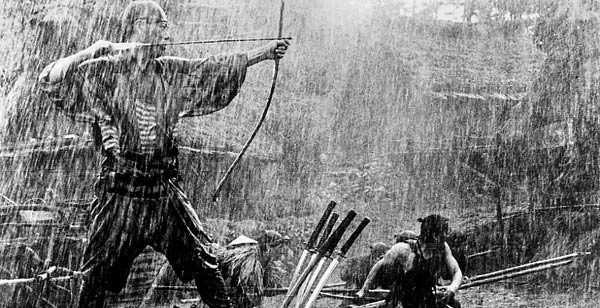
That would be the last money-maker Kurosawa would direct for decades. He made a recovery of sorts with Kagemusha (1980) and Ran (1985) but it's really with his films of the late '40s and '50s that his reputation rests--and what films! Kurosawa is possibly the easiest of great directors to love--his action films are filled with breathtaking movement and whirling violence, his dramas are intensely felt collisions of outrage, grief, despair. His camera is rarely static, and he will often cut only at the last minute, to capture as much of the motion as possible. When he does cut, it's often to expressive effect: to punctuate a moment, fragment a movement (doing the opposite of his long tracking shots), or piece together a giddy concatenation of images--in Seven Samurai (1954) when the alarm is sounded, the warriors run out to defend the village, and Kurosawa gives us seven brief shots of each warrior in quick succession. The gesture does little to advance the narrative, but the moment--a sort of salute to each as he rushes out to possibly die in battle--never fails to quicken one's pulse.

If I wanted to be facetious, I'd say Kurosawa was the precursor to Hollywood's James Cameron--both made big-budgeted productions, both had a dictatorial directing style, both liked to create elaborately shot and edited action sequences. Unlike Cameron Kurosawa knows how to cut coherently, to maintain spatial clarity--in Seven Samurai you always knew where you were in the village (thanks to Kurosawa's use of maps, spatially consistent shots, elaborate tours of the locations prior to battle). Unlike Cameron, when the cutting got hot and heavy Kurosawa always knew how to time the duration of a shot: short enough to eliminate fat and create urgency, long enough to inform the eye what's going on.

Moreover, Kurosawa's films were always about something--in Ikiru (1952) the meaning of a man's life in the world; in Rashomon (1950) the terrifying relativity of truth; in Yojimbo (1961) the bitter embrace of nihilism as the only valid response in a world gone mad. Cameron dabbles in relevance--Avatar is reportedly about the survival of indigenous natives and the preservation of the environment--but Cameron's message feels more like window dressing draped on expensive action sequences to give them dignity. With Kurosawa the action--and every other element in the picture including the acting, the intricate photography, the often massive production design, the at times magnificent weather--swirl and shudder and gather about to bow in total submission to his overarching theme. Said this before and I'll say it again: Cameron is basically Kurosawa after a Jarvik 7 implantation and prefrontal lobotomy.

I'd recommend watching every one of the films but if you can't I recommend watching the more difficult-to-find works--Sanshiro Sugata (1943) for one, his first directorial feature, which at first glance is Japanese propaganda thinly disguised as a judo sports film, on second glance reveals Kurosawa already exercising his muscular visual style (jump cuts, radical angles, expressive use of light, shadow, weather) to tell the story of a man's conquest not just of an external foe (staged in a raging windstorm) but of his inner self (staged in a still lotus pond at night). The Most Beautiful (1944) is Kurosawa doing his best with an imposed assignment--a patriotic propaganda piece about women working hard in an optics factory (Kurosawa turns it into an acting triumph for the workers, particularly Yoko Yaguchi, who eventually became his wife). Sanshiro Sugata 2 (1945) is the first of only two sequels in Kurosawa's career; here he pits Sanshiro against an American boxer, then against an opponent in heavy snow. They Who Tread on the Tiger's Tail (1945) is fascinating for its poverty-row production values (it was made at the end of the war, when Japan was short on every resource), its single set, and its director's use of that one set, shot mostly in long takes with Noh music and distinctive Noh acting style.

No Regrets for Our Youth (1947) should be seen for two reasons: to disprove the notion that Kurosawa is exclusively an action director, interested only in matters male and macho; and to view a Setsuko Hara you've never seen before--not the unfailingly cheerful daughter of Ozu films, but a passionate young woman determined to express her idealism and love for her politically active husband no matter what the cost. One Wonderful Sunday (1947)--well, not a big fan, but if you insist, sit and watch out for the uninhibited Peter Pan ending (Kurosawa is almost always intense and this can sometimes be a mixed blessing).

Of the better-known works--what more can one add to what has already been said, except to say Seven Samurai is war in a single massive volume, from inception to preparation to actual execution; Rashomon is the enigma of human existence wrapped in a mystery thriller; Yojimbo is the apocalypse achieved through fire and samurai blade, and Ikiru is the single clearest expression of Kurosawa's personal philosophy--Dostoevsky neat, no chaser (though if you want Dostoevsky done literally, as a straight adaptation, you should seek out his much underrated The Idiot (1951), with a jaw-dropping performance (again) from Setsuko Hara).
I won't even bother to tell you to enjoy yourself; that's a given. This is a feast beyond anything you're likely to see this year, a festival of pleasures that can only end in disappointment once the last screening is done and gone, and you're left with a lost weekend of a hangover. So what are you waiting for?

Claude Chabrol, 1930 - 2010 

A little something I wrote about one of his late films:

Claude Chabrol's La fille coupee en deux (A Girl Cut in Two, 2007) invites, as usual, comparisons to Hitchcock, but from where I'm sitting the most distinctive quality the two share, at least at this stage in Chabrol's career, is elegance in storytelling, elegance in all elements of storytelling, from characterization to dialogue to mis-en-scene to soundtrack (the opening credits roll to the strains of Puccini's Turandot, the plot of which suggests interesting sidelights to the plot of Chabrol's film). Even the title works overtime to raise questions in the viewer's mind--just why is the eponymous girl (local TV weather girl Gabrielle, played by Ludivine Sagnier) cut in two? Because she's of two minds? Because she's desired by two men? Because a whirling blade literally cuts her in half?

One often thinks when thinking of Hitchcock of visual challenges solved with brilliantly, sometimes breathtakingly elegant solutions (the problems of confined space in Lifeboat or Rope or Rear Window; of a shower-stall murder in Psycho; of wide-open spaces and sustaining tension through a cross-country odyssey in North by Northwest). Chabrol in this case solves one kind of challenge: the suggestion of perverse sexual appetites with the least amount of fuss (a head sinks below a table; a girl crawls on all fours in shadow; a private club is visited, and one member asks another a pointed question: "does she know what goes on here?").The story is loosely based on the killing of architect Stanford White by Harry K. Thaw, for a long-ago affair White had with Thaw's wife Evelyn Nesbit, updated with a bit of class rivalry.

Central to the film is the mystery of Gabrielle: is she corrupted innocent or cruel sadist? Middle-class victim or social-climbing instigator? In Turandot, the two main female characters are the eponymous princess and the slave girl, Liu, and Gabrielle seems to embody qualities of both women--she is by turns loyal and loving to her elderly lover, cruel and distant to her young husband. By combining the two in one woman, does Chabrol make his heroine more or less convincing, more or less complex--both, maybe? Sagnier plays her as a cool blonde in the best Hitchcockian tradition (I have to take back I suppose what I said earlier about Chabrol's resemblance or lack of to Hitchcock). Towards the end she's revealed as more innocent and less guileful than she seems--or is she instead completely at the mercy of her own inner demons? She's the lure, the McGuffin, the enigma that draws both men--and herself--to their irrevocably entangled dooms.


. 

Saturday, May 09, 2009

Philippine Customs blocking imported books


A blog post from Robin Henley, University of Iowa Creative Writing professor on a fellowship in the Philippines:

Philippine Customs imposes illegal duties on imported books

Setting aside the impression one gets that the reasoning behind their duty-happy spree is idiotic (that 'missing coma the Undersecretary points out being a particularly brilliant piece of idiocy--one wants to check her educational credentials), and setting aside the fact that if one more copy of Stephanie Myer's moronic Twilight never lands on the Philippines I'd be a happier Filipino, there are serious consequences to this development.

Like the curtailment of knowledge between countries. Like a further financial burden on educational or cultural organizations (never much of a priority for governments, mind you) that depend on these books. Like students or youths or anyone even remotely interested in a subject that might require a book suddenly finding themselves out of luck, because someone insists on hanging government policy on a missing comma.

Shame, shame.

Postscript: a cursory google search reveals several blogs discussing the subject, including an excellent one on the legal ramifications. Problem is, though, they all quote the same source (that website I link to above) and I haven't spotted (yet) a major Filipino newspaper covering the story. So in case this whole thing's a hoax (I don't know, it just so sounds like the government), For the record, I at least entertained the possibility.

Tuesday, March 27, 2007

Comfort Women House Resolution--800 signatures strong

Tuesday, March 27, 2007

Dear Friends and Colleagues,

The petition to support Comfort Women House Resolution 121 is two weeks old and 800 signatures strong. Though it began as a United States petition to House Speaker Pelosi, we have received global support from citizens in Japan, Thailand, Malaysia, The Netherlands, The Philippines, Australia, Germany, Italy, France, Singapore, Austria, Hong Kong, Indonesia and Taiwan. If you go online you can read comments written by our international community, expressing concern, outrage, apologies, compassion, and testimonies from survivors of WWII comfort stations. It is turning into an amazing international document of support.

Yesterday, Prime Minister Abe said, “I express my sympathy toward the comfort women and apologize for the situation they found themselves in.” While this sounds like an apology, Prime Minister Abe is not taking responsibility for Japan’s Imperial Army’s action under the direction of the Japanese government. He is not apologizing for these war crimes. His statement falls short of a sincere apology.

The House Committee on Foreign Affairs has decided not to take action on the Comfort Women issue until after Prime Minister Abe’s U.S. visit April 26-27. This gives the petition one month to grow and to truly support House Resolution 121. If it passes, Congress will ask Japan to take full responsibility for the systematic rape and enslavement of the 200,000 women and girls during WWII.

More importantly, the petition itself sends a strong message to surviving Comfort Women. It honors and respects their experiences and demonstrates to them that the global community hears them and believes them. Their experiences are a part of history.

I urge you to send the petition around. Continue to post the link on your blogs, continue to send out email blasts and to announce the petition to your friends, your colleagues and your family members. After all, this is about our women. This about how we choose to treat one another. Let’s aim for 1000 signatures at the very least. Let’s see if we can find 200,000 signatures for each of the women who suffered during WWII.

To sign the petition go directly to http://www.gopetition.com/petitions/comfort-women-house-resolution.html or for more information you can go to labanforthelolas.blogspot.com.

Sincerely, M. Evelina Galang

M. Evelina Galang
Assistant Professor, English
University of Miami
PO Box 249214
Coral Gables, FL 33124
Mevelinagalang.com
Labanforthelolas.blogspot.com

Thursday, March 15, 2007

Comfort Women petition

Comfort Women House Resolution

110 Signatures
Created by M. Evelina Galang on Mar 13, 2007
Category: Human Rights
Region: United States of America
Target: Everyone
Web-site: http://labanforthelolas.blogspot.com

Description/History:

On March 2, 2007 Japanese Prime Minister Shinzo Abe insisted, “There is no evidence to prove there was coercion, nothing to support it (the coercion of WWII military sex slaves).” We ask Congress to urge Prime Minister Abe to look at the evidence, to see the coercion, to apologize and give appropriate reparations. The women are waiting.

Please See http://www.justiceforcomfortwomen.org/?pg=home or visit http://labanforthelolas.blogspot.com/.

Petition:

Speaker of the House Nancy Pelosi
H 232 Capitol
Washington DC 20515-6501

Dear Speaker of the House Nancy Pelosi,

We the undersigned request you to support House Resolution 121-1H. We urge you to bring the House Floor to a full vote.

Historians and researchers in South Korea and Japan discovered several official war documents in the late 1980’s that established the existence and systematic abuse of WWII Comfort Women. They estimated 200, 000 young women were taken hostage by Japanese soldiers to serve as military sex slaves from all of South East Asia.

After fifty years of silence, surviving Comfort Women have broken the culture of shame to document their experiences of systematic rape and sexual slavery by the Japanese Imperial Army. Their demands are simple -- they would like a formal apology and reparations for the war crimes they suffered, crimes that continue to affect their aging bodies in physically, mentally and sexually abusive ways. The women make their demands in order to reclaim their dignity, and ensure the safety of their own daughters, granddaughters and now, great granddaughters.

The surviving Comfort Women are mostly in their 80’s now. Many are dying. We urge Congress to act swiftly so that some may see justice before they pass away.

Sincerely,

(Go to http://www.gopetition.com/online/11466.html to sign)

Tuesday, March 06, 2007

Prime Minister Abe and His Imaginary Comfort Women

This whole brouhaha may be a tempest in a teacup for Americans, preoccupied with their liddle war out in the Middle East, but it's long been a sore point with us Southeast Asians.

The exact statement PM Abe makes goes something like this: "There was no evidence to prove there was coercion as initially suggested. That largely changes what constitutes the definition of coercion, and we have to take it from there"

Personally, I'd like to know what he believes constitutes 'evidence'--the personal testimony of Korean, Chinese and Filipino (not to mention the Dutch) women apparently don't count; they may be lying, to take advantage of Japan's obviously overtaxed sense of guilt about the war that the country helped start.

This argument between Abe and Democratic Party lawmaker Toshio Ogawa is interesting. Some highlights from the debate:

Abe: No one would voluntarily apply to be a comfort woman. In some cases, private agents forced the women, so in this broad context, forced coercion existed. However, Japanese government officials did not raid civilians¡¯ homes to ¡°kidnap¡± women. The testimony that the Japanese military hunted women as sex slaves is completely fabricated. No other evidence supports such testimony.

As the article notes, this flatly contradicts the statement of former Cabinet secretary Yohei Kono in 1993, that the military authorities had been involved. This plus additional unearthed evidence suggests that Prime Minister Abe is either a barefaced liar or in a state of denial as grandiose as Mel Gibson's.

Abe adds in Japan's defense: "Japan¡¯s acts for 60 years following the end of World War II have been highly appreciated."

Sure it's been appreciated. Can we all please say "hush money" out loud?

To his credit, Abe this Sunday still affirmed the 1993 Kono statement. Which leads to the question: does he think they were coerced, or doesn't he? Maybe he's not lying or in a state of delusion; maybe he's just confused. He definitely didn't win a lot of friends in the international scene during the past few days.

The earlier Inquirer article's last sentence, incidentally, is heartbreaking:

More than 80 Filipino women, now mostly in their 80s, have accepted money from the fund out of poverty, but all still seek legislated compensation from the Japanese government.

These women were repeatedly raped, have repeatedly testified in public to their humiliation, and have to take consolation money anyway--money which comes from private funds, allowing the Japanese government to keep its hands squeaky clean.

Frankly, I hope they manage to sue Abe's ass off.

EDIT: Here's a Filipino website that disseminates information on and campaigns for the surviving Filipina Comfort Women of World War 2.